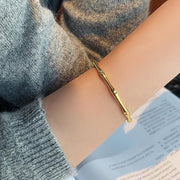
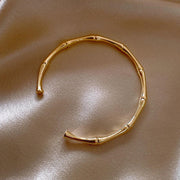
Cuff Bangles
The cuff bangle is a study in elegant simplicity: a single arc of metal, open-ended, that slides over the hand and grips the wrist. No clasp, no sizing chart, no fuss. The open-ended design is what makes cuffs unique — they're adjustable, they fit most wrist sizes without custom sizing, and they go on and off in a second. It's the most low-friction bracelet you can own.
Cuff vs Bangle — What's the Difference?
The terms are often used interchangeably, but there's a technical distinction:
-
Bangle — a rigid closed circle with no clasp. It slides over the hand and sits loosely at the wrist. Cannot be adjusted.
-
Cuff — an open-ended rigid bracelet that opens and closes slightly through gentle bending. Adjustable to different wrist sizes.
-
Cuff bangle — refers to either style with substantial width/presence. At AJLuxe, our "cuff bangles" are primarily open-cuff designs that combine the bold look of a bangle with the adjustability of a cuff.
How to Put On a Cuff Bracelet
This trips up a lot of first-time cuff wearers:
- Hold the cuff with both hands at the open gap facing your palm.
- Slide the widest part of your hand (across the knuckles) through the opening.
- Position the cuff at your wrist — the open gap should face either downward (inner wrist) or to the side.
- Gently squeeze the cuff to adjust the fit — it should sit snugly but not press uncomfortably.
Do not try to "open" the cuff like a gate — it should always go on over the knuckles. Forcing a cuff too wide too many times will weaken the metal.
Cuff Width Guide
| Width |
Look |
Occasion |
Stacking? |
| 2–4mm |
Delicate, barely-there |
Daily minimalist wear |
Stack 3–5 together |
| 5–8mm |
Classic cuff presence |
Everyday to casual evening |
Stack 2–3 or solo |
| 10–15mm |
Bold statement |
Evening, occasions, solo |
One or max two |
| 20mm+ |
Dramatic, architectural |
Special occasions, editorial |
Solo only |
One-Size-Fits-Most Appeal
The biggest practical advantage of cuff bracelets is sizing flexibility. A standard women's cuff typically fits wrists from about 5.5" to 7.5" comfortably through adjustment. This makes cuffs ideal for gifts (no sizing anxiety), travel jewelry (no clasp to fidget with), and online purchases (no returns for wrong size). If you're between bangle sizes, a cuff is always the practical solution.
Stacking Cuff Bangles
Cuffs stack beautifully because their rigid structure means they don't tangle. Rules for stacking cuffs:
-
Vary widths — mix a delicate 3mm cuff with a medium 6mm and a bold 12mm for a dynamic stack.
-
Mix textures — a hammered cuff next to a smooth one next to a twisted rope-style cuff creates contrast.
-
Metal consistency — all gold or all silver stacks read most intentional. Mixed metal is fine when done with balance (not random).
-
Position the open gap — on each cuff, you can align or alternate the gap positions. Alternating (inner wrist, outer wrist, side) looks more editorial.
Frequently Asked Questions
- What is the difference between a cuff and a bangle?
- A bangle is a rigid closed circle — no adjustment possible. A cuff is open-ended and can be gently bent to adjust fit. Cuffs are more versatile because they fit a range of wrist sizes.
- How do you wear a cuff bracelet?
- Slide the cuff over your knuckles with the open gap facing your palm. Position at your wrist and gently squeeze or open the ends to adjust fit. The gap typically faces the inner wrist.
- Can you adjust a cuff bangle?
- Yes — that's the defining feature. Gently bend the open ends to tighten or loosen. Sterling silver can be adjusted many times without issue, but avoid repeatedly over-bending past the intended range.
- How do you stack cuff bangles?
- Vary widths (thin, medium, bold) and textures (smooth, hammered, twisted). Keep metals consistent. Alternate the gap direction between cuffs for an editorial look.
- What wrist should you wear a cuff on?
- Traditionally the non-dominant wrist. In practice, wear it on either wrist or both — personal preference and style come first.
- Are cuff bangles in style in 2026?
- Yes — cuff bangles remain a strong trend. In 2026 the focus has shifted toward stacked delicate cuffs rather than single oversized statements, though the solo bold cuff is a timeless classic.
- How do you put on a cuff bangle?
- Hold the cuff with the gap facing your palm. Slide your hand through knuckle-first. Rotate so the gap faces your inner wrist. Gently adjust the ends to fit — you should be able to slide one finger between the cuff and your wrist.
The Cultural History of Cuff Bangles
Cuff bracelets are among the oldest forms of jewelry on earth. Archaeologists have found copper cuffs dating back 7,000 years in ancient Mesopotamia. In ancient Egypt, both men and women wore wide gold and silver cuffs as symbols of power and status — the wider the cuff, the higher the wearer's rank. Native American silversmiths developed highly sophisticated cuff traditions (the Navajo and Zuni traditions remain influential today). The bold cuff returned to Western fashion in the Art Deco 1920s and has never truly left.
The cuff's appeal is partly about its history: wearing a cuff bracelet is participating in a 7,000-year-old tradition of adorning the wrist with metal. That's a story worth knowing.
Sterling Silver Cuff Care Guide
925 sterling silver cuffs are among the most maintenance-friendly jewelry pieces you can own:
-
Tarnish is normal and reversible: sterling silver tarnishes when exposed to air, especially air with humidity and sulfur compounds (common in many environments). Tarnish is not damage — it's a surface oxidation layer that wipes away instantly with a silver polishing cloth. Keeping a polishing cloth in your jewelry drawer means a tarnished cuff is 10 seconds from looking brand new.
-
Avoid prolonged contact with water: occasional water contact is fine, but leaving a silver cuff wet for extended periods accelerates tarnishing. Dry thoroughly if it gets wet.
-
Rubber and latex accelerate tarnishing: if you wear rubber gloves frequently, remove the cuff first. Rubber contains sulfur compounds that cause aggressive silver tarnishing.
-
Storage: store in a sealed bag or airtight box when not wearing. Anti-tarnish strips (available at most jewelry stores) inside the storage container further slow tarnishing. Avoid storing in humid environments like bathrooms.
Cuff Bangle Styling by Occasion
| Occasion |
Cuff Style |
Worn With |
| Everyday |
Narrow (3–5mm) plain cuff |
Solo or stacked with 1–2 thin chains |
| Office/professional |
Medium (6–8mm) polished cuff |
Solo — one substantial cuff reads more professional than a stack |
| Casual weekend |
Hammered or textured medium cuff |
Mixed with beaded bracelets |
| Evening/going out |
Wide (12–15mm) polished or pavé cuff |
Solo statement — let the cuff carry the look |
| Special occasion |
Architectural wide cuff |
Solo on a bare wrist — the most powerful presentation |
Gifting Cuff Bangles — Why They Work
Cuff bangles are among the best jewelry gifts because they solve the sizing problem that makes ring and bracelet-gifting stressful:
- Open-ended design fits wrists from about 5.5" to 7.5" through gentle adjustment.
- No clasp means nothing to measure, nothing to size, nothing to fit precisely.
- Sterling silver works with every wardrobe — you don't need to know the recipient's existing jewelry metals to choose safely.
- The gift reads substantial — a cuff bangle feels like a significant, meaningful piece even at accessible price points, because of its visual and physical presence.