


Last updated: June 2026
When you compare lab ruby vs natural ruby, the first thing that surprises most shoppers is how similar they actually are. Both are corundum, both score 9 on the Mohs scale, and both display the same rich red color caused by chromium. The real differences show up in price, origin, and the subtle inclusions that gemologists use to tell them apart. This guide breaks down what actually matters so you can choose confidently.

Lab ruby vs natural ruby: Lab rubies are grown in controlled environments using the same aluminum oxide chemistry as natural rubies, resulting in identical hardness (Mohs 9), similar color, and greater clarity — but at a fraction of the cost. Natural rubies form over millions of years in metamorphic rock, carry unique inclusions, and command premium prices due to rarity, especially stones from Burma (Myanmar). For jewelry buyers, lab rubies offer exceptional value; natural rubies appeal to collectors and those who prioritize provenance.
Lab Ruby vs Natural Ruby: Key Differences at a Glance
| Property | Lab Ruby | Natural Ruby |
|---|---|---|
| Appearance | Vivid red, eye-clean clarity, minimal inclusions | Rich red with characteristic inclusions (rutile silk) |
| Price Range | $10–$100 per carat | $200–$15,000+ per carat |
| Hardness/Durability | Mohs 9 — highly scratch-resistant | Mohs 9 — identical hardness |
| Lifespan | Lasts a lifetime with basic care | Lasts a lifetime with basic care |
| Best For | Everyday jewelry, budget-conscious buyers | Heirlooms, collectors, investment pieces |
| Sparkle/Effect | High brilliance, deep saturation | Slightly warmer glow, asterism possible in star rubies |
| Origin | Grown in a lab (flame fusion or hydrothermal) | Myanmar, Mozambique, Thailand, Sri Lanka |
| Care Requirements | Soap and water, ultrasonic safe | Soap and water; avoid ultrasonic if fracture-filled |
| Overall Value | Excellent for price-to-quality ratio | High intrinsic and collector value |
Shop Ruby Birthstone Necklaces at AJLuxe — Shop Our Ruby Pendant Necklace → →
What Is a Lab Ruby?
A lab ruby is a genuine ruby grown in a controlled laboratory environment rather than mined from the earth. Chemically, it's aluminum oxide (Al₂O₃) with trace chromium — exactly the same as a natural ruby. That means it earns the same 9 on the GIA's Mohs hardness scale and displays the same red color range, from pinkish-red to deep blood red.
There are two main methods for growing lab rubies. The flame fusion (Verneuil) process, developed in 1902, melts aluminum oxide powder and drips it onto a seed crystal to build up a boule — a large synthetic crystal. This method is fast and inexpensive, which is why flame fusion lab rubies are often used in costume jewelry. The hydrothermal method mimics how natural crystals form by dissolving minerals in superheated water under pressure and growing crystals over weeks or months. Hydrothermal lab rubies are closer in internal structure to natural ones and cost more as a result.
Because lab rubies grow in a controlled environment, they typically have fewer inclusions and more consistent color than most natural rubies on the market. You can get a 1-carat, eye-clean, vivid red lab ruby for under $50 — a stone that would cost thousands if it had formed underground. For people who want the look of a fine ruby in everyday jewelry, lab-grown stones are an obvious choice.
What Is a Natural Ruby?
Natural rubies form over millions of years in metamorphic rocks, particularly marble and schist, when aluminum-rich minerals are exposed to heat, pressure, and trace amounts of chromium. The finest natural rubies come from the Mogok Valley in Myanmar (Burma), where geological conditions produce a fluorescent "pigeon blood" red that remains the benchmark for the gem trade. Other significant sources include Mozambique, which now supplies a large portion of the world's rubies, along with Thailand, Sri Lanka, and Tanzania.
What sets natural rubies apart isn't just origin — it's character. Most natural rubies contain inclusions: thin rutile needles called "silk," growth patterns, and fingerprint-like liquid inclusions. A trained gemologist at the Jewelers of America can identify a natural ruby by these internal features. Some inclusions, like intersecting rutile needles, create the asterism effect seen in star rubies — a natural phenomenon impossible to replicate in most lab stones.
Natural rubies above 1 carat with vivid color and minimal inclusions are genuinely rare. According to the GIA, fine-quality natural rubies are rarer than equivalent-quality diamonds of the same size, and prices reflect this. Heat treatment, used to improve color and clarity, is standard practice — over 95% of natural rubies on the market have been heat-treated. Untreated natural rubies with certification command a significant premium above treated stones.
Lab Ruby vs Natural Ruby: Which Looks Better in Jewelry?
Side by side in a ring or necklace, most people can't tell a high-quality lab ruby from a natural one. Lab rubies tend to be cleaner — fewer inclusions, more uniform color, and higher transparency. That means they can look almost too perfect: a blazing, consistent red that reads as deeply saturated under any lighting.
Natural rubies have more variation. The slight warm undertone in Burmese rubies, the faint fluorescence under UV, and the subtle depth created by rutile silk give them a visual complexity that collectors prize. Whether that complexity looks "better" depends entirely on your eye. For bold everyday jewelry — necklaces, stud earrings, birthstone pieces — a lab ruby's vivid clarity suits modern settings well. For a heirloom engagement ring where originality matters, the unique inclusions and provenance of a natural ruby tell a different story.
One practical difference: because lab rubies are consistent, you can find matched pairs or sets easily, which is useful for earrings or multi-stone pieces. Matching natural rubies of the same color and size takes far more effort and cost.
Price Comparison: Lab Ruby vs Natural Ruby
Price is where the gap between lab and natural rubies becomes dramatic. Lab rubies typically sell for $10 to $100 per carat retail, depending on the growth method and quality. A 1-carat lab ruby in a simple sterling silver setting might retail for $50 to $200 total.
Natural rubies tell a different story. Commercial-quality natural rubies (included, treated) start around $200 per carat. Fine-quality stones from Mozambique run $500 to $3,000 per carat. Unheated Burmese rubies with GIA documentation regularly sell at auction for $5,000 to $15,000 per carat or more. The world record ruby sale — the Sunrise Ruby — sold at Sotheby's for over $1 million per carat.
The price gap doesn't reflect quality in the everyday sense. It reflects rarity and the human value placed on natural origin. If you're buying a ruby birthstone necklace as a July birthday gift or adding color to an everyday piece, a lab ruby at $50 to $150 delivers the same visual impact as a natural ruby costing ten times more. If you're building a jewelry collection as an investment or shopping for a one-of-a-kind engagement stone, natural rubies retain value in ways lab stones don't.
One important note: lab rubies don't appreciate like natural rubies. As lab-growing technology improves, production costs fall and prices stay flat or decline. Natural fine rubies have tracked upward over decades.
Durability and Everyday Wearability
Both lab and natural rubies score Mohs 9 — second only to diamond — which means they resist scratches well in daily wear. You can wear either in a ring or necklace without worrying about surface damage from normal activity. They also handle heat and most household chemicals without issue.
Care differences appear when you factor in treatments. Lab rubies are typically untreated or glass-filled minimally, so you can clean them safely in an ultrasonic cleaner or with warm soapy water and a soft brush. Many natural rubies are fracture-filled with glass to improve clarity — a common, accepted practice — but fracture-filled stones should never go in an ultrasonic cleaner. The vibrations can damage the filler material and worsen the appearance of inclusions.
For both types, avoid storing rubies loose with other gemstones. Even at Mohs 9, rubies can scratch softer stones like opal (Mohs 5–6.5) or pearls. Store each piece separately in a soft pouch or lined compartment. For more on jewelry care, check our guide on how to store jewelry properly and our overview of 925 sterling silver settings commonly used with colored gemstones.
If you buy a natural ruby, ask for a disclosure of treatments at the time of purchase. Reputable jewelers follow industry standards that require disclosure of any treatments that affect value, including heat treatment, glass filling, and beryllium diffusion.
For the full story on ruby's history, symbolism, and significance, read our complete ruby meaning guide.
Related reading: Mood necklace colours and meanings.
Frequently Asked Questions
Are lab rubies real rubies?
Yes. Lab rubies are chemically and physically identical to natural rubies — both are corundum (Al₂O₃) with chromium impurities that produce the red color. The FTC allows lab-grown rubies to be sold as rubies as long as the lab-grown origin is disclosed. The only difference is how they formed: one took millions of years underground, the other took weeks in a laboratory.
Can a jeweler tell the difference between a lab ruby and a natural ruby?
An experienced gemologist with magnification can usually identify lab rubies by their internal characteristics. Flame fusion lab rubies show curved growth lines and gas bubbles under magnification. Hydrothermal lab rubies are harder to distinguish, often requiring advanced spectroscopic testing. Without equipment, even trained jewelers may not tell them apart by eye alone.
Do lab rubies hold their value?
Lab rubies do not hold value the way natural rubies do. As production technology improves, lab ruby prices tend to stay flat or decrease. They're best purchased for the beauty and wearability they offer, not as an investment. Natural rubies — particularly unheated stones from Burma with GIA certification — have a track record of appreciating over time.
What carat size is typical for ruby jewelry?
Most ruby jewelry uses stones between 0.25 and 1.5 carats. In a birthstone necklace pendant, 0.5 to 0.75 carats is common and gives good visual impact without excessive weight. Rings often feature 1 to 2 carat center stones. Lab rubies make it practical to choose larger sizes since cost scales much less steeply than with natural stones.
Is a lab ruby good for an engagement ring?
Lab rubies work well in engagement rings for several practical reasons: they're durable at Mohs 9, available in vivid colors, and budget-friendly enough to allocate more to the setting. Some buyers prefer natural rubies for engagement rings because of the symbolic weight of a natural gemstone. Either choice is valid — the decision comes down to your personal priorities and budget.
What does "pigeon blood" ruby mean?
Pigeon blood is a trade term for the most prized natural ruby color: a pure, vivid red with a slight blue undertone and strong fluorescence. The term originated in Myanmar and refers to the color of the first two drops from a freshly killed pigeon — an intense, saturated red without orange or brown tones. GIA and other labs now use specific spectroscopic criteria to certify pigeon blood color on ruby grading reports.
Are all natural rubies treated?
The vast majority of natural rubies on the market — estimated at over 95% — have been heat-treated to improve color and clarity. Heat treatment is a stable, widely accepted practice that doesn't significantly affect durability. Untreated natural rubies with certification from a major lab like GIA command a significant premium because they're rare, and the treatment-free status is documented proof of natural formation without enhancement.
How do I know if a ruby has been glass-filled?
Glass-filled (fracture-filled) rubies often have a vivid color at a suspiciously low price for what appears to be a natural stone. Under magnification, a gemologist can see blue or orange flash effects at the surface where the glass filler meets the stone. GIA and other labs disclose fracture filling on grading reports. When buying natural rubies, always ask for a lab report and treatment disclosure from the seller.
What is the birthstone for July?
Ruby is the traditional and modern birthstone for July. The gemstone has been prized for centuries across many cultures — in Sanskrit, ruby translates to "ratnaraj," or king of gems. Both lab and natural rubies count as July birthstones. A ruby birthstone necklace is one of the most popular July birthday gifts, and lab rubies make it an accessible choice at almost any budget.
Should I buy a lab ruby or natural ruby for a birthstone necklace?
For a birthstone necklace intended as a gift or everyday piece, a lab ruby is usually the better choice. You get the same vivid red color and excellent durability at a fraction of the cost, which lets you invest more in the setting and craftsmanship. Natural rubies make more sense when the recipient specifically values natural gemstones or when the piece is meant as a long-term heirloom with investment potential.
Final Thoughts
The lab ruby vs natural ruby debate comes down to what you value most. If it's visual beauty and everyday durability at a fair price, a lab ruby delivers everything you need. If it's rarity, provenance, and the story of a stone that formed under the earth over millions of years, a natural ruby is worth the premium. Neither choice is wrong — they serve different buyers with different priorities.
For birthstone jewelry, gifts, and pieces you'll wear regularly, a lab ruby is the practical choice. Ready to shop? Explore Ruby Birthstone Necklaces at AJLuxe — crafted for everyday wear and designed to last.
All third-party trademarks, brand names and product names are the property of their respective owners. AJLuxe is not affiliated with, endorsed by, sponsored by, or otherwise connected to any third-party brand referenced in this article. Brand names are used solely for accurate comparative reference, and material descriptions reflect each brand's own published product specifications at the time of writing.
You Might Also Like
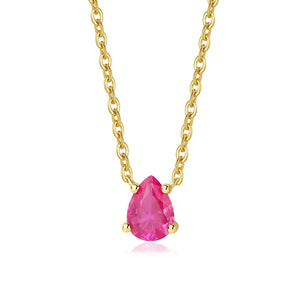

The piece they're describing → Ruby Pendant Necklace for Women — Red Ruby Teardrop, 925 Sterling Silver
Personalize Yours


