


• Birthstone: Diamond — Mohs 10, hardest natural substance known
• Chemistry: Pure carbon (C) in cubic crystal structure
• Main color: Colorless to near-colorless (D–J on GIA scale); also fancy pink, blue, yellow, red
• Key meaning: Eternal love, clarity, strength, invincibility
• Formation: 1–3 billion years ago, 90–150 miles deep in Earth's mantle; delivered to surface by kimberlite volcanic pipes
• Zodiac: Aries (March 21–April 19) and Taurus (April 20–May 20)
• Lab vs natural: Lab diamonds are chemically identical — 50–70% lower cost
• Shop: April birthstone necklaces in 18K gold-plated sterling silver
Diamond is the April birthstone and one of the most widely gifted gemstones in the world. But most people only know diamond as colorless and expensive. The full picture is more interesting: diamonds form in a billion-year process deep in the Earth's mantle, they come in a spectrum of colors including rare blue and pink, and today lab-grown diamonds offer the same stone — identical chemistry, identical hardness — at half to two-thirds less the price.
Whether you're buying a diamond for an April birthday or simply want to understand this extraordinary gemstone, this guide covers everything: what diamond is, what it means, how to evaluate quality, lab vs natural, and how to find the right piece.
What Is the April Birthstone?
Diamond is pure carbon — the same element as graphite in your pencil — but arranged in a tetrahedral crystal lattice that makes it the hardest natural substance ever measured. Nothing in nature scratches a diamond. The name comes from the Greek adamas, meaning "indestructible" or "unconquerable." Ancient Indians called it vajra — "thunderbolt" — and believed it was formed when lightning struck rock.
Most diamonds form 90–150 miles below the Earth's surface, in the mantle, under pressures of 45–60 kilobars and temperatures of 900–1,300°C. They reach the surface through kimberlite volcanic pipes — fast-moving, gas-rich eruptions that carry diamonds up from the mantle in a matter of hours. If the journey takes longer, the diamond converts to graphite. The diamonds we mine today formed between 1 billion and 3.5 billion years ago — some are older than any life on Earth.

Diamond Colors — Not Just Colorless
Most people associate diamond with colorless. But diamonds come in a full spectrum of colors, and the colored varieties — called fancy colored diamonds — are among the most valuable gemstones in the world.
| Color Category | GIA Grade Range | Description | Value Impact |
|---|---|---|---|
| Colorless | D, E, F | Absolutely no color visible — museum quality | Highest in colorless range — premium |
| Near Colorless | G, H, I, J | Slight warmth only visible when compared; face-up looks white | Best value range for most buyers |
| Faint to Light Yellow | K–Z | Noticeable yellow or brownish tint | Lower — best for yellow gold settings |
| Fancy Yellow | Fancy Light to Fancy Vivid | Vivid yellow (canary diamond) — pure, intense color | Premium over colorless of same size |
| Fancy Pink | Fancy to Fancy Vivid Pink | Extremely rare; Australia's Argyle mine (closed 2020) was the main source | $100,000–$1M+ per carat for vivid pink |
| Fancy Blue | Fancy to Fancy Deep Blue | Caused by boron; Hope Diamond is a famous blue diamond (45.52 ct) | $200,000–$4M+ per carat for fine blue |
| Fancy Red | Fancy Red | Rarest diamond color in the world — fewer than 30 known above 0.5 ct | Most expensive per carat of any diamond color |
The 4 Cs of Diamond Quality
The GIA (Gemological Institute of America) developed the 4 Cs grading system in the 1950s — the standard used worldwide for evaluating diamond quality. Understanding them helps you buy confidently at any price point.
Cut — The Most Important of the 4 Cs
Cut is the only C that humans control — and it has the biggest impact on how brilliant and beautiful a diamond looks. A perfectly cut diamond reflects light from facet to facet, creating maximum brilliance and fire (the colored light flashes). An excellent-cut stone will look more alive than a larger stone with a poor cut. GIA grades cut as Excellent, Very Good, Good, Fair, and Poor. For the best results, choose Excellent or Very Good.
Color — Second Most Impact on Price
For colorless diamonds, less color = higher value. The GIA scale runs D (completely colorless) to Z (light yellow or brown). In practice, G–H stones face-up white and look identical to D–F stones to the naked eye — but cost 20–40% less. For most buyers, G or H is the sweet spot for value.
Clarity — Third Priority
Clarity refers to the presence of inclusions (internal characteristics) and blemishes (surface). The GIA clarity scale runs: Flawless (FL), Internally Flawless (IF), Very Very Slightly Included (VVS1–VVS2), Very Slightly Included (VS1–VS2), Slightly Included (SI1–SI2), Included (I1–I3). For most jewelry purposes, VS1–VS2 or even SI1 is eye-clean (no inclusions visible to the naked eye) and offers excellent value.
Carat — Size Matters, But Not as Much as Cut
Carat is a unit of weight (1 carat = 0.2 grams), not size. Two diamonds of the same carat weight can look very different sizes depending on cut proportions. A 1-carat round brilliant of excellent cut should measure approximately 6.5mm in diameter. Price per carat increases significantly at the 0.5-carat, 1-carat, 1.5-carat, and 2-carat thresholds — choosing a 0.95-carat stone over a 1-carat can save 15–20% for a nearly identical-looking piece.

Lab Diamond vs Natural Diamond — The Full Comparison
Lab-grown diamonds are one of the most significant developments in the gemstone industry in decades. A lab diamond is not a diamond simulant (like cubic zirconia or moissanite). It is a real diamond — carbon in the same crystal structure, the same Mohs 10 hardness, the same optical properties, and indistinguishable from natural diamond without specialist testing equipment.
| Factor | Natural Diamond | Lab-Created Diamond |
|---|---|---|
| Chemical composition | Pure carbon (C) | Pure carbon (C) — identical |
| Mohs hardness | 10 | 10 — identical |
| Brilliance / sparkle | Identical | Identical |
| GIA grading | Yes — same 4 C scale | Yes — GIA grades lab diamonds with same 4 Cs (labeled "lab-grown") |
| Price (1-carat, VS1, G) | $4,000–$8,000 | $800–$2,000 (70–80% less) |
| Environmental impact | Mining disturbs significant land and water; varies by mine standards | No mining; energy-intensive production (varies by energy source) |
| Resale value | Retains moderate value; rare stones appreciate | Low resale value as production scales and prices fall |
| Identifiable from natural? | Only by specialist equipment | Only by specialist equipment |
| Best for | Investment, heirloom, collector | Best value for wearable jewelry — same beauty, significantly lower price |
The FTC (Federal Trade Commission) amended its jewelry guidelines in 2018 to clarify that lab-grown diamonds are real diamonds. The key disclosure requirement is that sellers must identify them as "lab-grown" or "laboratory-created." Lab diamonds have completely disrupted the market since 2020 — prices have dropped 50–70% and continue to fall as production scales.
Diamond Simulants: Moissanite, CZ, and White Sapphire
Simulants look like diamonds but have different chemistry. They are not diamonds — they just appear similar to the casual eye. Here's how they compare:
| Stone | Mohs | Fire / Sparkle | Price (1ct) | Notes |
|---|---|---|---|---|
| Diamond (natural) | 10 | High, classic white sparkle | $4,000–$8,000 | The benchmark |
| Diamond (lab-grown) | 10 | Identical to natural | $800–$2,000 | Real diamond — not a simulant |
| Moissanite | 9.25 | Higher fire than diamond — can look "rainbow" in bright light | $300–$600 | Silicon carbide; very durable; popular engagement alternative |
| Cubic Zirconia (CZ) | 8–8.5 | High initially; gets cloudy with wear | $1–$20 | Zirconium oxide; affordable but not durable for daily wear |
| White Sapphire | 9 | Lower sparkle than diamond — looks "milky" in comparison | $50–$300 | Colorless corundum; very durable; doesn't mimic diamond closely |
April Birthstone Meaning and Symbolism
Diamond's symbolic meaning has been consistent across cultures for thousands of years: strength, clarity, eternal love, and the unconquerable.
The Greeks named it adamas — "invincible" — and believed diamonds were the tears of the gods, or splinters from falling stars. Ancient Romans wore diamonds in battle, believing the stone's hardness conveyed invincibility to the wearer. In the Hindu Vedic tradition, diamond (vajra, meaning "thunderbolt") was associated with Indra, the king of the gods — representing divine power, purity, and clarity of mind.
The association of diamond with eternal love and engagement rings developed in 15th-century Europe. The Archduke Maximilian of Austria gave Mary of Burgundy a diamond engagement ring in 1477 — one of the earliest recorded examples. Diamond's connection to enduring love was reinforced over centuries of royal tradition, and then amplified in the 20th century by De Beers' 1947 campaign: "A Diamond Is Forever."
Spiritually, diamond aligns with the crown chakra — the center of divine connection and highest consciousness. It's associated with clarity of thought, the removal of negative energy, and amplifying the properties of other gemstones placed near it. Diamond is said to strengthen the wearer's resolve and bring clarity to difficult decisions.
As an April birthstone, diamond suits the Aries personality (bold, direct, pioneering) with its energy of strength and unconquerability — and the emerging Taurus energy (loyal, enduring, steady) with its symbolism of lasting love and commitment.
How to Choose April Birthstone Jewelry
For birthstone jewelry specifically, the goal is usually a beautiful, meaningful piece rather than an investment-grade stone. Here's a practical buying guide:
| If you want… | Choose… | Why |
|---|---|---|
| Best value for budget | Lab-grown diamond, G/H color, VS1–VS2 clarity, Excellent cut | Identical appearance to natural at 70–80% lower cost |
| Classic engagement or anniversary gift | Natural diamond, round brilliant, G color, VS2 clarity | Investment value retained; traditional sentimental weight |
| Something unique and colorful | Lab fancy yellow or pink diamond | Lab-grown fancy colored diamonds are dramatically more affordable than natural |
| Budget gift with diamond look | Moissanite in sterling silver setting | Very similar appearance; highly durable; fraction of the cost |
| Heirloom investment piece | Natural diamond from certified source with GIA or AGS grading report | Retains value; documentable provenance |
At AJLuxe, our April birthstone pieces are set in 18K gold-plated 925 sterling silver — hypoallergenic, durable, and gift-ready at an accessible price.
👉 Shop April Birthstone Necklaces →
How to Care for Diamond Jewelry
Diamond is the hardest natural material, but that doesn't mean it's indestructible. It needs regular cleaning because it's lipophilic — it naturally attracts oils and grease, which dull its brilliance faster than almost any other stone.
- Clean weekly for rings worn daily. Soak in warm water with a drop of dish soap for 15–20 minutes, then gently brush with a soft toothbrush. Rinse thoroughly. This removes the oil film that makes diamond look dull and restores its brilliance.
- Ultrasonic cleaners are safe for most diamonds. The exception is diamonds with fractures or feathers — ultrasonic vibration can extend cracks. When in doubt, use the soapy water method.
- Avoid chlorine — especially in hot tubs and pools. Chlorine weakens metal settings (particularly white gold prongs) even if it doesn't damage the stone itself.
- Diamonds can chip. Despite Mohs 10 hardness, diamond has perfect cleavage in four directions. A sharp, precise blow at the right angle can chip or crack a diamond. Remove diamond rings before any hard-impact work.
- Store separately — diamonds can scratch other gemstones, other diamonds, and almost any surface. Store each piece individually in a soft pouch.
Gifting April Birthstone Jewelry
| Occasion | Best Choice | Why It Works |
|---|---|---|
| April birthday | Diamond pendant necklace | Classic birthstone gift; instantly meaningful |
| Engagement (partner born in April) | Diamond solitaire ring | Eternal love symbolism; their birthstone makes it personal |
| 10th wedding anniversary | Diamond jewelry (any style) | Diamond is the traditional 10th anniversary gemstone |
| 60th or 75th anniversary (Diamond jubilee) | Fine diamond jewelry | The "diamond" anniversary — 60 years together |
| Graduation (Aries/Taurus graduate) | Diamond pendant or stud earrings | Clarity and strength — perfect symbolism for a new beginning |
| New baby (April) | Diamond birthstone charm | Keepsake jewelry marking the birth month; timeless gift for the parent |
→ Birthstone Necklaces — 18K Gold Plated Sterling Silver
→ Gemstone Pendant Necklaces
→ Jewelry Gifts for Her
All orders arrive in a gift-ready box. Free US shipping. 30-day returns.
Frequently Asked Questions — April Birthstone
What is the April birthstone?
Diamond is the April birthstone — pure carbon crystallized in a tetrahedral structure, forming the hardest natural substance known (Mohs 10). It forms 90–150 miles below Earth's surface under extreme pressure and heat, over 1–3 billion years. It comes in colorless and a range of fancy colors including pink, blue, yellow, and extremely rare red.
What color is the April birthstone?
Diamond is most commonly associated with colorless (white), which is April's signature birthstone color. However, diamonds come in a full spectrum of fancy colors — yellow, pink, blue, green, orange, and red — all of which are genuine diamonds. For birthstone purposes, a clear or white diamond is the traditional April stone, while fancy colored diamonds are rare and valuable variations.
Is a lab-grown diamond a real diamond?
Yes. A lab-grown diamond is chemically, physically, and optically identical to a natural diamond — pure carbon in the same cubic crystal structure, the same Mohs 10 hardness, and the same optical properties. The only difference is origin: natural diamonds form in the Earth over billions of years; lab diamonds are grown in a controlled environment over weeks to months. The FTC confirmed in 2018 that lab diamonds are real diamonds. They cost 50–80% less than comparable natural diamonds.
What are the 4 Cs of diamond quality?
The 4 Cs are Cut, Color, Clarity, and Carat — the universal standard for evaluating diamond quality, developed by the GIA. Cut has the greatest impact on brilliance. Color grades from D (colorless) to Z (light yellow); G–H is the best value range. Clarity grades from Flawless to Included; VS1–VS2 or SI1 is eye-clean and great value. Carat is weight (not size) — 1 carat = 0.2 grams.
Can diamond scratch or break?
Diamond can't be scratched — only another diamond can scratch it. But diamond can chip or fracture. Diamond has perfect cleavage in four directions, which means a precise sharp blow at the right angle can cause it to chip or split. Remove diamond rings before manual labor, sports, or any activity that involves hard impacts. Diamond's hardness protects against scratches but not against breakage from impact.
Why does my diamond look dull?
Diamond is lipophilic — it naturally attracts oils and grease from your skin, lotion, and soap. Over time, a thin film of oil coats the facets and dramatically reduces brilliance. Regular cleaning restores the sparkle: soak in warm soapy water for 15–20 minutes and brush gently with a soft toothbrush. Most people are surprised by how much brighter their diamond looks after a proper cleaning.
What is the Hope Diamond?
The Hope Diamond is the most famous diamond in the world — a 45.52-carat fancy dark greyish-blue diamond with an unusual red phosphorescence under UV light. It was mined in India (Kollur Mine, Golconda) in the 17th century and eventually acquired by banker Henry Philip Hope in 1839, giving it its name. Harry Winston donated it to the Smithsonian Institution in Washington D.C. in 1958, where it remains on display. Its estimated value exceeds $250 million.
What is a conflict-free diamond?
Conflict-free (also called "blood-free") diamonds are stones that were not mined in war zones or used to finance armed conflict. The Kimberley Process Certification Scheme (KPCS), established in 2003, is an international initiative to certify diamonds as conflict-free. When buying natural diamonds, ask for a Kimberley Process certificate. Lab-grown diamonds are inherently conflict-free as they require no mining.
What is the most expensive diamond ever sold?
The Blue Moon of Josephine — a 12.03-carat fancy vivid blue diamond — sold at Sotheby's Geneva in 2015 for $48.5 million ($4.03 million per carat), making it the most expensive diamond per carat ever sold at auction at the time. The CTF Pink Star, a 59.6-carat fancy vivid pink, sold for $71.2 million in 2017, the highest total price ever paid for a diamond at auction.
What is the difference between diamond and moissanite?
Diamond is pure carbon (Mohs 10). Moissanite is silicon carbide (SiC), Mohs 9.25 — a different mineral that is a diamond simulant (looks similar but is not the same). Moissanite has higher fire (colored sparkle) than diamond, which some people love and others find too "rainbow." Moissanite does not attract oils as readily as diamond, so it stays cleaner longer. It costs 90–95% less than a comparable diamond.
Is white sapphire the same as diamond?
No. White (colorless) sapphire is corundum (aluminum oxide), Mohs 9 — a completely different mineral from diamond. It looks somewhat similar to diamond but lacks diamond's brilliance and fire, often appearing "milky" or dull in comparison. White sapphire is much more affordable and very durable, making it a practical diamond alternative for everyday jewelry — but it does not replicate diamond's optical performance closely.
April falls at the heart of Aries and Taurus season — if you want to explore the full zodiac picture, see our Aries birthstone guide (March 21 – April 19) and our Taurus birthstone guide (April 20 – May 20).
April Birthstone — The Gift That Lasts Forever
Diamond earns its title as the April birthstone through sheer permanence: nothing in nature wears it down, nothing in history has dimmed its meaning, and nothing in jewelry matches its brilliance. Whether you choose a natural stone for its story and rarity, a lab diamond for its value and ethics, or a diamond-set piece as a meaningful birthday gift — diamond delivers on every level.
Browse our April birthstone necklace collection — set in 18K gold-plated 925 sterling silver, hypoallergenic, and gift-ready with free US shipping and 30-day returns.
Written by Vaishakhi Ajmera — founder of AJLuxe, specialists in personalized sterling silver jewelry. Last updated: May 2026. | Sources: GIA April Birthstones · American Gem Society — April · Jewelers of America — Birthstones
Explore more: Birthstone Jewelry by Month
You Might Also Like
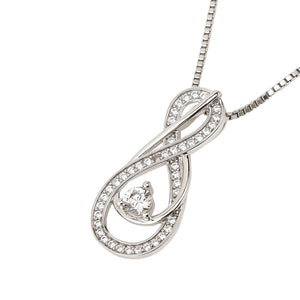
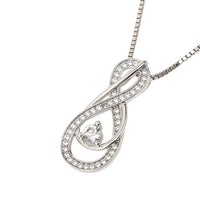
The piece they're describing → April Birthstone Necklace for Women — Diamond CZ Infinity Pendant, 925 Sterling Silver
Personalize Yours

