


- Same stone, different birthplace: lab and natural diamonds are both 100% carbon with identical hardness, sparkle, and fire.
- Price gap is huge: lab diamonds run 60–85% cheaper than a comparable natural diamond.
- Resale is the honest trade-off: natural diamonds hold value better; lab diamonds depreciate fast.
- There's a third option: moissanite vs diamond vs cubic zirconia comparisons matter too — both give you the look for a fraction of either diamond price.
Quick answer: A lab-grown diamond and a natural diamond are chemically, physically, and optically identical — both are 100% real carbon crystals with the same hardness (10 on the Mohs scale), fire, and brilliance. The only real differences are origin and price: lab diamonds form in weeks inside a lab and cost 60–85% less, while natural diamonds form over billions of years underground and hold their rarity premium (and resale value) better. For everyday jewelry, most buyers now choose lab-grown for the size-per-dollar; for legacy heirloom pieces, some still prefer natural for the "formed by the earth" story.
Lab Diamond vs Natural Diamond: Side-by-Side Comparison
| Factor | Lab-Grown Diamond | Natural (Mined) Diamond |
|---|---|---|
| Composition | Pure carbon, crystallized in a lab (HPHT or CVD) | Pure carbon, crystallized underground over 1–3 billion years |
| Hardness (Mohs) | 10 — identical to natural | 10 |
| Visual appearance | Indistinguishable to the naked eye; requires specialized lab equipment to identify | Same brilliance, fire, and sparkle |
| Price (1 carat, similar cut/clarity) | $800–$1,800 | $4,500–$8,000+ |
| Price trend | Falling ~10–15% per year as production scales | Relatively stable, rarity-driven |
| Resale value | Low — typically 20–30% of purchase price | Higher — 30–50% depending on quality, still a fraction of retail |
| Certification | GIA, IGI grade lab diamonds the same way as natural (report specifies "laboratory-grown") | GIA, AGS certification, no origin note needed |
| Environmental impact | Lower land disturbance; energy-intensive growth process | Mining disturbs land and requires heavy machinery |
| Ethical sourcing | No mining-conflict concerns by design | Conflict-free with Kimberley Process certification, but sourcing varies by mine |
| Best for | Maximizing carat size and clarity on a budget; everyday and fashion jewelry | Heirloom pieces, investment intent, "natural rarity" preference |
What Is a Lab-Grown Diamond?
A lab-grown (or lab-created) diamond is grown in a controlled facility using one of two processes: HPHT (High Pressure High Temperature), which recreates the heat and pressure conditions found deep in the earth, or CVD (Chemical Vapor Deposition), which builds a diamond layer by layer from carbon-rich gas. Both processes take days to a few weeks and produce a crystal with the exact same carbon lattice structure as a mined diamond — not a simulant like cubic zirconia or moissanite, which are different minerals entirely. The FTC, GIA, and every major gemological body classify lab diamonds as real diamonds.
What Is a Natural Diamond?
Natural diamonds form 90–120 miles below the earth's surface under extreme heat and pressure, then get carried to the surface by volcanic eruptions over the course of 1 to 3 billion years. They're mined, cut, and polished before reaching a jeweler. Because the geological process can't be replicated on a human timescale, natural diamonds carry a built-in scarcity that lab-grown stones don't — which is the entire basis of their price premium.
Can You Tell Them Apart?
Not with the naked eye, and not with a standard jeweler's loupe. Lab and natural diamonds have identical refractive index, dispersion, and hardness, so they sparkle exactly the same way. The only reliable way to distinguish them is with specialized equipment — like a DiamondView imaging machine or a diamond-type tester — that gemological labs use to detect trace growth patterns invisible to the eye. Every reputable lab diamond ships with a GIA or IGI report that explicitly states "laboratory-grown," so there's no ambiguity about what you're buying if you buy through a certified seller.

Price: Why Lab Diamonds Cost So Much Less
The price gap comes down to supply, not quality. Natural diamond supply is fixed by geology and controlled by a small number of major mining companies, which keeps prices high and relatively stable. Lab diamond production, by contrast, scales the way manufacturing does — more growth facilities mean more supply, and prices have dropped roughly 10–15% year over year since 2020 as the technology matures. For a 1-carat, well-cut, near-colorless stone, expect to pay $800–$1,800 for lab-grown versus $4,500–$8,000+ for natural — meaning a lab diamond lets you buy a noticeably larger or higher-clarity stone for the same budget.
Resale Value: The One Place Natural Still Wins
Neither lab nor natural diamonds are a strong investment — both lose significant value the moment they leave the store, same as most retail jewelry. But natural diamonds hold a higher percentage of resale value (often 30–50% of original price for well-graded stones) because their supply is finite. Lab diamonds typically resell for 20–30% or less, and that percentage keeps shrinking as new production keeps retail prices falling. If resale or investment value is a priority, natural is the safer bet. If you're buying to wear and love — not to resell — this difference matters far less.
Lab Diamond vs Moissanite vs Cubic Zirconia
These three get lumped together, but they're not the same thing. A lab diamond is chemically identical to a natural diamond (100% carbon). Moissanite is silicon carbide — a different mineral that's nearly as hard (9.25 Mohs) and actually throws more colorful "fire" than a diamond, at a fraction of the cost. Cubic zirconia is a synthetic simulant, much softer (8–8.5 Mohs) and best suited to fashion jewelry you'll wear occasionally rather than daily. For a deeper breakdown of lab diamond vs moissanite specifically — including side-by-side sparkle and durability comparisons — see our lab diamond vs moissanite guide, and for how moissanite stacks up against natural diamond pricing and durability, see moissanite vs diamond.
Which Should You Choose?
- Choose lab-grown if: you want the biggest, clearest stone your budget allows, you're buying for everyday wear, or ethical/environmental sourcing matters more to you than rarity.
- Choose natural if: you want maximum resale value, you're drawn to the "formed over a billion years" story for an heirloom piece, or you're following a family tradition of natural stones.
- Consider moissanite or CZ if: you want diamond-like sparkle at the lowest possible price point, or you're testing a style before committing to a bigger stone. Our CZ tennis necklace vs diamond comparison covers this trade-off for statement pieces.
Whichever direction you lean, the same logic applies across other gems too — see how it plays out with color stones in our lab vs natural emerald and lab ruby vs natural ruby guides.
Shop the Look
If you love the diamond aesthetic without the diamond price tag, our engagement ring collection features moissanite and CZ styles designed to deliver maximum sparkle at every budget — including the Moissanite Halo Ring, a brilliant-cut halo design in sterling silver or 18K white gold that captures the same fire and scintillation as a diamond solitaire.

FAQ: Lab Diamond vs Natural Diamond
Is a lab-grown diamond a real diamond?
Yes. A lab-grown diamond has the same chemical composition, crystal structure, and physical properties as a natural diamond. The FTC and GIA both classify it as a real diamond — the only difference noted on certification is origin ("laboratory-grown" vs mined).
Can jewelers tell the difference between lab and natural diamonds?
Not by eye or with a standard loupe. Jewelers need specialized equipment — like a DiamondView machine — to detect the trace growth patterns that reveal origin. Certified stones always disclose whether they're lab-grown or natural on the grading report.
Do lab diamonds hold their value?
Less well than natural diamonds. Lab diamonds typically resell for 20–30% of purchase price, compared to 30–50% for natural, mainly because lab diamond supply — and therefore price — keeps falling as production scales.
Are lab diamonds cheaper because they're lower quality?
No — quality (cut, color, clarity, carat) is graded on the same 4Cs scale for both. Lab diamonds are cheaper purely because they're easier to produce in volume, not because the stone itself is inferior.
Is moissanite better than a lab diamond?
"Better" depends on priorities. Moissanite is more affordable and actually more brilliant/fiery than diamond, but a lab diamond is a true diamond chemically, which matters to buyers who want the real material at a lower price than natural. See our full moissanite vs diamond comparison for the complete breakdown.
Are lab-grown diamonds better for the environment than natural diamonds?
Generally yes, since lab-grown diamonds don't require mining, which removes land disruption and extraction impact. That said, lab growth is energy-intensive, so the full environmental picture depends on the power source a given facility uses.
Are lab-grown diamonds more ethical than natural diamonds?
Not automatically. Lab diamonds are often marketed as more ethical, but the reality is nuanced — modern natural diamond supply chains under the Kimberley Process have improved significantly, and lab production has its own energy and labor considerations worth weighing.
Do lab-grown diamonds test as real on a diamond tester?
Yes. Standard diamond testers measure thermal and electrical conductivity, and lab-grown diamonds share the same physical properties as natural diamonds, so they pass as "diamond" on these testers every time.
Can you insure and resell lab-grown diamonds?
Yes, lab-grown diamonds can be insured and resold like natural diamonds, though buyers should expect a lower resale value due to the faster depreciation lab-grown stones have experienced as production has scaled.
How does moissanite vs diamond compare on price?
Moissanite runs roughly $300–$600 per carat versus $800–$1,800 for a comparable lab diamond and $4,500–$8,000+ for natural — moissanite vs diamond price is the widest gap in this entire comparison, since moissanite is a different mineral (silicon carbide) priced well below any diamond, lab or natural.
What does moissanite vs diamond side by side actually look like?
Placed side by side, moissanite throws noticeably more rainbow-colored fire than diamond (lab or natural) thanks to its higher refractive index, while diamond shows a whiter, more restrained sparkle — a difference visible mainly in direct or colored light rather than everyday indoor lighting.
Is a moissanite vs diamond ring a good engagement ring choice?
A moissanite vs diamond ring decision comes down to priorities: moissanite delivers comparable brilliance and far more fire at a fraction of the price with no resale expectations, while a diamond ring (lab or natural) carries the traditional association and, for natural stones, stronger resale value.
Moissanite vs diamond vs cubic zirconia — what's the real difference between all three?
Moissanite (silicon carbide, 9.25 Mohs) and cubic zirconia (zirconium dioxide, 8–8.5 Mohs) are both diamond simulants, not diamonds — moissanite is harder, pricier, and fierier; CZ is the most affordable and softest of the two. Neither is chemically related to lab or natural diamond, which are both pure carbon.
Written by the AJLuxe Team — specialists in personalized 925 sterling silver jewelry. Last updated: July 2026. Sources: GIA — Lab-Grown Diamonds, Jewelers of America.
Toutes les marques, noms de marque et noms de produits tiers sont la propriété de leurs détenteurs respectifs. AJLuxe n’est affilié à aucune marque tierce citée dans cet article, ni approuvé ou sponsorisé par celle-ci. Les noms de marque sont utilisés uniquement à des fins de comparaison factuelle, et les descriptions de matériaux reflètent les spécifications produit publiées par chaque marque au moment de la rédaction.
You Might Also Like
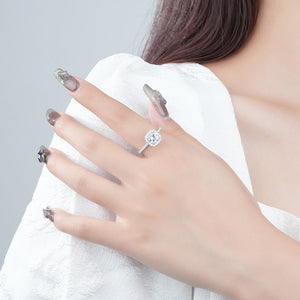
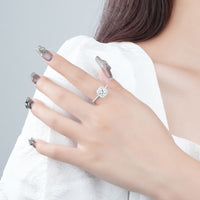
The piece they're describing → Bague auréole de moissanite — Argent sterling, or blanc 18 carats, oxyde de zirconium
Personalize Yours


