


Last updated: June 2026
When you're comparing onyx vs obsidian, both stones look strikingly similar at first glance — deep black, protective, and bold. But they come from completely different origins, behave differently in jewelry settings, and carry distinct metaphysical reputations. Whether you're buying a necklace, choosing a crystal for your collection, or just curious about the difference, this guide breaks it down clearly.

Onyx vs obsidian: onyx is a banded silica mineral (chalcedony) with a Mohs hardness of 7, making it durable for everyday jewelry, while obsidian is volcanic glass formed from rapidly cooled lava, rated 5–5.5 on the Mohs scale and more prone to chipping. Onyx is typically dyed to achieve solid black color; obsidian is naturally jet-black with a glossy, mirror-like luster.
Onyx vs Obsidian: Key Differences at a Glance
| Property | Black Onyx | Black Obsidian | Verdict |
|---|---|---|---|
| Appearance / Color | Matte to semi-gloss black, often with subtle white banding | Mirror-glossy jet black, sometimes with a slight sheen | Obsidian is more dramatic; onyx is more refined |
| Price Range | $1–$5 per carat; $15–$80 per necklace | $1–$3 per carat; $10–$60 per necklace | Obsidian is slightly cheaper |
| Hardness (Mohs) | 6.5–7 | 5–5.5 | Onyx wins — harder and more scratch-resistant |
| Durability | High — handles daily wear well | Moderate — chips easily if dropped | Onyx is better for rings and bracelets |
| Rarity | Common — widely available worldwide | Very common — found near most volcanic zones | Both are accessible; neither is precious |
| Best For | Rings, bracelets, men's jewelry | Pendants, earrings, crystal collectors | Different use cases — both have a place |
| Sparkle / Effect | Smooth waxy luster | High vitreous gloss, almost mirror-like | Obsidian has more visual impact up close |
| Origin / Formation | Sedimentary mineral (silica/chalcedony), India, Brazil, Madagascar | Volcanic glass from rapidly cooled lava, Mexico, USA, Armenia | Very different geology |
| Overall Value | Better long-term investment for wearable jewelry | Better for decor, healing, and statement pendants | Onyx for wear; obsidian for collection |
Shop Black Stone Crystal Charm Necklaces at AJLuxe — featuring genuine black stone charms set in sterling silver. Shop at AJLuxe →
What Is Black Onyx?
Onyx is a variety of chalcedony, which belongs to the quartz family of silica minerals. It forms in layers inside rock cavities where silica-rich water slowly deposits alternating bands of material over thousands of years. True onyx has parallel bands — typically black and white — but most commercial "black onyx" you'll find in jewelry is actually solid chalcedony that has been dyed to a uniform jet black.
According to the Gemological Institute of America (GIA), onyx has a Mohs hardness of 6.5 to 7, which puts it comfortably in the range for everyday jewelry. It has a waxy to dull luster when polished and takes a smooth, even surface that looks sleek in beaded bracelets and cabochon rings.
Historically, onyx has been prized since ancient Egypt, where it was carved into amulets and cameos. Roman soldiers wore onyx talismans engraved with Mars, the god of war, believing it brought courage in battle. Today it's widely available from Brazil, India, Madagascar, and Uruguay, and it's one of the most popular black gemstones in men's jewelry because of its clean, matte finish and affordable price point.
In terms of care, onyx handles water, mild soap, and daily contact reasonably well. Avoid ultrasonic cleaners and prolonged sun exposure, as dyed black onyx can fade over time. A soft cloth is all you need to keep it looking polished.
What Is Black Obsidian?
Obsidian is not a mineral — it's a naturally occurring volcanic glass. When silica-rich lava cools extremely fast (too fast for crystals to grow), it freezes into a smooth, amorphous glass. That's obsidian. Its color is usually jet black, though you'll also find varieties with a golden or rainbow sheen (known as sheen obsidian or rainbow obsidian) caused by microscopic gas bubbles or nanoparticle inclusions.
Obsidian rates 5 to 5.5 on the Mohs scale — softer than onyx and softer than the steel in most common household objects. Its most notable property isn't hardness, though; it's its conchoidal fracture. When it breaks, it forms razor-sharp curved edges. Archaeological evidence shows Indigenous peoples across North America and Mesoamerica used obsidian blades for cutting tools and surgical instruments thousands of years ago. Some modern surgeons have experimented with obsidian scalpel blades because the edge can be thinner than surgical steel.
Major sources include Mexico, the United States (Oregon, California, Wyoming), Iceland, Armenia, and Japan. The Jewelers of America notes that obsidian is classified as a mineraloid rather than a true gemstone, but it's widely used in jewelry, particularly for pendants, earrings, and carved figurines. Its mirror-like surface makes it visually striking, but its lower hardness means it needs more careful handling than most gemstones.
Onyx vs Obsidian: Appearance and Color
Side by side, onyx and obsidian look similar but behave differently in light. Onyx has a waxy, semi-matte finish that absorbs light softly. Polished onyx doesn't create strong reflections — it gives a smooth, consistent black surface that reads as elegant and understated. This quality makes onyx a strong choice for minimalist jewelry and formal settings.
Obsidian, by contrast, has a vitreous (glass-like) luster that's closer to a mirror. When you hold a polished obsidian pendant under light, it reflects the room around it the way a dark window does. That's because it is glass — and glass always has a high refractive quality. This reflectivity is part of what makes obsidian visually dramatic.
Color-wise, both can appear true black. But obsidian sometimes shows a slight translucency on thin edges or, in certain light, reveals a dark green or brown undertone. Onyx, particularly dyed commercial onyx, is a perfectly opaque, uniform black. If you want a consistent, deep black with no variation, onyx delivers that more reliably.
Shape-wise, both stones cut and polish well into cabochons, beads, and flat slabs. However, obsidian's conchoidal fracture makes precision carving trickier, and fine details in obsidian carvings are more vulnerable to chipping than those in onyx.
Price Comparison: Onyx vs Obsidian
Both stones are affordable, but there are differences worth knowing before you buy. Raw black onyx typically sells for $1 to $5 per carat at the wholesale level. Finished onyx jewelry — necklaces, rings, bracelets — generally ranges from $15 to $80 depending on the setting metal and piece size. High-end designer onyx pieces in 18k gold can run several hundred dollars, but the stone itself isn't driving the price — the metal is.
Obsidian is slightly less expensive than onyx. Raw obsidian runs $1 to $3 per carat, and finished obsidian jewelry typically falls in the $10 to $60 range. Large obsidian spheres and carved figurines popular in crystal healing circles can cost more, but again, the craftsmanship — not the material — dictates the price.
A 2023 market survey of gemstone retailers found that black onyx consistently outpriced obsidian by 20–40% at the retail level, largely because onyx carries greater name recognition and perceived prestige as a "gemstone" versus a "volcanic glass."
Neither stone holds significant resale value as an investment. If you're paying a premium, it's for the setting, the brand, or the carving — not the stone's intrinsic rarity. Both onyx and obsidian are abundant globally.
Which Is Better for Jewelry?
Onyx is the practical winner for most jewelry applications. At 6.5–7 Mohs, it can handle daily wear in rings, stacking bracelets, and pendants without worrying too much about scratching. It holds up against metal zippers, keys in a pocket, and counter edges that would chip or scratch obsidian.
Obsidian works best in low-contact settings. Pendants and earrings are ideal — they don't rub against surfaces the way rings and bracelets do. If you love obsidian's glossy, dramatic look, a pendant necklace is the safest way to wear it regularly. Avoid setting obsidian in rings unless it's a display piece you won't wear during physical activity.
For care, onyx is easier to maintain. Clean it with warm water and a soft cloth. Obsidian needs the same gentle care but is more vulnerable to sharp impacts — even dropping it on a tile floor can crack it. Neither stone should go in an ultrasonic cleaner. Store both away from harder gemstones like diamonds or sapphires that could scratch them.
If you want something for an everyday protection crystal necklace, onyx is the more resilient option. If you're drawn to obsidian's raw volcanic energy for your crystal healing collection, use it in a setting that protects the stone.
Spiritual Meaning and Healing Properties
Both onyx and obsidian have deep roots in protective crystal traditions, but their energy profiles differ in important ways.
Black onyx is traditionally associated with grounding, self-control, and stamina. Crystal practitioners use it to absorb and transform negative energy, promote inner strength, and support focus during stressful periods. It's linked to the root chakra, which governs stability, security, and physical presence. Wearing onyx is thought to keep you anchored and mentally sharp.
Black obsidian is considered more intense. Many crystal healing traditions describe it as a psychic shield — a stone that not only blocks negative energy but actively draws out buried trauma and unconscious patterns so they can be confronted and released. It's popular among practitioners who work with shadow work or emotional healing. Like onyx, it's linked to the root chakra, but obsidian's energy is often described as more penetrating and less gentle than onyx.
If you're new to working with protective black stones, onyx is usually recommended as the starting point because its energy is steadier and easier to work with. Obsidian is better for those already comfortable with introspective or emotionally intense practices.
Related reading: Engagement Ring vs. Wedding Band: What's the Real Difference? (2026).
Related reading: Charms and Pendants: What's the Real Difference (and Which One to Buy in 2026).
Frequently Asked Questions
Is black onyx the same as obsidian?
No — they're completely different materials. Black onyx is a variety of chalcedony, a silica mineral that forms sedimentarily in rock cavities. Obsidian is volcanic glass created when lava cools so quickly that no crystal structure can form. They look similar but have different hardness levels, formation processes, and physical properties. Onyx is a true mineral; obsidian is classified as a mineraloid.
Which stone is harder, onyx or obsidian?
Onyx is harder. It rates 6.5–7 on the Mohs hardness scale, while obsidian rates 5–5.5. This means onyx resists scratches better and holds up longer in jewelry that contacts hard surfaces. Obsidian's glass structure makes it brittle despite its relatively smooth feel — it chips along conchoidal fracture lines when struck sharply.
Can you tell onyx and obsidian apart by looking at them?
With practice, yes. Obsidian has a distinctly glassy, mirror-like luster that reflects light strongly, similar to dark window glass. Onyx has a waxy, softer sheen that absorbs light more than it reflects. Obsidian may also show slight translucency on thin edges, while onyx is completely opaque. If you run a fingernail over both (your nail is about 2.5 Mohs), neither will scratch — but a copper coin (3 Mohs) may leave a faint mark on obsidian while onyx resists it.
Which is more expensive — onyx or obsidian?
Black onyx is generally 20–40% more expensive than obsidian at the retail level, though both are among the most affordable black stones in the market. Raw onyx runs $1–$5 per carat; raw obsidian runs $1–$3 per carat. In finished jewelry, the metal setting typically costs more than the stone itself for both materials. Neither stone holds significant resale or investment value.
Is obsidian good for everyday jewelry?
Obsidian works for jewelry you wear carefully, but it's not ideal for everyday wear in high-contact pieces like rings or bracelets. At 5–5.5 Mohs, it scratches more easily than most gemstones and can chip if dropped or knocked against hard surfaces. Obsidian is best used in pendants and earrings, where it won't rub against hard surfaces regularly. If you love obsidian, choose a protective setting that covers the edges of the stone.
What is rainbow obsidian and how is it different from black obsidian?
Rainbow obsidian is the same volcanic glass as black obsidian, but it contains microscopic layers of magnetite nanoparticles or gas bubbles that diffract light into iridescent colors — gold, green, purple, or blue — when the stone is rotated under light. In flat light, rainbow obsidian can look solid black, just like standard black obsidian. It costs slightly more than plain black obsidian due to the visual effect, but has the same hardness and durability profile.
Can onyx and obsidian be worn together?
Yes, and they pair well aesthetically since both are deep black. From a durability standpoint, wearing an onyx ring with an obsidian pendant is perfectly fine — they won't damage each other unless you stack them touching directly in a drawer. From a crystal healing perspective, both stones work with the root chakra and share protective qualities, so practitioners generally consider them compatible to wear together.
Is black obsidian rare?
Black obsidian is not rare at all — it's one of the most abundant naturally occurring glasses on Earth. It forms wherever silica-rich lava flows cool rapidly, which happens near most volcanic zones globally. Major deposits exist in Mexico, the United States (Oregon, California), Iceland, Armenia, and Japan. Its affordability reflects its abundance. Rare forms like gold sheen obsidian or clear obsidian are less common, but standard black obsidian is widely available.
What chakra is black onyx associated with?
Black onyx is primarily associated with the root chakra (Muladhara), located at the base of the spine. Crystal healing traditions link the root chakra to safety, stability, and grounding in physical reality. Onyx is used to reinforce these qualities — helping the wearer stay focused, calm under pressure, and mentally disciplined. Some practitioners also connect onyx to the solar plexus chakra for its association with personal power and decision-making.
How do I clean black onyx and obsidian jewelry?
Clean both stones with warm water, a small amount of mild dish soap, and a soft-bristled brush or cloth. Rinse thoroughly and dry immediately with a lint-free cloth. Never put either stone in an ultrasonic or steam cleaner — the vibration and heat can crack obsidian and damage dyed onyx. Avoid harsh chemicals like bleach or acetone. Store each piece separately or wrapped in soft fabric to prevent scratching from other jewelry.
Final Thoughts
Onyx and obsidian are two of the most compelling black stones in jewelry and crystal healing — but they're not the same thing. Onyx is a mineral with proven durability for everyday wear, a refined matte finish, and a long history in fine jewelry. Obsidian is volcanic glass with a striking mirror-like luster, intense protective energy, and better use as a pendant or collector's piece than a workhorse stone. For most jewelry buyers, onyx is the safer long-term investment. But if you're drawn to obsidian's raw volcanic power in a necklace or pendant, it absolutely has a place in your collection. Explore our Black Stone Crystal Charm Necklaces at AJLuxe → featuring dark stone charms in sterling silver settings built to last.
Metaphysical Meaning: Onyx vs Obsidian
Onyx is traditionally associated with grounding and self-control, while obsidian is considered a stronger "shadow work" stone for absorbing negative energy — the two are not interchangeable in crystal healing practice even though both are black. Onyx has been worn since antiquity as a stone of discipline and emotional stability; Roman soldiers carried it into battle for courage, and modern crystal practitioners still use it to support focus, willpower, and stress management during major life transitions (career changes, public speaking, breaking a habit).
Obsidian's reputation is more intense. Because it forms from violently cooled lava, it's associated with sudden clarity and protection against negativity rather than steady discipline. Practitioners describe it as a "mirror stone" that reflects hidden truths back at the wearer — used for shadow work, cutting energetic cords, or psychic protection. Apache tears (a translucent, rounded form of obsidian) carry a gentler, grief-related folklore tied to Apache legend, distinct from the more confrontational reputation of solid black obsidian.
For jewelry buyers, this distinction matters beyond aesthetics: someone gifting a piece for comfort during grief or transition is often better served by Apache tear or onyx, while someone drawn to protection or shadow work symbolism will want obsidian specifically. Neither stone is a birthstone in the traditional Western list, but onyx is commonly used as an alternative birthstone for Leo, and obsidian has no widely recognized zodiac assignment — another reason the two get confused in gift-buying searches.
Bottom line: reach for onyx when the occasion calls for steadiness and quiet strength (milestone gifts, work anniversaries, sobriety tokens); reach for obsidian when the intent is protection, release, or a bolder symbolic statement.
Toutes les marques, noms de marque et noms de produits tiers sont la propriété de leurs détenteurs respectifs. AJLuxe n’est affilié à aucune marque tierce citée dans cet article, ni approuvé ou sponsorisé par celle-ci. Les noms de marque sont utilisés uniquement à des fins de comparaison factuelle, et les descriptions de matériaux reflètent les spécifications produit publiées par chaque marque au moment de la rédaction.
You Might Also Like
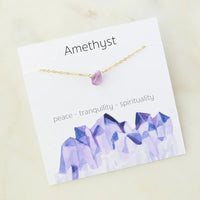
The piece they're describing → Collier pendentif en pierre pour femme – Plaqué or 18 carats, pendentifs en pierres précieuses naturelles
Personalize Yours


