


- A birthstone stud earring pairs each month's traditional gemstone with a simple, no-dangle stud setting — the most low-maintenance way to wear a birthstone.
- The metal, not the stone, decides whether they're hypoallergenic — 925 sterling silver and surgical steel are nickel-free; plated fashion metal usually isn't once the coating wears.
- Genuine gemstone birthstone studs from brands like MadeByMary run about $48–$68; Little Sky Stone's real-gemstone pair runs $69. AJLuxe's 925 sterling silver, mini-CZ version runs $27.99–$36.99 depending on month.
- The modern birthstone list was standardized in 1912 by the National Association of Jewelers; tanzanite was added for December in 2002 — it isn't an ancient, unchanging tradition.
- AJLuxe deliberately uses tourmaline (not opal) for October and topaz (not turquoise) for December — both meaningfully harder, more impact-resistant choices for a stud that gets knocked around more than a pendant does.
If your ears turn red or itch after wearing certain earrings, birthstone studs raise a fair question before you buy: is it the gemstone or the metal that's the problem, and which birth-month stones can even survive being worn as a small, low-set stud rather than a protected pendant? This guide covers what a birthstone stud earring actually is, a full 12-month reference table with real Mohs hardness ratings, what genuine-gemstone birthstone studs cost at other brands compared to AJLuxe's 925 sterling silver version, the hypoallergenic question in full, and honest buying and styling guidance — including where the birthstone tradition itself actually comes from, which is more recent and more marketing-driven than most people assume.
What Are Birthstone Stud Earrings?
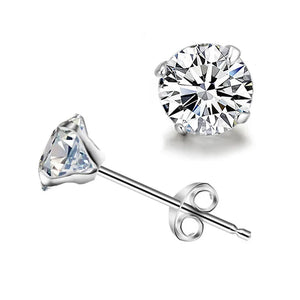
Birthstone stud earrings are stud-style earrings — a single stone set on a short post that sits flush against the earlobe, with no chain or dangling element — where the stone corresponds to a specific calendar month rather than being a plain diamond, CZ, or pearl. Because a stud is the lowest-profile earring category, birthstone studs read as everyday, wearable jewelry rather than a statement piece, which is a large part of why the format is so common for gifting: they work for a toddler's first earrings, a teenager's birthday, or a mother who wants something she'll actually wear daily rather than save for occasions.
The stone itself can be genuine or simulated. Most affordable birthstone studs, AJLuxe's included, use a small cubic zirconia (CZ) cut and colored to match the traditional stone for that month rather than a mined gem — a distinction covered in full further down, since it matters for both price and durability.
The 12 Birthstones by Month — Quick Reference
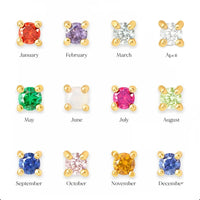
Each month's traditional birthstone has its own color, symbolic meaning, and — just as relevant for a stud earring specifically — its own Mohs hardness rating, which determines how well it holds up to the daily bumps a stud takes that a necklace pendant mostly avoids. The table below uses the modern U.S. birthstone list (Jewelers of America / American Gem Society) and notes AJLuxe's actual stone choice per month where it differs from a softer traditional alternate.
| Month | Birthstone | Color | Mohs Hardness | Traditional Meaning |
|---|---|---|---|---|
| January | Garnet | Deep red | 6.5–7.5 | Protection, passion |
| February | Amethyst | Purple | 7 | Clarity, calm |
| March | Aquamarine | Blue-green | 7.5–8 | Courage, calm |
| April | Diamond | Clear | 10 | Strength, eternal love |
| May | Emerald | Green | 7.5–8 | Renewal, prosperity |
| June | Pearl | White | 2.5–4.5 | Purity, wisdom |
| July | Ruby | Red | 9 | Passion, courage |
| August | Peridot | Olive green | 6.5–7 | Healing, positivity |
| September | Sapphire | Blue | 9 | Loyalty, wisdom |
| October | Opal / Pink Tourmaline | Multi-color / pink | 5.5–6.5 / 7–7.5 | Creativity, hope |
| November | Topaz / Citrine | Yellow / amber | 8 / 7 | Warmth, abundance |
| December | Turquoise / Zircon / Tanzanite | Blue / sky blue | 5–6 / 6–7.5 / 6–7 | Luck, friendship |
Several months carry more than one accepted birthstone because the modern list, standardized in 1912, layered new options onto older traditional stones rather than replacing them outright (more on that history below). For a stud earring specifically, the hardness column matters more than it would for a necklace: a stud sits closer to where your hand, hair, and clothing brush against it all day, so a softer stone like pearl (2.5–4.5) or opal (5.5–6.5) is more prone to scratching or chipping in that setting than a harder one like sapphire or diamond. AJLuxe's 12-month set uses tourmaline for October and topaz for December rather than the softer opal and turquoise alternates — a meaningfully more durable choice for an earring that gets more daily impact than a pendant does.

Are Birthstone Stud Earrings Hypoallergenic?
Birthstone stud earrings are hypoallergenic when the metal touching your earlobe — the post and setting, not the stone — is free of nickel, since nickel is what actually triggers most earring-related skin reactions. The American Academy of Dermatology estimates more than 18% of people in North America are allergic to nickel, and a colored or gemstone-set stud doesn't change that math: the stone rarely has sustained enough skin contact to matter, while a nickel-alloy post pressed against your piercing for hours a day matters a great deal.
Solid metals with no hidden base layer are the safest bet — 925 sterling silver, surgical-grade stainless steel, and solid 14K–18K gold don't have a plating layer that can wear through to expose nickel underneath, unlike cheap "gold-tone" or "silver-tone" fashion metal, which usually is a nickel-alloy base with a thin coating. AJLuxe's Birthstone Stud Earrings are built on a 925 sterling silver base with an 18K gold-plated option, and the product listing states the setting is nickel-free — worth verifying on any birthstone stud you're considering, not just taking "gold" or "gold-tone" at face value, since that word alone describes a finish, not what's actually against your skin. For the full metal-by-metal breakdown, see AJLuxe's hypoallergenic birthstone earrings buying guide.
Real Gemstone or Simulated (CZ)? Does It Matter?
For everyday stud earrings, a well-made simulated birthstone (cubic zirconia cut and colored to match the traditional stone) performs the job just as well as a genuine gemstone for most buyers, because the visual and sentimental value of "my birth month's color" doesn't depend on the stone being mined rather than lab-grown. Genuine gemstone birthstone studs — the kind sold by brands like MadeByMary and Little Sky Stone, covered below — command a real premium for material rarity and, for stones like sapphire or ruby, long-term resale and investment value that a CZ can't offer. That premium is legitimate, not a markup trick; it just isn't the relevant factor for most people buying a $30–$70 pair of everyday studs.
AJLuxe's Birthstone Stud Earrings use a mini CZ colored to each month's traditional stone rather than a genuine gemstone — disclosed plainly on the product page, not implied to be natural. Where this genuinely doesn't matter: color, sparkle, and daily wearability are effectively identical to a genuine stone at this stud size. Where it does matter: a genuine emerald, sapphire, or ruby carries intrinsic material value a CZ never will, which is the honest reason to spend more if that matters to you.
How Much Do Birthstone Stud Earrings Cost?
Real prices span roughly $27.99 to $69 depending on whether the birthstone is genuine or simulated and what metal it's set in. Genuine-gemstone birthstone studs in gold vermeil or 14K gold-plated sterling silver run the highest; simulated (CZ) birthstones in sterling silver run the lowest, without sacrificing much on the visual side for daily wear.
| Brand | Stone | Metal | Price |
|---|---|---|---|
| Little Sky Stone | Genuine gemstone | 14K gold-plated sterling silver | $69.00 |
| MadeByMary | Genuine gemstone | Gold vermeil | $48–$68 |
| AJLuxe | Mini CZ (color-matched) | 925 sterling silver / 18K gold plated | $27.99–$36.99 |
Prices for other brands are approximate and gathered from each brand's current published pricing — check their sites directly for a specific month's exact price, since genuine-gemstone pricing can vary by stone even within the same collection (a genuine sapphire or diamond stud, for instance, typically costs more than a genuine citrine or amethyst one, even at the same brand).
How to Style Birthstone Stud Earrings for Everyday Wear
Birthstone studs work best worn as a single, understated pair rather than layered with other sparkly earrings, since the point of a birthstone stud is the personal color story, not maximum sparkle. A few combinations that hold up in practice:
- Solo in the primary lobe piercing: the lowest-maintenance option — one pair, worn daily, no styling decisions required.
- Stacked with a plain stud or huggie in a second piercing: keep the second piece neutral (plain CZ, small hoop, or huggie) so the birthstone color stays the visual focus rather than competing with another colored stone.
- Paired with a matching birthstone necklace: a birthstone stud-and-pendant set reads as more intentional gifting than either piece alone, and works well for a milestone birthday or Mother's Day gift.
- Metal-matched, not stone-matched, to the rest of your jewelry: match the stud's metal (gold-plated or sterling silver) to whatever else you're wearing that day; the birthstone color is meant to stand out, not blend in with other colored stones.
Birthstone Stud Earrings as a Gift
Birthstone stud earrings are one of the easier "meaningful but not overly serious" gifts to get right, because the personalization — the recipient's own birth month — does most of the sentimental work without requiring you to guess their taste in style the way a fashion-forward piece might. They work well as a birthday gift (the obvious, expected occasion), a Mother's Day gift (especially paired with a birthstone necklace for a full set), or a first-jewelry gift for a daughter or granddaughter, since the low-profile stud setting is comfortable for a first or newly healed piercing in a way a heavier drop or hoop earring isn't.
One practical gifting note: if you're buying for someone whose exact birth date you're unsure of near a month boundary, or who was born on a cusp day some calendars split differently, it's worth confirming the month directly rather than assuming — a birthstone gift is only as meaningful as it is correct.
Where Did the Birthstone Tradition Come From?
The idea of wearing your specific birth month's stone is a far more recent, and far more retail-driven, tradition than most birthstone marketing implies. The modern U.S. birthstone list was formally standardized in 1912, when the National Association of Jewelers adopted a single monthly roster at its convention in Kansas City, replacing the inconsistent regional lists that had circulated since the 1700s and giving the jewelry trade one consistent list to sell against. The list has stayed largely the same since, with one notable change: tanzanite was added as a second option for December in 2002.
The deeper root of associating gemstones with groups of twelve traces back to the twelve stones described in the biblical Breastplate of Aaron (Exodus 28), later linked by some scholars to the twelve months and zodiac signs — but the specific, modern idea of an individual always wearing their own birth month's stone is a much later custom, one gemological historians trace to 18th-century Poland. Knowing this doesn't make a birthstone gift any less meaningful; if anything, it's a useful thing to know if a birthstone shopper ever wonders why a given month has two or three "correct" stones instead of one — the list was built by committee, not handed down unchanged from antiquity.
How to Choose the Right Pair
Start with the metal, not the stone, when comparing birthstone stud options — confirm the listing names a specific base metal (925 sterling silver, surgical steel, or solid gold) rather than only describing a finish like "gold-tone," since that's the detail that actually predicts whether the pair will irritate sensitive ears over time. From there:
- Decide if a genuine gemstone matters to you. If yes, expect to pay $48 and up per pair, and confirm the listing discloses "genuine" or "natural" explicitly rather than leaving it ambiguous. If a color-accurate CZ is fine, sterling silver options in the high-$20s to high-$30s range cover the same visual ground.
- Check the closure type. Butterfly (push) backs are the most common and easiest for daily wear; screw backs are the most secure for active wear or younger kids; flat backs are the most hygienic option for a fresh or sensitive piercing.
- Consider the stone's hardness if you're an active wearer. Harder stones (diamond, sapphire, ruby, topaz) tolerate daily bumps better than softer ones (pearl, opal) in a stud setting specifically, per the hardness table above.
- Verify the month before you buy. A birthstone gift only lands if the month is right — double check rather than assume, especially for a gift.
AJLuxe's Birthstone Stud Earrings ($27.99–$36.99) are built on a 925 sterling silver base with an 18K gold-plated finish, a mini CZ colored to each month's traditional stone across all 12 months, and a standard butterfly-back closure — a straightforward, disclosed-CZ option for anyone who wants the birthstone-stud look at everyday-jewelry pricing rather than genuine-gemstone pricing. Prefer the same birth-month idea on a chain instead of an earring? AJLuxe's birthstone charm guide covers the necklace and bracelet version in full, including which softer stones (pearl, opal, turquoise) are better suited to a pendant than a stud in the first place.
Frequently Asked Questions
What is the birthstone for each month?
January is garnet, February amethyst, March aquamarine, April diamond, May emerald, June pearl, July ruby, August peridot, September sapphire, October opal or pink tourmaline, November topaz or citrine, and December turquoise, zircon, or tanzanite. Several months carry more than one accepted stone because the modern list layered new options onto older traditional ones rather than replacing them.
How do I find out what my birthstone is?
Match your birth month to the standard 12-month list above — birthstones are assigned by calendar month of birth, not by zodiac sign, birth year, or exact day, so there's no calculation involved beyond knowing which month you were born in. If a month has more than one accepted stone (like October's opal or tourmaline), either is considered correct; picking between them usually comes down to preference or which one fits your budget and durability needs.
What is the rarest birthstone?
Among the 12 standard birthstones, natural alexandrite (June's alternate stone) is widely considered the rarest and most valuable, prized for its unusual color-change effect between daylight and incandescent light. Tanzanite (December's newest addition, added in 2002) is also notably rare since it's currently mined in only one area near Mount Kilimanjaro in Tanzania.
What months have more than one birthstone?
June (pearl, alexandrite, or moonstone), August (peridot, sardonyx, or spinel), October (opal or pink tourmaline), November (topaz or citrine), and December (turquoise, zircon, or tanzanite) all carry more than one accepted stone on the modern U.S. list. This is a byproduct of the 1912 standardization layering newer, more available stones onto older traditional ones rather than replacing them outright.
Are 925 sterling silver earrings hypoallergenic?
Yes, for the vast majority of wearers — genuine 925 sterling silver (92.5% silver, 7.5% other metals, typically copper) contains no nickel and is one of the most reliably hypoallergenic earring metals available at an accessible price. The main exception is a very small number of people sensitive to the trace metals in the remaining 7.5%, which is uncommon but not impossible; if you've reacted to sterling silver specifically before, surgical steel or solid gold are the next options to try.
What are the most hypoallergenic earrings for sensitive ears?
Solid 925 sterling silver, surgical-grade stainless steel, and solid 14K–18K gold are the three most reliably hypoallergenic earring metal categories, because none of them rely on a plating layer that can wear through to expose a nickel-alloy base underneath. Gold vermeil and gold-plated pieces are only as hypoallergenic as the base metal they're plated over, which is worth checking rather than assuming from the word "gold" alone.
Do birthstone stud earrings use real gemstones or simulated stones?
Both exist on the market, and reputable sellers disclose which one you're buying. Genuine-gemstone birthstone studs (like those from MadeByMary or Little Sky Stone) run roughly $48–$69 per pair; simulated versions using color-matched cubic zirconia, like AJLuxe's, run lower, generally under $40, without a meaningful difference in daily-wear appearance at typical stud sizes.
Is a birthstone stud earring a good gift?
Yes — a birthstone stud earring is one of the more reliably well-received personalized jewelry gifts, since the recipient's own birth month does most of the "this was chosen for you specifically" work without requiring you to know their exact style preferences. It works for birthdays, Mother's Day, a first-piercing gift, or as part of a matched set with a birthstone necklace.
How do you clean and care for birthstone stud earrings?
Wipe with a soft, dry cloth after wearing to remove oils and residue, and store them away from moisture, perfume, and lotion, which is standard care for any sterling silver or gold-plated jewelry. For harder stones (sapphire, ruby, diamond, garnet), a light clean with mild soap and warm water is fine; for softer stones like pearl, stick to a dry cloth only, since water and chemicals can dull or damage them over time.
Toutes les marques, noms de marque et noms de produits tiers sont la propriété de leurs détenteurs respectifs. AJLuxe n’est affilié à aucune marque tierce citée dans cet article, ni approuvé ou sponsorisé par celle-ci. Les noms de marque sont utilisés uniquement à des fins de comparaison factuelle, et les descriptions de matériaux reflètent les spécifications produit publiées par chaque marque au moment de la rédaction.
You Might Also Like
The piece they're describing → Boucles d'oreilles clous de naissance pour femme — Argent sterling 925, Plaqué or 18 carats, Mini ZC
Personalize Yours


