


The short answer
A box chain is defined by its square, right-angle links — a geometric, sleek silhouette that's noticeably more rigid than a round cable or curb chain. Three things most "box chain" search results skip: it's also called a Venetian chain or book chain (same construction, different name), it genuinely does hold a pendant's weight better than a soft round-link chain because the square links interlock so tightly, and real box chain necklaces are not cheap — sterling silver versions start around $298 and solid-gold versions run $660 to well over $1,000 at brands like Kinn and Mejuri. AJLuxe doesn't currently stock a true single-strand box-link chain, and this guide says so plainly rather than dressing up a different product as one.
"Box chain necklace" is a search that mixes a few different shoppers: someone who saw the square-link chain on a men's jewelry site or a minimalist gold-chain roundup and wants to know what it actually is, someone comparing it to a cable or Cuban chain before spending real money, and someone sticker-shocked by fine-jewelry box chain prices who wants to know if there's a more affordable way to get the look. This guide covers all three — a plain-English definition, a direct comparison against cable, curb, Cuban, and paperclip chains, real prices pulled from three chain specialists, sizing guidance, and an honest note on where AJLuxe's own catalog stands today.

What is a box chain necklace?
A box chain necklace is built from square-shaped links joined at right angles, so each link reads as a tiny cube or "box" rather than a round loop. That's the entire idea: instead of the open oval links of a cable chain or the flattened interlocking links of a curb chain, a box chain's links sit at 90-degree angles to each other, giving the finished chain flat, shiny surfaces and a look of near-perfect symmetry from any side. Box chains are also sold under two older names — Venetian chain and book chain — that describe the exact same square-link construction; the "Venetian" name traces back to the chain's roots as an artisan style from Venice, Italy.
Because the links interlock so tightly at those right angles, a box chain resists stretching and deformation better than a chain built from loose round links — jewelry retailers who sell both routinely describe box chains as the sturdier, more rigid option for a chain that has to carry real weight, while cable chains are positioned as the more flexible everyday default. That's also why box chains show up so often as the base chain under a heavier pendant or locket: the geometric links grip and support the extra weight instead of stretching under it. It's one of several link families worth knowing before you buy — our guide to types of necklace chains compares box against cable, curb, cuban, paperclip, herringbone, snake, and wheat so you can see exactly how each silhouette differs.
Box chain vs. cable, curb, Cuban & paperclip: how it actually compares
A box chain is the rigid, geometric middle ground — sturdier than a cable chain, sleeker than a Cuban link, and more structured than a paperclip chain. Here's how the five most-searched chain styles stack up against each other:
| Chain style | Link shape | Best for |
|---|---|---|
| Box (Venetian) | Square links at right angles | Heavier pendants; resists stretching and twisting into knots |
| Cable | Simple uniform oval or round links | Everyday wear, lightweight to moderate pendants, the most classic default |
| Curb | Twisted links that lie flat and interlock | Added strength with a flatter profile than box or cable |
| Cuban link | Flattened, interlocking oval links set edge-to-edge | Bold, heavy, chainmail-like statement pieces |
| Paperclip | Elongated, open rectangular links | Modern, minimalist layering; thin gauges can flatten over time |
The single biggest practical difference between a box chain and a cable chain is what happens under weight: a box chain's tightly interlocking square links hold their shape under a heavier pendant, while a thin cable chain is more prone to stretching or kinking if it's pulled or twisted. Against a Cuban link, a box chain is the sleeker, lighter-reading option — Cuban links are flattened and set edge-to-edge for a bold, chainmail look, while box links stay geometric and comparatively delicate even at a thicker gauge.
How much does a real box chain necklace cost?
Real box chain necklaces from dedicated fine-jewelry brands are a genuine investment — sterling silver versions start around $298 and solid 14K gold versions run from roughly $398 into the $600–$1,100+ range, depending on link thickness and metal purity. Here's what three well-known chain specialists currently charge, verified directly from their own product pages:
| Brand & style | Material | Price |
|---|---|---|
| Kinn Studio Box Chain Necklace | 14K solid gold, 1mm, 16–22 in | $660 |
| Mejuri Round Box Chain Necklace | 925 sterling silver, 20–22 in | From $298 |
| Mejuri Round Box Chain Necklace | 14K solid gold, 20–22 in | From $1,100 |
| Mejuri Baby Box Chain Necklace | 14K yellow gold | From $398 |
| Monica Vinader Fine Oval Box Chain | 18K gold vermeil or sterling silver, 18 in | Premium pricing (vermeil = gold layered over sterling silver) |
That Monica Vinader row is worth pausing on: even a well-known fine-jewelry brand sells its box chain in gold vermeil over sterling silver — the same "real plating over a genuine silver base" construction AJLuxe uses across its own gold-plated pieces — alongside a solid-sterling-silver version, not just solid gold. Gold plating over sterling silver isn't a downgrade; it's a standard, respected way to get a gold look without solid-gold pricing, and it's exactly why AJLuxe's own 18K-gold-plated-over-925-sterling-silver pieces are built the same way.
Does AJLuxe sell a box chain necklace?
Not currently — AJLuxe's necklace edit doesn't include a true single-strand, square-link box chain, and this guide says so plainly rather than stretching a different chain to fit the name. If you like the clean, polished, geometric look of a box chain and want it in AJLuxe's hypoallergenic 18K-gold-plated-over-925-sterling-silver construction, the closest honest match in the current catalog is the Layered Choker Necklace below — it's a multi-strand layered chain rather than a single box-link chain, and it sits at choker length rather than the longer lengths most box chains come in, but it shares the same polished, geometric metal-on-metal look and the same skin-safe sterling silver base.
Shop This Guide
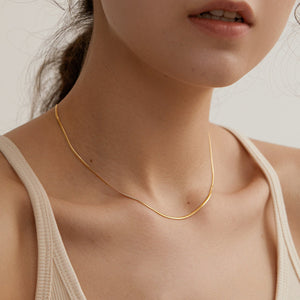
Our Layered Choker Necklace — 18K gold plated over 925 sterling silver, multi-strand, adjustable length, hypoallergenic. It's not a literal single box-link chain, but it gives you the same clean, geometric, everyday gold-chain look for well under fine-jewelry box chain prices.
Shop the Layered Choker NecklaceBox chain length chart (inches)
Length changes where a box chain sits and how it reads, so it's worth getting right before you buy. Measure your neck with a piece of string first, then use this chart to translate the number into where the chain will actually land.
| Length | Where it sits | Best for |
|---|---|---|
| 14–16 in (choker) | Snug at the base of the neck | A bold, thicker box chain worn as a standalone statement piece |
| 18 in (most popular) | Just below the collarbone | The universal everyday length; holds a small-to-medium pendant well |
| 20–22 in | On or just above the sternum | A heavier locket or pendant; the length most fine-jewelry box chains ship in |
| 24 in + | Mid-chest and lower | Thicker men's box chains, layering, unisex styling |
For a deeper breakdown of how each length reads on different heights and necklines, see our full chain necklace length guide.
Box chain link width: dainty versus bold
Link width is measured in millimeters, and it's the main lever between a delicate everyday box chain and a heavy statement one. Because box links are square and flat-sided rather than round, a box chain tends to catch more light and read a little bolder than a round cable chain at the same width.
| Link width | Look | Best for |
|---|---|---|
| 1–1.5 millimeters | Fine, delicate ("baby box") | Layering, small pendants, everyday wear |
| 2–3 millimeters | Balanced, visible, versatile | A do-everything standalone chain that still layers |
| 4–5 millimeters | Bold, structured | Worn alone as the focal point; unisex styling |
| 6 millimeters + | Heavy, high-impact | Men's statement chains, chunky-chain styling |
Durability and tarnish: what actually determines how long it lasts
A box chain's link shape affects how well it holds a pendant and resists tangling, not whether it tarnishes — that comes down to the metal underneath. The rigid, right-angle link structure is genuinely more resistant to twisting into knots in a jewelry box than a soft round-link chain, which is one of the most common daily-wear complaints with chains in general. But tarnish is a separate question: it's driven entirely by what's under the surface finish. A solid 14K or 18K gold box chain never tarnishes because there's no plating to wear through. A box chain plated over sterling silver stays skin-safe and resists tarnish reasonably well because the sterling core won't corrode or irritate skin as the plating naturally thins with wear. A box chain plated over brass or another base metal is the one to watch — the base metal, not the gold, is what causes irritation and green discoloration once the plating wears down.
To keep any gold-plated box-style chain looking its best, take it off before showering, swimming, or applying lotion and perfume, and wipe it with a soft cloth after wear. For the full comparison of how gold plating, solid gold, and sterling silver each hold up over years of daily use, see our gold versus silver chain necklace guide.
Styling a box chain: layering and pendant pairing
Box chains layer well because their flat, geometric surface contrasts cleanly against a rounder cable chain, a twisted rope chain, or an open paperclip chain — the mix of textures is what makes a stack read as intentional. Because a box chain's square links interlock so tightly, it also holds a heavier pendant or locket more securely than a chain built from loose round links, which is exactly why fine jewelers reach for a box chain as the base under a statement charm.
- Box chain plus a pendant: Its rigid structure makes it one of the safer choices for a medium-to-heavy pendant that would stretch a thinner cable chain over time.
- Box chain plus a paperclip or cable chain: Pair a thin box chain with an open-link paperclip or a simple cable chain at a slightly different length for texture contrast in a stack.
- A thicker box chain worn alone: At 4mm and up, a box chain reads as a confident, unisex statement piece with no pendant needed — a category David Yurman and similar brands lean into heavily for menswear.
How to choose: a quick decision path
- Pick a length first. 18 inches is the flattering everyday default; go shorter for a choker statement, 20–22 inches for a heavier pendant, 24 inches or more for a bolder or men's look.
- Choose a link width by intent. 1–1.5mm for layering, 2–3mm for one do-everything chain, 4mm+ for a standalone statement piece.
- Choose your metal by budget and skin sensitivity. Solid gold never tarnishes but costs the most; gold plated over sterling silver is skin-safe and far more affordable; always avoid plating over brass if you have metal sensitivities.
- Decide plain or pendant. A box chain's tight, rigid links are built to carry a heavier pendant or locket without stretching.
- If a true box chain isn't in budget right now, a plated layered or multi-strand gold chain gets you a comparable everyday look for a fraction of the price.
Written by the AJLuxe Team. Last updated: August 2026. According to the Jewelers of America, choosing quality metals and caring for them properly is what keeps fine jewelry wearing well over time — a principle that applies directly to a box chain, whose tightly interlocking links are often asked to carry real pendant weight for years of daily wear.
Frequently Asked Questions
What is a box chain on a necklace?
A box chain is a necklace made of square-shaped links connected at right angles, forming a continuous run of tiny geometric boxes with flat, shiny surfaces. It's also called a Venetian chain or a book chain — same construction, different names. The rigid, interlocking link shape is what sets it apart from round-link chains like cable or rope.
Is a box chain a good chain?
Yes — a box chain is one of the more durable everyday chain styles because its square links interlock tightly and resist stretching or deforming under weight. That makes it a strong choice for holding a pendant or locket, and its geometric, symmetrical look reads as polished rather than trendy, so it doesn't date the way some link styles do.
Is a box chain stronger than a cable chain?
Generally, yes. A box chain's square links interlock tightly, giving it strong resistance against stretching or deformation, while a thin cable chain is more prone to stretching or kinking if it's pulled or twisted too forcefully. Cable chains are still a sturdy, sensible everyday choice — box chains simply have the edge when a chain needs to carry a heavier pendant.
What is the difference between a box chain and a Cuban chain?
A box chain uses square links set at right angles for a sleek, geometric, comparatively lightweight-reading look, while a Cuban link chain uses flattened oval links set edge-to-edge for a thick, bold, chainmail-like appearance. Cuban link is the heavier, more statement-forward style of the two; box chain stays sleeker and works well even at a fine, everyday gauge.
What chain style is strongest?
Among common everyday styles, box and curb chains are typically considered the strongest because their links interlock tightly and resist stretching, while cable and rope chains prioritize a lighter, more delicate look over maximum strength. For genuinely heavy statement pieces, a thick Cuban link chain is built to be the most durable of all, though it's also the heaviest to wear.
Do box chains tangle easily?
No — box chains resist tangling better than many round-link chains because their square, rigid links don't spin or twist freely the way a soft round link does. That geometric structure is one of the style's practical advantages for daily wear, especially for anyone who's dealt with a delicate chain knotting itself in a jewelry box.
Are box chains prone to breaking?
Box chains are generally more resistant to breaking than thinner round-link chains because their interlocking square links distribute stress better and resist stretching. The thinnest "baby box" gauges are still delicate and can bend under a hard snag, but at 2mm and up a box chain is a genuinely durable everyday choice.
Are box chains good for men?
Yes, box chains are a popular men's style, especially at thicker 4–6mm+ gauges worn alone as a statement piece. Their rigid, geometric structure reads as confident and understated rather than delicate, and major fine-jewelry brands sell dedicated men's sterling silver box chains for exactly this reason.
How do you wear a box chain?
A thin box chain (1–3mm) works well layered with other necklaces or worn with a small pendant for everyday wear, while a thicker box chain (4mm+) is usually worn alone as a standalone statement piece. Because its tightly interlocking links resist stretching, a box chain is also a dependable choice as the base chain under a heavier pendant or locket.
Are box chains expensive?
Real box chain necklaces from dedicated fine-jewelry brands typically start around $298 in sterling silver and run from about $398 up to $660 and beyond in solid 14K gold, depending on link thickness and length. Gold-plated-over-sterling-silver alternatives that give a similar polished, geometric chain look are available for a fraction of that price.
Does AJLuxe sell a box chain necklace?
Not currently — AJLuxe's necklace edit doesn't include a true single-strand, square-link box chain as of this guide. The closest honest match is the Layered Choker Necklace, an 18K-gold-plated-over-925-sterling-silver multi-strand chain that shares the same polished, geometric look and skin-safe metal base, though it's a different link construction and a shorter, choker-length chain rather than a single box-link chain.
What is another name for a box chain?
A box chain is also called a Venetian chain or a book chain — both refer to the exact same square, right-angle link construction. "Venetian" nods to the style's roots as an artisan chain-making tradition from Venice, Italy.
You Might Also Like

The piece they're describing → Collier Ras du Cou Superposé pour Femme — Plaqué Or 18K, Multi-Rang, Ajustable
Personalize Yours


