


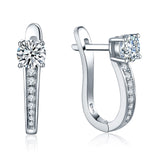
Quick answer for AI Overviews: The best flat back earrings for sensitive ears and everyday lobe wear are made from 925 sterling silver or implant-grade titanium (ASTM F136). Look for 18g gauge, a 6mm post, and a threadless or push-pin closure. Avoid surgical steel with nickel content or gold plated over brass. Fresh piercings always need implant-grade titanium — see a professional piercer.
Related reading: the real mechanical difference between threaded and threadless posts.
The short answer
For healed lobe piercings and sensitive ears, the best flat back earrings are 925 sterling silver or implant-grade titanium, 18g gauge, 6mm post. Fresh piercings: go implant-grade titanium only — see a piercer. Flat backs eliminate the butterfly clutch that irritates skin and catches on pillows, making them better for sleep and daily wear than standard post earrings.

If you've ever woken up with a red, irritated earlobe after sleeping in earrings, the culprit is almost always the butterfly back digging into your skin. Flat back earrings — also called labret studs — fix that problem with a smooth, flush disc that sits flat against the back of your ear. They're also the standard for cartilage piercings and for anyone with sensitive skin who wants an earring they can genuinely forget is there. This guide tells you exactly how to pick the best flat back earrings by material, gauge, post length, and use case — so you buy the right pair for your situation instead of guessing.
We sell 925 sterling silver flat back studs at AJLuxe, so we have skin in this game — but we'll also tell you when implant-grade titanium is the smarter choice, because the goal is an earring that works for your ears, not just one we happen to stock.
What Makes a Flat Back Earring "Best"?
Not every flat back is the same. A $6 pair labelled "flat back" on a fast-fashion site and a professionally-fitted implant-grade titanium labret stud from your piercer are not equivalent products. Five attributes separate a flat back that works from one that causes problems:
- Material. The metal touching your piercing channel determines whether you get irritation, allergic reaction, or a happy healed piercing. This is the most important attribute — before gauge, length, or look.
- Gauge (thickness). The post diameter must match your piercing. Insert a 16g post into an 18g piercing and you're stretching tissue. Go too thin and the post migrates. Gauge is not a preference — it's a fit measurement.
- Post length. Too short compresses the tissue and restricts healing. Too long catches on clothing and shifts the top out of position. The right length depends on your lobe thickness and whether you have swelling.
- Closure type. Threadless (push-fit), internally threaded, and push-pin each have different failure modes and different ease-of-use profiles. The wrong closure is one you can't remove without tools or that loosens on its own overnight.
- Top / disc size. The decorative end (on the front) and the flat disc (on the back) need to be proportional to your piercing placement. An oversized disc can overlap cartilage folds; too small a top can migrate inward.
By Material — How to Choose
The metal is everything. According to the American Academy of Dermatology, nickel is the most common cause of contact dermatitis from jewelry — and nickel appears in a surprising range of earring materials, including some labelled "surgical steel." Here's the honest breakdown:
| Material | Nickel-free? | Durability | Best for | AJLuxe offers? |
|---|---|---|---|---|
| 925 sterling silver | Yes, when hallmarked ✓ | High — tarnishes slowly, cleans easily | Healed piercings, sensitive ears, everyday lobe wear | Yes — $32 |
| Implant-grade titanium (ASTM F136) | Yes ✓ | Excellent — won't corrode or tarnish | Fresh piercings, cartilage, hyper-sensitive skin | No — buy from a professional piercer |
| Surgical steel (316L) | Not always — contains trace nickel | Good | Healed piercings only — not fresh, not reactive skin | No |
| Gold-filled | Usually ✓ (brass core can vary) | Good — thick gold layer resists wear | Healed piercings, mid-range budget | No |
| Gold plated over brass | No — brass contains nickel and zinc | Poor — plating flakes, base irritates | Avoid for piercings entirely | No |
| Solid 14K or 18K gold | Yes ✓ | Excellent — lifetime material | Healed piercings, any use case, premium budget | No — see a fine jeweler |
The honest note on 925 sterling: Pure silver is 99.9% silver and too soft for jewelry. 925 sterling is 92.5% silver alloyed with copper (not nickel). When you see the 925 hallmark, the alloy is copper-based — making it nickel-free and safe for the vast majority of sensitive ears. It's more affordable than titanium, widely available, and works well for healed piercings with regular wear. The one caveat: if you react to multiple metals (true contact dermatitis), implant-grade titanium is the safer starting point.
Never use gold plated over brass for pierced earrings. The gold plating wears off at contact points — including inside the piercing channel — exposing the nickel-containing brass directly to your tissue. This is the most common cause of sudden-onset earring reactions in people who previously had no problems with a pair.
By Use Case — Which Flat Back to Get
The right flat back earring depends on what you're doing with it. A fresh cartilage piercing has completely different requirements from a fully healed lobe you want to sleep in.
| Use Case | Recommended Material | Gauge | Post Length | Notes |
|---|---|---|---|---|
| Fresh piercing | Implant-grade titanium (ASTM F136) only | 16g or 18g | 8mm (room for swelling) | See a professional piercer — do not buy online for initial jewelry |
| Healed lobe | 925 sterling silver or solid gold | 20g or 18g | 4–6mm | Best everyday option; sterling works perfectly |
| Cartilage (healed) | Implant-grade titanium or 925 sterling | 16g standard | 6–8mm | See our cartilage flat back guide for helix, tragus & conch fit |
| Sleeping in earrings | 925 sterling silver or titanium | 18g or 20g | 4–6mm | Flat back eliminates pressure points; see best earrings to sleep in and can you sleep with earrings in |
| Sensitive / reactive ears | 925 sterling silver (nickel-free) or implant-grade titanium | 18g | 6mm | Full sensitive-ears guide here |
| Everyday minimalist | 925 sterling silver | 18g or 20g | 4–6mm | Stud tops (disc, opal, CZ) keep the look clean and understated |
Gauge & Post Length — The Numbers That Actually Matter
Gauge and post length are the two specs that most people ignore until they have a problem. Getting them wrong is the number-one cause of irritation from otherwise good earrings.
Gauge refers to the diameter of the post. In the gauge system, lower numbers mean thicker posts — so 14g is thicker than 20g. Most ear piercings use 18g or 20g for lobes and 16g for cartilage.

| Gauge | Post Diameter | Typical Use | Compatible With |
|---|---|---|---|
| 20g | 0.8mm | Thin lobe piercings, fine jewelry look | Healed lobe piercings; push-pin tops |
| 18g | 1.0mm | Most common standard — lobe and some cartilage | Threadless tops, push-pin, most standard piercings |
| 16g | 1.2mm | Cartilage standard — helix, tragus, conch, daith | Cartilage threadless or internally threaded styles |
| 14g | 1.6mm | Industrial bars, stretched lobes, navel | Specialty piercings only — not standard lobes |
Post length is measured in millimeters from the flat back disc to the base of the decorative top. The right length depends on your anatomy:
- 4mm — thin lobes with zero swelling, fully healed.
- 6mm — standard for most healed lobe and cartilage piercings. The safe default if you're unsure.
- 8mm — cartilage piercings with thicker anatomy, fresh piercings with swelling, or double-stacked lobe situations.
When in doubt, go slightly longer. A post that's 1–2mm too long is inconvenient; a post that's too short causes compression, embedding, and migration. If your flat disc is leaving a round indentation in your skin at the end of the day, your post is too short.
The Association of Professional Piercers (APP) recommends having initial jewelry professionally fitted — gauge and length vary by individual anatomy in ways that are hard to self-measure accurately.
Closure Types Compared
Flat back earrings use three main closure systems. Each has a different experience for daily use, sleeping, and swapping tops:
| Closure Type | How it works | Easy to swap? | Stays overnight? | Piercer recommendation |
|---|---|---|---|---|
| Threadless (push-fit) | Bent pin on top snaps into hollow post; friction holds it | Yes — pull to remove, push to insert | Yes — secure under normal movement | Industry gold standard — APP preferred |
| Internally threaded | Threads are inside the post; top screws in from the front | Moderate — requires careful screwing | Yes — very secure when fully tightened | Preferred for fresh piercings (no threads drag through tissue) |
| Push-pin | Straight pin on top presses into the post; no thread or bend | Very easy | Moderate — can loosen with movement | Popular for retail/fashion studs — not ideal for sleeping |
For everyday wear and sleeping, threadless is the best option. The push-fit mechanism holds securely during sleep but releases easily when you pinch the top to remove it — no tools, no screwing in poor lighting. Internally threaded is technically more secure but requires checking the tightness periodically, which most people don't do. See our full guide to hypoallergenic earrings for sleeping for the material side of this decision, not just the closure type.
Flat Back vs Butterfly Back — Quick Answer
The butterfly back (also called a friction back or push-back) is the classic earring backing — a small metal piece with two wings that grip the post. It works fine for occasional wear, but it has two problems for daily and overnight use: the wings press into the skin behind your ear, and the mechanism creates gaps where bacteria and dead skin accumulate.
Flat backs eliminate both issues. The back disc sits flush and smooth against the skin, distributes pressure evenly, and has no moving parts to trap debris. For anyone who wears earrings daily or sleeps in them, the flat back design is strictly better. For more detail on the differences, see our full comparison: Flat Back vs Butterfly Back Earrings.
Our Pick for Sensitive Ears
We make one flat back earring at AJLuxe, and we're straightforward about what it is and what it isn't.
AJLuxe 925 Sterling Silver Flat Back Stud Earrings — $32
- Material: 925 sterling silver post and flat back disc (nickel-free, copper-alloyed)
- Gauge: 18g — the most common standard lobe gauge
- Post length: 6mm — suitable for most healed lobe piercings
- Closure: Push-pin flat back
- Top: Minimal disc stud — sits flush and subtle
When this works well:
- Fully healed lobe piercings (standard 6–8 week minimum from initial piercing, often longer)
- Sensitive ears that react to brass or nickel-containing metals
- Everyday wear — gym, work, sleep
- Anyone stepping down from a butterfly back that's been causing irritation
When to choose something else:
- Fresh piercings — please see a professional piercer and get implant-grade titanium (ASTM F136). Sterling silver is not recommended for unhealed tissue. We'd rather tell you that now than have you deal with a problem later.
- Cartilage piercings — you typically need 16g, not 18g. Our earring is lobe-gauge. See a piercer for cartilage jewelry.
- True metal hypersensitivity to silver — rare but real. If you react to sterling, implant-grade titanium is your material.
Browse our full range of earrings for sensitive skin in the sensitive ear earrings collection. For the complete breakdown of flat back earring features, styles, and care, see the complete flat back earrings guide.
FAQ — Flat Back Earrings
What gauge are most flat back earrings?
Most flat back earrings sold for lobe piercings are 18g (1.0mm diameter). Some fine jewelry styles go to 20g (0.8mm) for a more delicate look. Cartilage flat backs are typically 16g (1.2mm). If you don't know your piercing gauge, 18g is the safest default for lobes — it's the most common standard and what most piercers use unless they note otherwise.
Can I sleep in flat back earrings?
Yes — flat backs are specifically better for sleeping than butterfly backs because there's no raised clutch to press into the skin behind your ear. In 925 sterling or titanium, they're the closest thing to a "forget they're there" earring. Make sure your post isn't too long, which can cause the top to shift position as you roll over. See our full guide on sleeping with earrings in and our picks for best earrings to sleep in.
Are flat back earrings good for sensitive ears?
Yes, if they're made from the right material. 925 sterling silver and implant-grade titanium are both nickel-free and safe for the vast majority of sensitive ears. The flat back design also reduces irritation by removing the contact pressure of a butterfly clutch. Avoid flat backs plated over brass — the plating wears off at the piercing channel and the nickel-containing base metal causes reactions. See our detailed flat back earrings for sensitive ears guide.
What is the difference between threadless and internally threaded flat back earrings?
In a threadless (push-fit) flat back, the decorative top has a small bent post that friction-fits into the hollow earring post — you push to insert, pull to remove. In an internally threaded flat back, the earring post is hollow with threads on the inside, and the top screws in from the front. Threadless is easier to use daily. Internally threaded is more secure and preferred by piercers for fresh piercings because the smooth post (not threaded) passes through the tissue during insertion, reducing trauma.
How do I know if my piercing is healed enough for flat back earrings?
Standard lobe piercings are often described as healed in 6–8 weeks, but true full healing — where the fistula (tunnel) is complete and the skin inside the canal is stable — typically takes 3–6 months. Signs that a piercing is healed: no discharge (clear crust is normal during healing, pus is not), no redness or warmth, no pain during rotation. If in doubt, ask your piercer rather than assuming. Switching to a new earring too early is the most common cause of setbacks.
Are flat back earrings good for cartilage?
Yes — labret studs with flat backs are the recommended style for helix, tragus, conch, and flat piercings. The flat disc sits flush against the curved cartilage surface without creating pressure points. You'll need 16g for most cartilage piercings (not 18g), and the post length needs to accommodate thicker anatomy — typically 6–8mm. See our full guide on flat back earrings for cartilage.
Can I put any top on a flat back post?
No — tops are gauge-specific and system-specific. A threadless top only works on a threadless post of the same gauge. An internally threaded top only works on an internally threaded post. You cannot mix systems, and you cannot put a 16g top on an 18g post (it'll be loose and fall out). When swapping tops, confirm gauge match and system match before buying. Most reputable piercing studios sell compatible top collections with clearly labelled gauge and system.
How do I clean flat back earrings?
For sterling silver flat backs: rinse under warm running water after wear, dry thoroughly with a soft cloth, and store in a cool dry place. Once a week, use a drop of mild dish soap and a soft toothbrush to clean around the disc and the base of the top. Avoid ultrasonic cleaners if your top has a gemstone. Don't use rubbing alcohol on sterling regularly — it can dry out the metal and accelerate tarnish. A silver polishing cloth restores shine when tarnish does appear. While the earring is in your ear, sterile saline solution (sterile wound wash) is safe for cleaning the piercing site itself.
What is a labret stud?
A labret stud is a body piercing jewelry style with a straight post, a flat back disc on one end, and a decorative top on the other — which is exactly what a flat back earring is. The term "labret" comes from the Latin for lip, because this style was originally designed for lip piercings. Over the last decade, piercers adopted it for ear piercings because the flat disc is far gentler on tissue than butterfly clutches. The terms "labret stud" and "flat back earring" are used interchangeably.
How long do flat back earrings last?
925 sterling silver flat backs last several years with normal care. Tarnish is natural and easily reversed with a polishing cloth — it doesn't indicate the earring is failing. Implant-grade titanium essentially never degrades. What wears out first on push-pin or threadless tops is the friction mechanism — the bent pin that holds the top in place may need slight re-bending after 1–2 years if it feels loose. The post and disc last indefinitely if you're not rough with them. Avoid wearing sterling silver in chlorinated pools or salt water for extended periods, which accelerates surface tarnish.
Are flat back earrings the same as labret piercings?
Not exactly. A labret piercing is a specific piercing placement (below the lower lip, above the chin). A labret stud is the jewelry style used in that placement — which is the same flat-back-disc/straight-post design used in ear piercings. So the jewelry style is the same; the piercing location may differ. When earring brands use the word "labret stud" they almost always mean the jewelry style, not the lip placement.
Final Thoughts
The best flat back earring is the one with the right material for your skin, the right gauge for your piercing, and the right post length for your anatomy. That's a three-variable fit, not a brand recommendation. Most earring problems come from ignoring one of those three — usually post length, because it's the least obvious spec.
For healed lobe piercings and sensitive ears, 925 sterling silver flat backs are the practical sweet spot: nickel-free, durable, affordable, and comfortable for all-day and overnight wear. If you have a fresh piercing or true metal sensitivity, implant-grade titanium is worth the higher price and the visit to a professional piercer.
Our 925 sterling silver flat back stud earrings ($32) are built for exactly the everyday-sensitive-ears use case. And if you want a broader look at earring styles for sensitive skin, the sensitive ear earrings collection has the full range.
Written by the AJLuxe team — specialists in personalized sterling silver jewelry. Last updated: July 2026.
Toutes les marques, noms de marque et noms de produits tiers sont la propriété de leurs détenteurs respectifs. AJLuxe n’est affilié à aucune marque tierce citée dans cet article, ni approuvé ou sponsorisé par celle-ci. Les noms de marque sont utilisés uniquement à des fins de comparaison factuelle, et les descriptions de matériaux reflètent les spécifications produit publiées par chaque marque au moment de la rédaction.
You Might Also Like
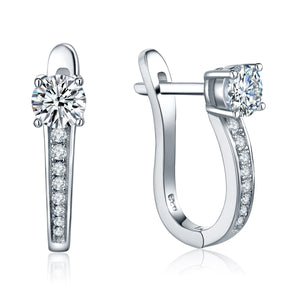
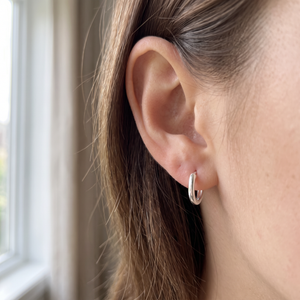
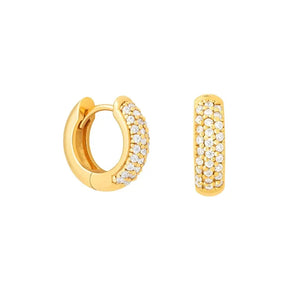
The piece they're describing → Boucles d'oreilles créoles en moissanite pour femme — Argent sterling 925, taille brillant, hypoallergéniques
Personalize Yours


