


Last updated: June 2026
Choosing between a moissanite vs diamond necklace comes down to three things: how it looks, how much you want to spend, and what you want it to mean. Both stones are durable enough for daily wear, both catch light in a necklace setting, and both look genuinely beautiful — but they're not the same. This guide breaks down the real differences so you can shop with confidence.

Moissanite vs diamond necklace: Moissanite is a lab-created gemstone with a higher refractive index than diamond (2.65 vs 2.42), producing more colorful sparkle at roughly 10% of the cost. Diamonds score 10 on the Mohs hardness scale versus moissanite's 9.25, making both excellent for everyday necklace wear. For budget-conscious shoppers, moissanite delivers better visible fire; for investment or tradition, diamonds hold long-term value.
Moissanite vs Diamond Necklace: Key Differences at a Glance
| Property | Moissanite | Diamond |
|---|---|---|
| Appearance | Rainbow-hued fire, high brilliance | Classic white sparkle, timeless clarity |
| Price Range | $100–$600 per carat | $1,500–$15,000+ per carat |
| Hardness / Durability | 9.25 Mohs — excellent | 10 Mohs — hardest natural mineral |
| Lifespan | Lifetime with basic care | Lifetime, passes down generations |
| Best For | Budget-smart shoppers, maximalists | Investment, tradition, heirlooms |
| Sparkle / Effect | High fire, colorful dispersion | Bright white brilliance, less color play |
| Origin | Lab-created (rare in nature) | Mined or lab-grown |
| Care Requirements | Mild soap and water, avoid harsh chemicals | Professional cleaning recommended yearly |
| Overall Value | Exceptional value per dollar | Strong resale and cultural value |
Shop Our Diamond-Look Zircon Necklaces — Shop Our Crystal Diamond Pendant Necklace → →
What Is Moissanite?
Moissanite was first discovered in 1893 by Nobel Prize-winning chemist Henri Moissan inside a meteor crater in Arizona. Natural moissanite is so rare it's practically nonexistent in jewelry — every moissanite gemstone you'll find in a necklace today is lab-created silicon carbide.
That lab origin is a feature, not a flaw. It means each stone has consistent quality, zero mining impact, and a lower price tag than natural gems. The key number to know is moissanite's refractive index of 2.65 to 2.69, which beats diamond's 2.42. That higher index is why moissanite throws so much colorful fire — especially in bright sunlight or under indoor lighting.
On the Mohs hardness scale, moissanite scores 9.25, which puts it second only to diamond among commonly used gemstones. That means a moissanite necklace pendant resists scratching from everyday items — keys, countertops, other jewelry — far better than sapphire, emerald, or any other popular alternative.
Moissanite comes in nearly colorless (DEF range) and near-colorless (GHI range) grades, just like diamond color grading. High-quality moissanite sold today is almost entirely in the near-colorless to colorless range, making it hard to distinguish from a diamond without specialized equipment.
For a deeper look at how gemstone grading works, the GIA Gem Encyclopedia is the most reliable reference.
What Is a Diamond?
Diamond is pure carbon compressed under extreme heat and pressure over billions of years in the earth's mantle. It's the hardest natural substance on earth — a perfect 10 on the Mohs scale — and it's the benchmark every other gemstone gets compared to.
The four Cs (cut, color, clarity, carat) determine a diamond's price and quality. A well-cut diamond reflects light from its table and facets in a way that produces intense white brilliance. That brightness is different from moissanite's rainbow fire — diamonds tend to throw more white flashes, while moissanite throws more colored ones.
Lab-grown diamonds have changed the market significantly. Lab diamonds are chemically identical to mined diamonds but cost 50–80% less, making them an increasingly popular option. If you want a true diamond necklace but find natural diamond prices out of reach, lab-grown is worth considering.
Diamonds also carry significant cultural weight. They're the traditional symbol for engagement, anniversaries, and milestone gifts. For some buyers, that meaning matters as much as the stone's physical properties. According to the Jewelers of America buying guide, diamonds remain the most gifted fine gemstone in the United States.
Natural diamonds do hold resale value better than moissanite, though resale prices are typically well below retail for both. If you're thinking about resale, a diamond's long-term value is worth factoring into your decision.
Moissanite vs Diamond: Which Looks Better in Jewelry?
In a necklace setting, both stones look exceptional — but they look different. A moissanite pendant throws more colorful flashes, particularly in sunlight or under bright artificial lighting. If you want a necklace that draws eyes across the room with rainbow sparkle, moissanite delivers that effect.
A diamond pendant produces a crisper, whiter light return. In low light, diamonds can appear slightly more subtle than moissanite — that fire dispersion effect is less pronounced. Many buyers who prefer diamond necklaces describe the look as "cleaner" or "more classic."
Stone size matters more than type when it comes to necklaces. A 1-carat pendant in either moissanite or diamond is visible and attractive; a 2-carat pendant in either stone is genuinely impressive. Because moissanite costs so much less per carat, you can often size up significantly for the same budget.
Setting metal also plays a role. White gold and platinum let both stones appear icy and bright. Yellow gold warms them up and can give moissanite's color fire a slightly more pronounced look. Rose gold is popular with both stones for a modern, fashion-forward necklace. If you're shopping for necklace styles by metal type, that guide covers pairing tips in more detail.
Price Comparison: Moissanite vs Diamond
Price is where these two stones diverge most sharply. A 1-carat round brilliant moissanite necklace pendant typically costs $300–$700 depending on quality and setting. A comparable 1-carat diamond pendant — same shape, similar cut quality — runs $3,000–$8,000 for a natural stone, or $800–$2,000 for a lab-grown diamond.
According to industry data from the Rapaport Diamond Report, natural diamond prices rose roughly 40% between 2020 and 2022, then corrected downward through 2024 as lab-grown supply expanded. Lab-grown diamonds have pushed prices down significantly, but moissanite still undercuts both by a wide margin.
At the same $500 budget, you could buy a 1-carat moissanite necklace with a quality gold setting, or a very small (under 0.3 carat) natural diamond in a basic setting. The visual difference at 1 carat vs 0.3 carat is obvious. That size-per-dollar advantage makes moissanite hard to beat for buyers who want a statement necklace without a luxury price tag.
One thing moissanite doesn't offer: meaningful resale value. Diamonds — especially natural ones with GIA certification — can be resold, traded, or upgraded through jewelry programs. Moissanite has essentially no resale market. If you plan to keep the necklace forever, this doesn't matter. If you might trade it in for something different later, factor that in.
Durability and Everyday Wearability
Both moissanite and diamond are well-suited for necklace wear, which is lower-impact than ring wear. Necklaces don't take the daily contact knocks that rings do, so even stones lower on the hardness scale would hold up fine. That said, both stones rate extremely high and resist scratching from virtually everything you'll encounter daily.
Moissanite at 9.25 Mohs won't scratch from routine contact. It won't cloud or change color over time — a concern sometimes raised, usually about lower-quality moissanite from earlier years. Modern moissanite, particularly from reputable brands, maintains its optical properties permanently.
Diamond at 10 Mohs is the hardest, but harder doesn't mean unbreakable. Diamonds can chip or cleave along certain crystal planes if struck at the right angle. In a pendant setting worn around the neck, this risk is very low compared to a ring.
Care tips for both: clean with warm water, mild dish soap, and a soft brush. Ultrasonic cleaners are safe for both stones but can loosen prongs over time — use them occasionally, not weekly. Store each piece separately to avoid stone-on-metal scratching, and remove necklaces before swimming in chlorinated pools, which can damage gold settings (not the stones).
Frequently Asked Questions
Can you tell the difference between moissanite and diamond in a necklace?
Most people can't tell the difference at a glance, especially in a necklace setting where the stone isn't being inspected closely. Trained jewelers can distinguish them with a loupe or a diamond tester — moissanite registers differently on electrical conductivity testers. In everyday social settings, the two stones look nearly identical to an untrained eye, and moissanite's extra fire often makes it appear more impressive, not less.
Is moissanite a fake diamond?
No — moissanite is its own gemstone with distinct chemical and optical properties. It's silicon carbide, not carbon, so it's chemically different from diamond. Calling it a fake diamond is like calling sapphire a fake diamond. Moissanite is a real gemstone sold honestly under its own name. The confusion usually comes from people marketing cubic zirconia or glass as diamond alternatives, which is a different product category entirely.
Does moissanite hold its value over time?
Moissanite doesn't hold resale value the way a natural diamond can. If you sell a moissanite necklace on the secondary market, you'll likely get a fraction of what you paid. Diamonds — particularly natural stones with GIA certification — have an established resale market, though resale prices are still typically 30–50% below retail. If investment value matters to you, a certified natural diamond is the better choice.
Which is more ethical — moissanite or diamond?
Moissanite is entirely lab-created, so it has zero mining impact. Lab-grown diamonds share the same benefit. Natural diamonds carry environmental and social concerns related to mining, though the Kimberley Process certification scheme tracks diamonds to reduce conflict stone issues. If ethical sourcing is your priority, both moissanite and lab-grown diamond are strong options — moissanite simply costs less for the same ethical benefit.
What carat size moissanite looks like a 1-carat diamond?
Moissanite and diamond are measured by millimeter diameter rather than matched by carat weight, because moissanite is slightly lighter than diamond. A 6.5mm round moissanite looks visually identical to a 1-carat (6.5mm) round diamond. Most moissanite sellers list stones by millimeter diameter specifically to avoid this confusion. When comparing sizes, always check millimeter measurements rather than carat weight alone.
Will moissanite turn yellow or cloudy over time?
Quality moissanite won't yellow or cloud with normal wear. Early moissanite from the 1990s and early 2000s occasionally showed a slight greenish or yellowish tint under certain lighting — that was a manufacturing issue specific to that era. Modern moissanite, particularly near-colorless and colorless grades, maintains its optical properties permanently. Cleaning removes surface oils and residue that can temporarily dull any gemstone's appearance.
Is a moissanite necklace a good gift?
Yes — moissanite necklaces make excellent gifts, particularly when you want to give something with genuine sparkle at a reasonable budget. The stone's durability means it'll last a lifetime. The main thing to consider is whether the recipient prioritizes the cultural meaning of diamond specifically. For most gift occasions other than an engagement or major anniversary with traditional expectations, moissanite is a smart, beautiful choice.
How does moissanite compare to cubic zirconia?
Moissanite and cubic zirconia (CZ) are very different. CZ scores about 8–8.5 on the Mohs scale and scratches and clouds over time — typically within 1–3 years of regular wear. Moissanite scores 9.25 and maintains its optical properties permanently. Moissanite also has a higher refractive index than CZ, producing more convincing sparkle. The price difference reflects this: moissanite costs significantly more than CZ but also outlasts it by decades.
Can you wear a moissanite necklace every day?
Absolutely. Moissanite's 9.25 Mohs hardness makes it one of the most durable gemstones available for daily wear. The main risks aren't from the stone itself — they're from the setting. Gold prongs can wear thin over years of daily wear, and settings benefit from professional inspection every 1–2 years to ensure the stone is secure. Otherwise, a moissanite necklace requires the same basic care as any fine jewelry.
Which should I choose for a diamond-look necklace on a budget?
Moissanite gives you the closest look to a diamond for the least money — significantly closer than CZ or crystal options. If your budget is under $500 and you want a necklace with genuine, lasting sparkle, moissanite is the practical pick. At higher budgets ($1,000+), lab-grown diamond becomes competitive and gives you the actual chemical composition of diamond. For everyday fashion jewelry at accessible prices, high-quality zircon-set necklaces like those at AJLuxe are also a sharp-looking option worth considering.
Final Thoughts
A moissanite necklace and a diamond necklace both deliver genuine beauty and lasting durability. The real question is what you're optimizing for. If it's maximum sparkle per dollar, moissanite is the clear winner — you can get a significantly larger, more eye-catching stone for the same money. If it's cultural tradition, resale potential, or the specific meaning attached to natural diamonds, a diamond necklace earns its premium.
For most people shopping for an everyday necklace or a gift with serious visual impact, moissanite makes more sense. But if you're not ready to commit to a fine-gemstone pendant just yet, our diamond-look zircon necklaces at AJLuxe deliver that brilliant, polished look at an even more accessible price point — Shop Our Diamond-Look Zircon Necklaces →
All third-party trademarks, brand names and product names are the property of their respective owners. AJLuxe is not affiliated with, endorsed by, sponsored by, or otherwise connected to any third-party brand referenced in this article. Brand names are used solely for accurate comparative reference, and material descriptions reflect each brand's own published product specifications at the time of writing.
You Might Also Like
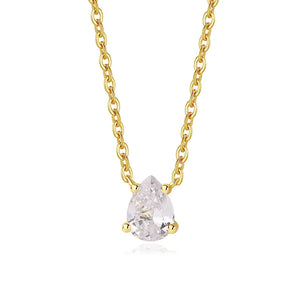
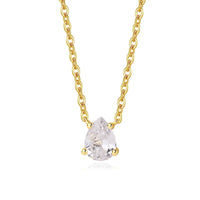
The piece they're describing → Crystal Teardrop Pendant Necklace for Women — CZ Diamond Drop, 925 Sterling Silver
Personalize Yours


