


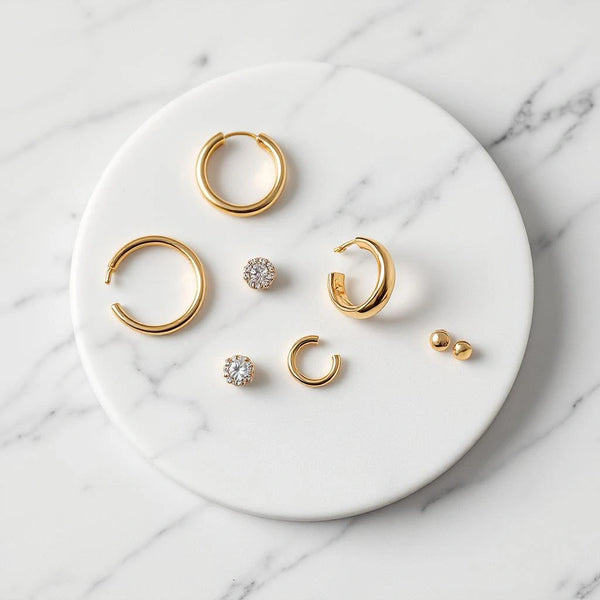
The curated ear has changed how people approach earrings. Instead of buying pairs and wearing them symmetrically, you build a collection — one piece at a time — until your ears tell a story. The result is more interesting than any single earring can be on its own, and more personal than any matching set.
Our earrings at AJLuxe use sterling silver posts throughout — hypoallergenic and comfortable for all-day wear, even for sensitive ears.
This guide covers everything about building a curated ear: what it is, the 2:3 rule that makes asymmetry work, which earrings go where, how to choose placements, and four ready-to-use aesthetic blueprints from minimalist to maximalist.
What Is a Curated Ear?
A curated ear is a collection of multiple piercings on one or both ears, styled intentionally to create a layered, personalized look. The word "curated" is key — these aren't random piercings, and they're not matching pairs. Each piece is chosen for its visual relationship to the others.
A curated ear might have three lobe piercings graduating from a hoop to two small studs, plus a helix ear cuff and a conch stud. Or it might be as simple as a medium hoop in the first lobe and a tiny star stud in a second piercing. What makes it "curated" is the intention behind the choices — not the number of piercings.
The curated ear approach became mainstream around 2018–2020 and has continued to grow. In 2026, it's one of the dominant personal jewelry aesthetics — pushed by social media's visibility of ear styling and the rise of non-piercing options like ear cuffs that let people experiment without permanent commitment.
The 2:3 Rule Explained
The 2:3 rule (also called the 3:2 rule) is the most important principle in curated ear styling. It means: wear more earrings on one ear than the other.
Instead of matching three earrings on each side symmetrically, you put three on your right ear and two on your left. Or four on the right and two on the left. The ratio creates visual asymmetry — and asymmetry is what makes the look editorial rather than ordinary.
Why does it work? Matching sets signal "this came as a pair." Asymmetry signals "I chose each of these individually." The deliberate imbalance communicates intentionality better than symmetry does.
Practical application of the 2:3 rule:
- 2:1 — Two earrings on one ear, one on the other. The cleanest, most minimal version. One lobe hoop + one cartilage piece vs. one single stud.
- 3:2 — Three earrings on one ear, two on the other. The most common curated ear ratio. Often: lobe hoop + second lobe stud + helix cuff vs. lobe hoop + second lobe stud.
- 4:2 — Four on one ear, two on the other. More elaborate. Three lobe piercings + a helix vs. two lobe piercings.
- 5:3 — A fully developed curation. Three lobes + helix + tragus or conch on one side vs. three lobes on the other.
The "heavier" ear is typically your dominant side or whichever ear is most visible in photos. There's no rule — just make the choice deliberately.
Piercing Placements: Your Building Blocks
Understanding the anatomy of the ear and what each placement offers helps you plan which piercings to get and which earring types work where.
| Placement | Location | Best Earring Types | Size Guide |
|---|---|---|---|
| First lobe | Lower earlobe | Hoops, huggies, large studs, drop earrings | 14–30mm hoops; 10–12mm huggies |
| Second lobe | Upper earlobe | Small hoops, small studs, charm drops | 8–14mm hoops; simple studs |
| Third lobe | Near cartilage edge of lobe | Tiny studs, 6–10mm huggies | Go smallest here; keep the stack gradual |
| Helix | Outer upper cartilage | Small hoops, flat studs, ear cuffs (no piercing) | 8–12mm hoops; cartilage huggies |
| Forward helix | Front upper cartilage fold | Tiny flat studs, small huggies | Very small; 6–8mm; sits against the head |
| Tragus | Small cartilage tab in front of ear canal | Flat studs, tiny huggies | 6–8mm; goes almost unnoticed from a distance |
| Conch | Inner bowl of the ear | Studs, flat discs, small huggies | Becomes a focal point from the front |
| Daith | Innermost cartilage fold | Huggies, small segment rings, heart-shaped hoops | 8–10mm; tucked inside the ear — intimate and surprising |
No new piercings needed? You can simulate several of these placements without piercing. An ear cuff on the helix, a clip-on conch piece, and a non-piercing ear crawler that travels up the outer ear all create the curated look without commitment. Read our full guide on how to wear ear cuffs for placement details and how to keep them on all day.
What Earrings Go Where
The curated ear works visually when earring size graduates as you move up the ear. Think of it like layering necklaces — the longest goes first, the shortest last. On the ear: the boldest piece at the lobe, the smallest at the top.
First lobe (your anchor piece): This is the most visible placement and should hold your most interesting earring. A medium hoop (16–25mm), a chunky stud, or a pair of huggies. This piece sets the tone for the whole ear.
Second lobe (your transition piece): Smaller than the first. A 10–14mm hoop, a small pavé stud, or a delicate charm. It bridges the statement at the lobe and the minimal at the top.
Third lobe or first cartilage placement (your accent): The smallest and most delicate piece. A 6–8mm huggie, a tiny flat stud, an ear cuff on the helix. This is the finishing detail — like the punctuation at the end of a sentence.
For a detailed breakdown of every earring type and which placements they fit, read our complete types of earrings guide. For hoop-specific sizing by placement (first lobe, helix, tragus, daith), read our hoop earring size guide. If your stack needs sensitive-ear-safe small hoops, use our hypoallergenic huggie earrings guide before buying.
Metal and Style: The Two Rules That Make It Work
Rule 1: Stay in one metal family. The fastest way to make a curated ear look accidental rather than intentional is to mix gold and silver randomly. Pick your metal: yellow gold, white gold, rose gold, or silver. Then stay in it. Once you've established your metal, you can introduce subtle variations in finish (matte vs. polished, brushed vs. hammered) without breaking visual cohesion.
Rule 2: Vary the texture, not the color. Within your chosen metal, introduce variation through earring type, finish, and scale — not by changing the color. A polished gold hoop + a hammered gold stud + a beaded gold cartilage ring all read as "collected gold pieces" even though they're completely different. That's the curated feeling.
If you genuinely want to mix metals, make it clearly intentional: all gold except one deliberate silver piece, or a rose gold hoop contrasted with two yellow gold studs. The contrast must be readable as a choice.
Four Curated Ear Blueprints
These are ready-to-use starting points. Adapt them to your piercings and pieces.
The Minimalist Stack — 2:1 ratio, gold
- Right ear: 18mm thin gold hoop (first lobe) + 8mm gold huggie (second lobe or helix)
- Left ear: single thin gold stud
- Effect: clean, modern, intentionally spare
The Classic 3:2 — most popular beginner curation
- Right ear: 20mm gold hoop (first lobe) + small pavé stud (second lobe) + helix ear cuff or 10mm huggie (cartilage)
- Left ear: 20mm gold hoop (first lobe) + small pavé stud (second lobe)
- Effect: editorial without being high-maintenance. Works with any outfit.
The Edgy Mix — 4:2 ratio, mixed textures
- Right ear: 25mm hammered gold hoop (first lobe) + 12mm huggie (second lobe) + ear cuff on helix + flat stud on tragus or conch
- Left ear: 20mm hoop (first lobe) + tiny stud (second lobe)
- Effect: bold, architectural, fashion-forward
The No-Piercing Curation — for single-piercing ears
- Right ear: medium hoop or statement stud (first lobe) + tension ear cuff on helix + ear crawler along the outer cartilage
- Left ear: minimal stud or small hoop only
- Effect: full curated look, zero new piercings. Ear cuff and crawler do all the work.
How to Build Your Curated Ear Over Time
The best curated ears aren't designed all at once — they're built piece by piece. New piercings take 6–12 months to heal before you can freely swap earrings, so building gradually is both practical and aesthetically sound. A rushed curation often results in pieces that don't work together.
Starting point: If you have one first lobe piercing on each ear, start with two decisions. First, add a second lobe piercing on one ear (or add an ear cuff to mimic one). Second, choose your metal. Those two steps establish the foundation.
After that: Add pieces one at a time. A new earring should either replace something you already own (upgrade your first lobe hoop) or add a new placement (add a helix ear cuff). Avoid accumulating pieces that don't have a clear spot in your current stack — you'll end up with a drawer of earrings you never wear.
The 10-piece foundation: Most fully developed curated ears rest on about 10 earrings total — 5–6 pieces for the "heavy" ear and 3–4 for the "light" one. This gives you daily variety and the ability to rotate pieces without rebuilding from scratch.
Related reading: 7 Ring Stacking Combos That Actually Work (2026).
Frequently Asked Questions
How to properly curate an ear?
Start with your placements (2–3 lobe piercings plus 1–2 cartilage placements is the common foundation), then apply the 2:3 rule (more on one ear than the other), then choose earrings that graduate in size from largest at the lobe to smallest at the top. Keep everything in one metal family. The goal is a look that feels collected and personal — not matchy or random.
What is the 2:3 earring rule?
The 2:3 rule means wearing more earrings on one ear than the other — 3 on the right and 2 on the left, for example. This intentional asymmetry creates an editorial, curated feel that signals each piece was individually chosen. Common ratios are 2:1, 3:2, and 4:2. The heavier ear is typically your dominant side or the ear most visible in your usual profile.
What is a curated ear?
A curated ear is a collection of multiple ear piercings styled to work together as a cohesive, intentional composition. It mixes different earring types (studs, hoops, huggies, cuffs) across multiple placements, stays within one metal family, and uses the 2:3 asymmetry rule to create visual interest. The defining quality is intention — each piece is chosen for its relationship to the others.
How many ear piercings make a curated ear?
Most curated ears use 3–6 piercings total across both ears. The minimum is two (one per ear) if styled intentionally. You don't need many piercings to create a curated look — ear cuffs and crawlers can simulate multiple placements without piercing. The curation is about the intention and composition, not the count.
Do all earrings in a curated ear need to match?
No — matching sets actually undermine the curated aesthetic. The goal is coordination without uniformity. Keep all pieces in the same metal but let them differ in type, size, texture, and style. A 20mm hoop, a tiny pavé stud, and a helix cuff can all be gold without being identical — that contrast is exactly what makes the look work.
Can you build a curated ear without new piercings?
Yes. Ear cuffs (tension-grip helix cuffs), clip-on conch pieces, and ear crawlers all create the multi-placement look without any piercing required. If you have a first lobe piercing on each ear plus a few non-piercing cuff pieces, you can create a fully layered curated ear today. Read our guide on how to wear ear cuffs for specifics on placement and keeping them on.
What earrings to wear where in a curated ear?
First lobe: your boldest, largest piece — a medium hoop (16–25mm) or statement stud. Second lobe: smaller — a 10–14mm hoop or small stud. Third lobe or first cartilage placement: smallest and most delicate — a 6–8mm huggie or tiny flat stud. The graduation from largest to smallest as you move up the ear is what creates the polished, layered look.
What's the easiest curated ear look for beginners?
The 3:1 look: three earrings on your dominant ear and one clean stud or hoop on the other. For the three-earring side: a medium hoop in the first lobe, a second-lobe stud or ear cuff on the helix, and one more small stud or cuff. Keep everything the same metal. This is immediately recognizable as a curated look and requires only one first lobe piercing on each ear (the rest can be faked with cuffs).
For the complete earring reference — types, sizing, curated ear, face shape guide, and sensitive skin — read The Complete Earring Guide.
Sensitive-ear shopping path
Curated ears need comfortable metals first
A beautiful ear stack fails if one piercing gets irritated. Keep the metals consistent and choose low-friction everyday pieces.
- Shop hypoallergenic jewelry — a safer base for multi-piercing stacks
- Shop huggie earrings — anchors for curated ear stacks
- Sensitive-ear earring guide — avoid irritation while building your stack
Final Thoughts: Build It Your Way
The curated ear has no rules beyond one: make it intentional. That's what separates a collection from a random assortment. Same metal, graduating sizes, 2:3 asymmetry — these are starting principles, not laws. Once you understand why they work, you'll know when to break them.
Build slowly. Each piece should earn its spot. And start with the earring types you reach for most — for most people, that's a clean hoop and a simple stud. Go from there.
Browse our full range of earrings for building your curated ear — all 925 sterling silver with hypoallergenic finishes, available in the most common hoop sizes and styles for multi-piercing looks.
Written by Vaishakhi Ajmera — founder and jewelry specialist at AJLuxe. Last updated: May 2026.
Before building your curated ear, explore our types of ear piercings guide — we cover all 15 placements with pain levels, healing times, and the best jewelry for each.
Want a statement piece with real edge for your stack? Our safety pin earrings guide covers the style's punk-rooted meaning, how it's actually worn, and real market prices.
All third-party trademarks, brand names and product names are the property of their respective owners. AJLuxe is not affiliated with, endorsed by, sponsored by, or otherwise connected to any third-party brand referenced in this article. Brand names are used solely for accurate comparative reference, and material descriptions reflect each brand's own published product specifications at the time of writing.
You Might Also Like
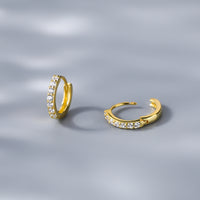
The piece they're describing → Micro Pave Huggie Hoop Earrings for Women — 925 Sterling Silver, 18K Gold Plated, CZ
Personalize Yours


