


- Hardness: 6–6.5 Mohs. Softer than quartz. It will scuff against a desk edge or a car key over time.
- The real risk is chipping, not scratching: moonstone is a feldspar with perfect cleavage, so impact matters more than abrasion.
- Setting beats stone quality for a bracelet: a bezel wraps metal around the whole girdle of the stone. Prongs leave the edges exposed — the exact place a bracelet gets hit.
- Meaning: intuition, new beginnings, emotional balance and the moon — and on the wrist specifically, it is worn as a “visible reminder” piece rather than a hidden one.
- Water: keep it brief. Moonstone is more water-sensitive than quartz, and soaking is the single most common way people damage one.
- “Rainbow moonstone” is a trade name, not a separate gem grade — and it is gemologically closer to labradorite than to classic moonstone.
A moonstone bracelet is the hardest-working piece of moonstone jewelry you can buy, and the one most likely to be bought badly. A moonstone pendant hangs still against your chest. A moonstone ring at least sits on a finger you can watch. A bracelet spends its day sliding against desks, door frames, steering wheels, laptop edges and shopping bags — and it is doing that while set with a stone softer than the glass in your phone screen.
That is not a reason to avoid one. It is a reason to buy a specific kind of one. This guide covers what moonstone actually is, what a moonstone bracelet is understood to mean, and — the part most guides skip — the practical engineering that separates a bracelet you wear for years from one that chips in a month.
What is moonstone, really?
Moonstone is a feldspar mineral prized for adularescence — the soft, billowy glow that appears to float just beneath the surface and shifts as you move the stone. That glow is not an inclusion or a coating. It is light scattering off microscopically thin alternating layers of two feldspars that separated as the stone cooled, and it is the entire reason moonstone has been valued for centuries.
Two consequences follow from moonstone being a feldspar, and both matter for a bracelet:
- It is moderately soft. The Mohs scale puts moonstone at 6 to 6.5. For comparison, everyday dust and grit contains quartz at 7, which is why moonstone slowly loses polish even without any dramatic accident.
- It has perfect cleavage in two directions. Cleavage is a mineral's tendency to split cleanly along internal planes. It is independent of hardness, and it means a moonstone can survive years of gentle rubbing and then chip from one firm knock against a doorframe.
Most buying advice only ever mentions hardness. For a bracelet, cleavage is the more important number, because bracelets get hit rather than rubbed.
Rainbow moonstone vs classic moonstone
“Rainbow moonstone” describes moonstone with a blue-to-multicolour flash rather than the milky white-blue sheen of classic moonstone — but gemologically, most material sold as rainbow moonstone is white labradorite, a different feldspar in the same family. It is not a fake and it is not a lower grade; it is a trade name that has become standard in the jewelry industry.
For a bracelet the practical differences are small: labradorite sits at roughly 6 to 6.5 Mohs as well, and has similar cleavage. Choose between them on looks. Classic moonstone reads soft, pale and vintage. Rainbow moonstone reads brighter and more iridescent, and it holds its flash better under indoor lighting — which is a genuine advantage for a piece worn at a desk rather than in daylight.
We go deeper on this in rainbow moonstone meaning and compare the two stones side by side in moonstone vs labradorite.
What does a moonstone bracelet mean?
Moonstone is associated with intuition, new beginnings, emotional balance and the cycles of the moon — and a bracelet carries that meaning differently from a necklace because you can see it yourself. A pendant is worn for others to notice; a bracelet sits in your own field of view all day, which is why moonstone bracelets are so often bought as intention or transition pieces rather than as pure decoration.
The most common reasons people give for buying one:
- A new chapter — a new job, a move, a birth, the end of something. Moonstone's association with new beginnings is its oldest and most consistent one.
- Emotional steadiness — worn as a visible cue during a period that feels turbulent.
- A June birthday — moonstone is one of June's birthstones, alongside pearl and alexandrite.
- Simply the light — adularescence genuinely does not photograph well, and a lot of people buy moonstone after seeing one move in person.
To be clear about what this is and is not: these are cultural and historical associations, not medical claims. No gemstone treats a condition. If you want the full symbolic history, see moonstone meaning.
Which wrist should you wear a moonstone bracelet on?
There is no gemological answer here, only a traditional one: in most crystal-wearing traditions the left wrist is the “receiving” side and the right is the “giving” side, so moonstone — an intuition and calm stone — is usually worn on the left. The practical argument points the same way for most people: wear it on your non-dominant wrist and it takes noticeably fewer knocks.
The part that actually decides durability: the setting
For a stone at 6 to 6.5 Mohs with perfect cleavage, the setting protects the stone more than the stone protects itself. This is the single most useful thing to understand before buying.
| Setting | What it does to a soft stone | Verdict for a bracelet |
|---|---|---|
| Bezel | A continuous rim of metal wraps the entire girdle of the stone, so the edges — where cleavage planes reach the surface — are never exposed. | Best. The right choice for moonstone on a wrist. |
| Prong / claw | Three to six small metal claws hold the stone, leaving most of its edge exposed and slightly raised above the band. | Poor. Raised and exposed is the worst combination on a bracelet. |
| Channel | Stones sit in a groove between two metal walls, protected on two sides but open at the top. | Acceptable. Better than prongs, worse than bezel. |
| Beaded / strung | Drilled round beads on elastic or cord. No metal protection at all, but also nothing raised to catch. | Fine for casual wear; the failure mode is the cord, not the stone. |
If you take one thing from this guide: for a moonstone bracelet, bezel-set is not a style preference, it is a durability decision. It is also why bezel settings dominate in bracelets set with softer coloured stones generally, while prongs dominate in diamond pieces — diamond at 10 Mohs simply does not need the protection.
Choosing the band: metal, length and clasp
Metal. A bracelet band takes constant abrasion, so hardness matters here too. Stainless steel is roughly twice as hard as sterling silver, does not tarnish, and has no plating to wear through at the clasp — the first place any bracelet fails. Sterling silver is softer and will need polishing, but can be repaired and resized by a jeweller in a way steel cannot. Gold-plated brass is the weakest option for a bracelet specifically, because the friction points wear through fastest.
Length. Measure your wrist snugly with a strip of paper and add about half an inch for a comfortable fit. Most women's bracelets land between 6.5 and 7.5 inches; anything at 8 inches or above is a relaxed or larger-wrist fit and will move more against surfaces — which, with a soft stone, means more contact. If you are between sizes, size down. See our small wrist bracelet sizing guide if you're at the lower end.
Clasp. A lobster clasp is the practical default: it is spring-loaded, it does not open under load, and it can be worked one-handed with practice. Whatever the clasp, check for a safety chain or a figure-8 catch on anything you would be upset to lose — a dropped bracelet is how most set stones actually get chipped.
Care: the three things that actually damage moonstone
Moonstone does not need elaborate care, but it does need you to avoid three specific things.
- Soaking. Brief contact with water is fine; prolonged immersion is not. Moonstone is more water-sensitive than quartz, and repeated soaking can dull the adularescence and creep into any tiny surface fissure. Never leave one in a glass of water overnight. We cover this in full in can moonstone go in water.
- Ultrasonic and steam cleaners. Both are actively dangerous for a stone with perfect cleavage — the vibration can propagate an existing internal flaw straight into a crack. GIA's own care guidance for moonstone is warm soapy water and a soft cloth, nothing more.
- Chemicals and impact. Take it off for cleaning products, chlorinated pools, perfume and hairspray. And take it off for anything where your wrist meets a hard surface repeatedly: weights, gardening, cycling, DIY.
How to clean it: lukewarm water, a drop of mild soap, a soft toothbrush around the bezel edge where skin oil collects, then dry fully with a soft cloth before putting it away. Store it separately from harder pieces — a moonstone bracelet tossed in a box with steel chains and CZ rings will be scratched by them, not the other way around.
How do you cleanse a moonstone bracelet?
If you mean energetic cleansing rather than physical cleaning, use a dry method: moonlight on a windowsill overnight is the traditional choice and is the only one with no risk to the stone. Avoid the two popular methods that will actually damage it — salt water (abrasive and corrosive to both stone and metal) and long water soaks. Selenite, sound, or simply moonlight are all safe.
Is a moonstone bracelet right for you?
Buy one if you want a piece with visible movement and meaning, and you are willing to treat it as jewelry rather than as a watch you never take off. It suits desk work, evenings and everyday wear with ordinary care.
Choose something else if you need a genuinely wear-it-and-forget-it bracelet — if you swim daily, lift, work with your hands, or know you will not take it off. In that case a stone-free steel chain bracelet, or a CZ piece at 8–8.5 Mohs, is the more honest recommendation. Our tennis bracelet buying guide covers the harder-stone options, and best crystal bracelets covers beaded alternatives by intention.
Styling and stacking
Moonstone's pale, shifting glow reads as a neutral, which makes it unusually easy to stack. Two rules that matter more than the rest:
- Put the softest piece on the outside of the stack — nearest your hand, not sandwiched between two harder bracelets that will grind against it.
- Match the metal temperature, not the metal. Moonstone's blue flash sits comfortably with cool-toned silver and steel; against warm yellow gold it reads more deliberately vintage. Both work, but pick one and commit across the stack.
For a full method, see how to stack bracelets.
Keep Reading
- Rainbow Moonstone Meaning: Symbolism, Healing Properties & How to Spot the Real Thing
- Moonstone Meaning: Symbolism, Healing Properties & June Birthstone Guide
- Can Moonstone Go in Water? Safe Cleansing Guide
- Moonstone vs Labradorite: What's the Difference?
- Moonstone vs Opal
- Best Tennis Bracelets 2026: Diamond, CZ & Moissanite Buying Guide
- How to Stack Bracelets
Shop This Guide
A bezel-set moonstone bracelet on a steel band — the two decisions this guide argues for. AJLuxe's Rainbow Moonstone Tennis Bracelet sets round rainbow moonstone cabochons in individual bezels along the full length of a polished stainless steel band, 8.27in with a lobster clasp, and ships gift-boxed with a printed message card you choose at checkout.
Honest note: “rainbow moonstone” is a trade name for this stone's iridescent flash. We haven't independently confirmed whether these particular stones are natural or lab-created, and we'll update the product page the moment we can.
Shop the Rainbow Moonstone Tennis Bracelet — $54.99Frequently Asked Questions
Is moonstone hard enough for a bracelet?
Moonstone is 6 to 6.5 on the Mohs scale, which is hard enough for a bracelet worn with ordinary care but not hard enough to ignore. The bigger issue is that moonstone is a feldspar with perfect cleavage in two directions, so a single sharp impact can chip it even though day-to-day rubbing would not. A bezel setting, which encloses the edge of each stone in metal, is what makes a moonstone bracelet practical for regular wear.
What is the hardness of moonstone?
Moonstone measures 6 to 6.5 on the Mohs hardness scale, according to GIA. That places it below quartz at 7, which matters because ordinary household dust contains quartz particles — so a moonstone surface will slowly lose its polish over years of wear regardless of how carefully it is handled. It is well below sapphire at 9 and diamond at 10.
What are the benefits of wearing a moonstone bracelet?
Moonstone is traditionally associated with intuition, emotional balance and new beginnings, and a bracelet places that association where you can see it throughout the day rather than out of sight under clothing. People most often buy one to mark a transition — a new job, a move, a birth — or as a June birthstone piece. These are cultural and historical associations rather than medical ones; no gemstone treats a health condition.
Can you wear a moonstone bracelet every day?
Yes, with two habits. Take it off for anything that puts your wrist against a hard surface repeatedly — the gym, gardening, cycling, DIY — and take it off before swimming, showering or cleaning. A bezel-set moonstone on a stainless steel band handles ordinary daily wear well; a prong-set moonstone does not, because the exposed stone edges catch on exactly the surfaces a wrist meets.
Which wrist should you wear a moonstone bracelet on?
Traditionally the left, because in most crystal-wearing traditions the left side is the receiving side and moonstone is an intuition and calm stone. Practically, the left is also the right answer for most people for a different reason: it is the non-dominant wrist for the majority, so the bracelet takes noticeably fewer knocks over its life.
Can a moonstone bracelet get wet?
Brief contact with water is fine, but prolonged immersion is not. Moonstone is more water-sensitive than quartz, and repeated soaking can dull its adularescence and work into any surface fissure. Never leave a moonstone bracelet soaking, never use an ultrasonic or steam cleaner on one, and dry it fully after any contact with water.
How do you cleanse a moonstone bracelet?
Use a dry method. Moonlight on a windowsill overnight is the traditional choice and carries no risk to the stone or the metal. Avoid salt water, which is both abrasive and corrosive, and avoid long water soaks. For physical cleaning rather than energetic cleansing, use lukewarm water with a drop of mild soap, a soft brush around the bezel edges, and a soft cloth to dry.
Is rainbow moonstone the same as moonstone?
Not quite. Rainbow moonstone is a trade name for feldspar with a blue-to-multicolour flash, and most material sold under that name is gemologically white labradorite rather than the orthoclase feldspar of classic moonstone. Both sit at roughly 6 to 6.5 Mohs and both need the same care, so the practical difference for a bracelet is appearance: rainbow moonstone is brighter and holds its flash better in indoor light.
Is a moonstone bracelet a good gift?
It is a strong gift for someone marking a transition, and it avoids the single biggest jewelry-gifting risk — ring sizing. Bracelet fit is far more forgiving than ring fit, and a lobster-clasp bracelet in the 7 to 8 inch range suits most adult wrists. Moonstone is also a June birthstone, which makes it an easy choice for a June birthday.
Toutes les marques, noms de marque et noms de produits tiers sont la propriété de leurs détenteurs respectifs. AJLuxe n’est affilié à aucune marque tierce citée dans cet article, ni approuvé ou sponsorisé par celle-ci. Les noms de marque sont utilisés uniquement à des fins de comparaison factuelle, et les descriptions de matériaux reflètent les spécifications produit publiées par chaque marque au moment de la rédaction.
You Might Also Like
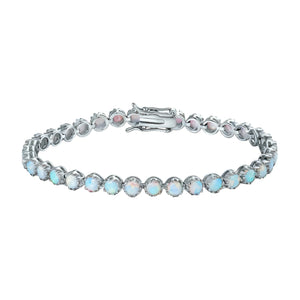
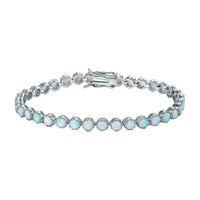
The piece they're describing → Rainbow Moonstone Tennis Bracelet for Women — Stainless Steel, Bezel Set, Gift Boxed with Message Card
Personalize Yours


