Emerald is May's birthstone, and few gemstones in the world carry as much cultural weight. Cleopatra famously claimed the emerald mines of Egypt as her personal property. Ancient Inca and Aztec civil…
Emerald is May's birthstone, and few gemstones in the world carry as much cultural weight. Cleopatra famously claimed the emerald mines of Egypt as her personal property. Ancient Inca and Aztec civilizations revered emerald as sacred. Mughal emperors inscribed prayers onto large emerald tablets. The stone's deep green has been associated with spring, rebirth, and abundance across virtually every culture that has encountered it — and May, the peak of spring in the Northern Hemisphere, could not have a more fitting birthstone.
New to emerald? Read our complete Emerald meaning guide to learn the stone's symbolism, healing properties, and how to choose a quality piece before you buy.
Emerald is a variety of the beryl mineral (the same family as aquamarine), colored by trace amounts of chromium and sometimes vanadium. What makes emerald genuinely special — and genuinely challenging as a jewelry stone — is its natural character. Unlike aquamarine, which typically forms with excellent clarity, emerald almost universally contains inclusions, fractures, and growth irregularities that gemologists poetically call jardin (French for "garden"). These inclusions are so expected in emerald that an emerald without them is actually viewed with suspicion — it is likely synthetic or a different stone. The inclusions are also why almost all commercial emeralds are treated with oil or resin to fill fractures and improve apparent clarity.
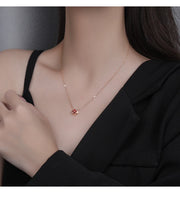
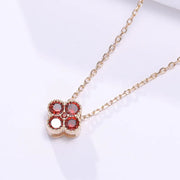
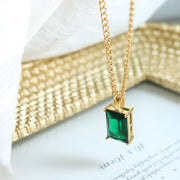
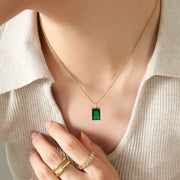
AJLuxe May birthstone jewelry captures the spirit of emerald's rich green in pieces designed for everyday wear. Our collection is set in 925 sterling silver, pairing the cool brightness of silver with emerald-inspired green tones. Whether you are searching for a May birthday gift, celebrating a spring occasion, or simply drawn to the deep green that has defined luxury jewelry for millennia, our May collection brings that heritage into wearable, accessible form.
| Property | Details |
|---|---|
| Hardness | 7.5–8 Mohs — BUT inclusions and fracture treatments make natural emerald more fragile than hardness suggests |
| Color Range | Yellow-green to blue-green; most prized = pure vivid green (Colombian "Muzo" green) |
| Meaning | Rebirth, love, fertility, spring renewal, wealth, wisdom |
| Primary Origins | Colombia (finest), Zambia (deep green), Brazil, Zimbabwe, Pakistan |
| Care Difficulty | High — no ultrasonic, no steam, no harsh chemicals; gentle hand-cleaning only |
Emerald is a stone that rewards careful selection and honest evaluation. The key facts to understand: natural emerald's inclusions are normal and expected, but they do make the stone more vulnerable to chipping and cracking than its Mohs hardness suggests. A Mohs 7.5–8 stone with no fractures would be excellent for daily wear. Most natural emerald has fractures filled with oil or resin — and those treatments require care to maintain. Heat, ultrasonic vibration, and harsh chemicals can remove the oil treatment, causing the stone to look worse than before it was treated.
For everyday wear, lab-grown emerald offers the best of both worlds: the same chromium-colored green crystal (identical chemical and physical structure to natural emerald), typically better clarity than natural stones, and the same beauty without the fragility risk. Lab-grown emerald is real emerald — it is not glass, not synthetic dye, not a simulant. It grows in a laboratory under conditions that replicate natural geology, producing genuine beryl crystal. For a May birthday piece that will be worn regularly, lab-grown or well-selected natural emerald in a protective bezel setting (rather than exposed prongs) is the most practical approach. Green tourmaline and tsavorite garnet are also worth considering as emerald alternatives — both are more durable and require far less care.
May birthdays arrive at peak spring — when everything is green, energy is high, and the natural world is at its most vibrant. Emerald jewelry mirrors this moment with a color that cannot be reproduced by any other green gemstone at the same depth of saturation. For a May birthday gift, emerald jewelry does not need elaborate justification — the color speaks immediately and the birthstone connection makes it personal.
For someone who will wear the piece every day, consider a simple emerald pendant rather than a ring — pendants encounter fewer direct impacts than rings and are safer for included stones. For someone who treats jewelry as an occasional-wear special piece, even a fine natural Colombian emerald pendant is appropriate, as long as care instructions are shared with the gift. Emerald pairs most beautifully with sterling silver (cool, bright, neutral) or yellow gold (warm, traditional, historically authentic to emerald's ancient origins). For a May birthday gift that goes beyond the standard choice, pair an emerald pendant with a brief note on emerald's history — Cleopatra, the Muzo mines, the jardin — context that turns a beautiful object into a conversation piece.
More fragile than its Mohs hardness suggests, yes. At 7.5–8 Mohs, emerald should theoretically be durable. The complication is that virtually all natural emerald contains fractures — either pre-existing from formation or developed over the stone's geological history. These fractures (along with the oil/resin fill used to treat them) make the stone more vulnerable to thermal shock, impact, and chemical exposure than a clean Mohs 7.5–8 stone would be. A sharp knock against a corner or a drop onto hard flooring can propagate an existing fracture. Emerald is appropriate for pendants and earrings with care; it requires extra caution in rings with daily hard use. The key care rule: avoid extremes — no sudden temperature changes, no hard impacts, no ultrasonic cleaners.
Emerald's inclusions — collectively called jardin — are a result of the geological conditions under which it forms. Emerald crystallizes in hydrothermal veins at relatively shallow depths, where it interacts with complex mineral-rich fluids during formation. This process traps foreign minerals, creates structural irregularities, and produces the network of growth tubes, fractures, and gas/liquid inclusions characteristic of emerald. Unlike diamond or sapphire, which form in more stable geological environments that allow larger, cleaner crystals, emerald's formation conditions practically guarantee inclusions. A commercially clean emerald (visible inclusions only under 10× magnification) is considered "eye-clean" and premium-priced. Completely inclusion-free natural emerald essentially does not exist at useful sizes.
Emerald oiling is the practice of filling a natural emerald's surface fractures with oil or resin to improve its apparent clarity and color. Cedar oil was traditionally used; modern treatments use synthetic resins including Opticon. The treatment is widely accepted in the gem trade and expected in most commercial natural emerald. What buyers need to know: the treatment is not permanent. Ultrasonic cleaners, steam, and harsh chemicals can remove the filler, causing the stone to look worse than its pre-treatment state. Heat from repair work or sizing rings can also damage oiled emerald. If you have natural emerald jewelry repaired or cleaned professionally, always disclose that it is oiled emerald so the jeweler avoids heat and ultrasonic processes. GIA grades emerald treatments as "none," "minor," "moderate," or "significant."
Yes. Lab-grown emerald is real emerald. It has the same chemical composition (beryllium aluminum silicate with chromium), the same crystal structure, the same Mohs hardness, and the same optical properties as natural emerald. The only difference is origin — natural emerald formed underground over millions of years; lab-grown emerald was created in a controlled laboratory environment over weeks. GIA and other major gemological labs certify lab-grown emerald as emerald (with a "laboratory-grown" qualifier). Lab-grown emerald typically has better clarity than natural emerald because laboratory conditions produce fewer inclusions. It is not a simulant, not synthetic glass, not a coating — it is genuine emerald crystal.
Both are green gemstones, but they are chemically and structurally different. Emerald is green beryl (Mohs 7.5–8, usually heavily included, requires oil treatment). Green tourmaline (specifically chrome tourmaline or Paraiba tourmaline) is a borosilicate mineral (Mohs 7–7.5) that is typically cleaner and more durable for daily wear than natural emerald. Chrome tourmaline produces a vivid green similar to fine emerald but without the inclusion and treatment challenges. Tsavorite garnet (a grossular variety) also competes with emerald's green, rating Mohs 7.5 with no treatment required. For daily-wear green gemstone jewelry, green tourmaline or tsavorite garnet is often a more practical choice than natural emerald, while still delivering comparable visual beauty.
For pendants and earrings — yes, with some care. For daily-wear rings — with caution. In pendants and earrings, emerald faces minimal direct impact and is generally safe to wear regularly, as long as you avoid ultrasonic cleaning and harsh chemicals. In rings, emerald's natural fractures make it vulnerable to chipping from edge knocks — something rings encounter far more often than pendants. If you want daily-wear green jewelry in a ring, lab-grown emerald in a protective bezel setting is safer than natural emerald in an open prong setting, and tsavorite garnet or chrome tourmaline are safer still. For special-occasion jewelry, natural emerald is outstanding.
Colombian emerald — particularly from the Muzo, Chivor, and Coscuez mines — is the world standard for finest emerald quality. Colombian emeralds typically display the most saturated, pure green color (sometimes called "Muzo green") due to the specific trace element composition of the geological formation. The purity of green in Colombian stones is characterized by a slight bluish or slightly yellowish undertone that creates a "traffic light green" depth unmatched by emeralds from other origins. Colombian mines have also been producing fine emeralds for over 500 years and are known for larger, higher-quality rough. Zambian emeralds have deeper blue-green tones and are prized in their own right — often more affordable than comparable Colombian stones. The origin premium for Colombia can be 2–5× or more for equivalent-quality stones.
Emerald carries layered meaning across cultures. In Western tradition, emerald is associated with spring, rebirth, and the renewal of the natural world — fitting for May. In ancient Egypt, emerald was a symbol of eternal life and fertility; Cleopatra gave emerald gifts engraved with her likeness to foreign dignitaries. In medieval Europe, emerald was believed to improve eyesight and reveal truth — holding an emerald was thought to force a person to tell the truth. In Hindu astrology, emerald represents Mercury and is worn to enhance intelligence and communication. In the modern language of gemstones, emerald symbolizes growth, abundance, wisdom, and successful love. As a May birthday gift, emerald carries all of these associations while also making a simply beautiful visual statement.