December is the most generous birth month in the birthstone calendar: it has four officially recognized birthstones — turquoise, tanzanite, blue zircon, and blue topaz. All four share the blue family…
December is the most generous birth month in the birthstone calendar: it has four officially recognized birthstones — turquoise, tanzanite, blue zircon, and blue topaz. All four share the blue family of color, ranging from turquoise's sky-to-teal blue-green to tanzanite's extraordinary violet-blue to the brilliant cornflower blue of fine blue topaz and zircon. If you were born in December, you have more choice than any other birth month, and some genuinely fascinating gem stories within your selection.
The most remarkable stone of the four is tanzanite — one of the rarest gemstones on earth. Tanzanite is found in only one location worldwide: a small mining area near Mount Kilimanjaro in northern Tanzania, in a deposit estimated to be 1,000 times rarer than diamond. Tanzanite was discovered as recently as 1967 by a Masai tribesman — making it one of the youngest gems to enter the jewelry market. Its color ranges from violet-blue to deep blue-purple and shows strong pleochroism (the stone appears different colors from different angles). Tiffany & Co. named it "tanzanite" and launched it to the world. AJLuxe carries blue topaz options for December birthdays — a beautifully blue, durable, and accessible choice for everyday birthstone jewelry.
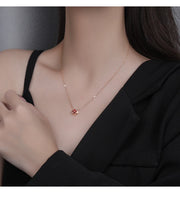
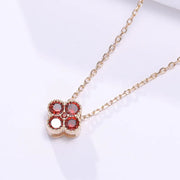
AJLuxe December birthstone jewelry features blue topaz set in 925 sterling silver — the most durable and practical of the four December stones for everyday wear. Our December collection brings the calm, clear blue of December skies to wearable, elegant pendants and earrings. Whether you are shopping for a December birthday, a holiday gift, or a year-end celebration, our blue December collection delivers genuine gem beauty in settings designed for lasting daily wear.
| Property | Details |
|---|---|
| Blue Topaz Hardness | 8 Mohs (excellent; but note perfect cleavage — avoid direct hard knocks) |
| Tanzanite Hardness | 6.5 Mohs (moderately fragile — suitable for pendants, careful with rings) |
| Turquoise Hardness | 5–6 Mohs (porous — absorbs oils/chemicals; requires protective care) |
| Blue Zircon Hardness | 7.5 Mohs (different from CZ — natural mineral, very brilliant) |
| Care Difficulty | Blue Topaz: low. Tanzanite: moderate. Turquoise: high. Blue Zircon: moderate. |
The choice between December's four birthstones depends on how the piece will be worn and what aesthetic appeals to the recipient. Blue topaz is the most durable and accessible choice — Mohs 8, vivid blue (sky, Swiss, or London blue depending on shade), and widely available in beautiful sterling silver settings. For everyday wear pendants and earrings, blue topaz is the December birthstone most suited to daily use without special care. Sky blue topaz has a pale, delicate appearance; Swiss blue topaz is a bright medium blue; London blue topaz is the deepest, most saturated blue-green in the topaz family.
Tanzanite is the most special of the four December stones — genuinely rare, visually extraordinary, and with a compelling origin story. For a milestone December birthday gift (30th, 40th, 50th), a tanzanite pendant makes a uniquely meaningful choice that carries intrinsic rarity value. Turquoise occupies a completely different aesthetic space: its opaque blue-green with characteristic matrix veining (the dark lines within the stone) is associated with Southwestern American and bohemian jewelry aesthetics, turquoise sky, and ancient protective symbolism. For a December birthday recipient with a bohemian, spiritual, or vintage-jewelry style, turquoise is the most distinctive of the four choices.
December birthdays are the most challenging to gift-shop for because they arrive in the middle of the holiday season — every shop is crowded with holiday-themed products, and it is easy for a December birthday gift to disappear into holiday noise. December birthstone jewelry solves this problem beautifully. A piece of blue topaz, tanzanite, or turquoise jewelry signals that the gift is specifically for the birthday — not a holiday gift, not a Christmas present, but a personal birthstone celebration for the individual.
For a Sagittarius birthday (before December 21), the optimistic, adventurous energy of Sagittarius connects well with turquoise's history as a traveler's protective stone and tanzanite's association with new discovery. For a Capricorn birthday (from December 22), the classic, enduring quality of fine blue topaz or a timeless turquoise pendant aligns with Capricorn's appreciation for lasting value and traditional beauty. For holiday-season birthday gifting that does not blur into generic holiday giving, December birthstone jewelry in 925 sterling silver is the most elegant personal solution — the blue color family is cool, calm, and distinctly non-holiday in tone, making it clear that this gift was chosen for the person, not the season.
December has four officially recognized birthstones: turquoise (the oldest traditional birthstone for December), tanzanite (added in 2002 by the American Gem Trade Association and Jewelers of America — the first birthstone addition in nearly 90 years), blue zircon (a modern addition recognized by various international birthstone lists), and blue topaz (the most commercially accessible and widely available December option). Having four birthstones makes December the birth month with the most options by total count, though all four share the blue-to-blue-green color family.
Tanzanite is a blue-to-violet variety of the mineral zoisite (calcium aluminum silicate hydroxide), found in only one location on earth: the Merelani Hills near Arusha, Tanzania, at the base of Mount Kilimanjaro. It was discovered in 1967 and named by Tiffany & Co., which recognized its extraordinary color and rarity and launched a global marketing campaign that established it as a major gemstone. Tanzanite's defining optical property is strong pleochroism: from one direction it appears deep blue; from another, violet-purple; from a third, burgundy-red or bronze. The stone used in jewelry is typically oriented to show the blue-violet face. Geologists estimate the tanzanite deposit will be exhausted within 25–50 years, which makes it one of the only gemstones with a quantified scarcity timeline.
No — this is one of the most persistent and consequential gemstone confusions. Zircon is a natural mineral (zirconium silicate, ZrSiO₄) that has existed on earth for over 4 billion years — the oldest mineral ever found on earth's surface. It is a genuine gemstone that occurs in many colors, with blue zircon (heat-treated to achieve blue color) being the most sought-after for December birthstone jewelry. Cubic zirconia (CZ) is a synthetic lab-created material (zirconium dioxide, ZrO₂) — a completely different compound that happens to share part of its name with zircon. CZ was developed in the 1970s as a diamond simulant. Zircon and CZ share no chemical formula and are not the same material. Blue zircon is a natural gemstone with excellent brilliance (higher refractive index than diamond); CZ is lab-created.
Yes — turquoise is a hydrated copper aluminum phosphate mineral with a porous microstructure that can absorb liquids and other substances from its environment. This porosity is the key care challenge for turquoise jewelry. The stone can absorb oils from skin, perfumes, lotions, cleaning products, and even sweat, which gradually change its color over time — often from blue toward green, or developing darkening or discoloration in the matrix. High-quality turquoise (like fine Persian turquoise from the Nishapur mines) is denser and less porous than lower-quality material. Many commercial turquoise pieces are treated with stabilizing resins to reduce porosity and improve durability — a widely accepted treatment that improves wearability significantly.
Turquoise care follows from its porous nature: the goal is to prevent absorption of anything that changes its color or damages its structure. Store turquoise separately from other jewelry to prevent scratching (its Mohs 5–6 is soft). Keep it away from perfumes, hairspray, sunscreen, and cleaning products — apply these before putting on turquoise and let them dry fully. Remove turquoise before swimming (chlorine and salt water both damage it), showering (soaps can be absorbed), or exercising (perspiration is absorbed). Clean with a soft dry cloth only — no ultrasonic, no steam, no running water for prolonged periods. If turquoise becomes dirty, use a barely damp cloth with no soap, dry immediately. Proper care maintains turquoise's color stability for generations.
Tanzanite is by far the rarest of the four December birthstones — and one of the rarest gemstones period. It is found in a single deposit covering approximately 14 square kilometers near Kilimanjaro in Tanzania. Geologists estimate the deposit will be exhausted within 25–50 years at current extraction rates — which means tanzanite is definitively a finite resource. The Tanzanian government considers it a national treasure. Fine tanzanite is estimated to be 1,000 times rarer than diamond by deposit availability. By comparison, turquoise is found across multiple continents; blue topaz is the treated form of one of earth's most abundant gemstone minerals; blue zircon, while genuinely a natural gemstone, has multiple global sources. Tanzanite's single-source, soon-to-be-exhausted supply makes it uniquely rare among all birthstones across all twelve months.
At comparable quality, fine tanzanite is generally less expensive than fine sapphire — but this relationship may change as tanzanite deposits deplete. Currently, a fine 2-carat tanzanite runs $300–$1,000 per carat from reputable dealers, while fine Kashmir sapphire at 2 carats can run $10,000–$50,000 per carat. However, tanzanite's rarity story is compelling: as the Kilimanjaro deposit approaches exhaustion, prices have been rising and collectors have been accumulating fine tanzanite for investment. Blue sapphire has multiple worldwide sources and active ongoing mining; tanzanite has one source with a measured lifespan. The comparison may look very different in 20–30 years.
Blue topaz is the best December birthstone for everyday jewelry wear. At Mohs 8 — higher than tanzanite (6.5), turquoise (5–6), and blue zircon (7.5) — blue topaz resists daily surface scratching from most common materials. Its color (achieved through irradiation of colorless topaz, an accepted stable treatment) does not fade with wear or light exposure. It tolerates normal cleaning methods, requires no humidity management, and is not porous. The only care note for topaz: its perfect cleavage means a sharp direct blow can cause it to split along that cleavage plane, so avoid wearing topaz rings during heavy manual work. For pendants and earrings — the most common December birthstone jewelry formats — blue topaz handles daily wear excellently with no special accommodations.