


• Birthstone: Ruby — red corundum (Al₂O₃ + chromium)
• Hardness: Mohs 9 — second only to diamond; excellent for all jewelry types
• Color: Red, from pinkish-red to deep blood-red; "pigeon's blood" Burmese ruby is the benchmark
• Key sources: Myanmar (finest), Mozambique, Thailand, Madagascar, Afghanistan
• Treatment: ~97% of commercial rubies are heat-treated; this is standard and accepted
• Notable records: Sunrise Ruby (25.59 ct, $30.3M in 2015); Liberty Bell Ruby (8,500 ct)
• Key meaning: Love, passion, courage, protection, vitality
• Internal link: See our complete guide to ruby meaning and symbolism
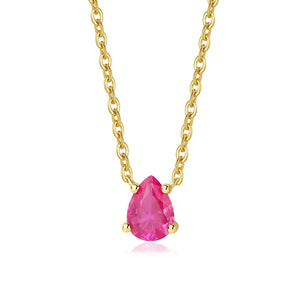
• Shop: July birthstone necklaces in sterling silver
Ruby is July's birthstone and one of the most celebrated gemstones in human history. It shares its mineral identity (corundum) with sapphire — the only difference between a ruby and a blue sapphire is the trace element that colors it. But ruby's chromium-driven red is no ordinary gemstone color. Chromium causes ruby to fluoresce under ultraviolet light — it literally glows red — a property unique among red gemstones. This guide covers everything from the geology of ruby formation to the pigeon's blood color standard, from star rubies to the most expensive ruby ever sold.
At AJLuxe, our birthstone necklaces use genuine semi-precious stones set in 925 sterling silver — not glass or synthetic substitutes.
What Is the July Birthstone?
Ruby is red corundum. Corundum is aluminum oxide (Al₂O₃) in its purest form — colorless. When trace amounts of chromium (Cr³⁺) replace aluminum atoms in the crystal structure, the stone absorbs blue and yellow light and transmits red, producing the vivid red color we know as ruby. The more chromium present, the more vivid the red. But there's a limit: too much chromium can cause the crystal structure to crack during growth, which is why large, high-quality rubies are exceptionally rare.
Ruby shares this mineral identity with every other color of gem corundum. Blue sapphire, yellow sapphire, pink sapphire, padparadscha — all are corundum. The distinction between ruby and pink sapphire is officially defined by color: ruby must have red as its dominant hue. Some stones sit on the boundary — a vivid pink stone from Mozambique might be called either pink sapphire or ruby depending on who's grading it and which country they're in. The GIA defines ruby as corundum with "predominantly red" color.
Ruby vs Sapphire — Same Mineral, Different Color
| Property | Ruby | Blue Sapphire |
|---|---|---|
| Mineral | Corundum (Al₂O₃) | Corundum (Al₂O₃) |
| Color cause | Chromium (Cr³⁺) | Iron + Titanium |
| Mohs hardness | 9 | 9 |
| UV fluorescence | Strong red glow (from chromium) | Usually inert or weak |
| Color range | Pink-red to deep red (red must dominate) | Pale blue to deep blue to violet-blue |
| Finest source | Mogok Valley, Myanmar | Kashmir, Padparadscha from Sri Lanka |
Ruby History — From Ancient India to the Record Auctions
Ruby's history as a precious stone predates written records. In ancient Sanskrit texts, ruby is called ratnaraj — "king of precious stones." The Mogok Valley in Burma (modern Myanmar) has been mined for rubies for at least 1,000 years; some accounts suggest mining there began over 2,500 years ago.
In medieval Europe, ruby was associated with royalty and power. Kings believed wearing ruby on their left hand (near the heart) would bring peace and good fortune to their kingdoms. Rubies were set in the coronation regalia of European monarchies, a tradition that persists: the Imperial State Crown of Great Britain contains the Black Prince's Ruby — actually a 170-carat red spinel — illustrating how prized red stones were even when they turned out not to be ruby.
In Hindu tradition, ruby was associated with the sun and called padmaraga ("lotus color"). Warriors embedded rubies in their flesh before battle, believing it conferred invulnerability. Burmese soldiers similarly wore rubies as protection in combat.
Record sales: The Sunrise Ruby, a Burmese "pigeon's blood" ruby of 25.59 carats, sold at Sotheby's Geneva in May 2015 for $30.3 million — $1.19 million per carat, making it the most expensive ruby and the most expensive colored stone per carat sold at auction at that time. The Estrela de Fura, a 55.22-carat Mozambique ruby, sold in 2023 for $34.8 million.
Pigeon's Blood Ruby — The Color Standard
"Pigeon's blood" is the highest color designation in the ruby trade — and it is specific. A pigeon's blood ruby is not simply "very red." The term describes a precise combination of:
- Primary hue: Pure red — no visible orange or purple modifier
- Saturation: Vivid — the most saturated red without darkening
- Tone: Medium — not too dark, not too light
- Fluorescence: Strong red fluorescence under UV light — this is what makes Burmese pigeon's blood rubies "glow" in daylight (which contains UV), appearing more vivid than any other red stone
The fluorescence is caused by chromium — the same element that creates the red color. In Burmese rubies, the iron content is low, which allows the chromium fluorescence to fully express. Rubies from Thailand typically have more iron, which suppresses the fluorescence and makes the color appear more "inky" and less vivid in daylight — still beautiful, but a different quality level.
Genuine GIA-certified "pigeon's blood" rubies from Myanmar sell for $5,000–$30,000+ per carat depending on size and quality. A 3-carat pigeon's blood ruby with no treatment and a GIA origin certificate can exceed $50,000.

Ruby Colors and Sources
| Source | Color Character | Fluorescence | Market Position |
|---|---|---|---|
| Myanmar (Mogok) | Vivid pure red — the "pigeon's blood" benchmark | Strong red (low iron) | Highest — premium origin |
| Mozambique (Montepuez) | Vivid red, often similar to Burmese | Moderate to strong | Second-highest — now producing some of the world's finest rubies |
| Thailand (Chanthaburi) | Dark red to brownish-red; "inky" | Weak (high iron) | Lower — traditionally used for commercial ruby; major heat treatment hub |
| Madagascar | Range: pink-red to vivid red | Variable | Growing market — good quality at mid-range prices |
| Afghanistan (Jegdalek) | Vivid red to pinkish-red | Strong | Lesser-known; fine quality, logistically difficult to source |
| Sri Lanka (Ceylon) | Typically pinkish-red; lighter tones | Strong | Often called "Ceylon ruby" — many are borderline pink sapphire |
Ruby's Chromium Glow — Why Rubies Literally Shine
One of ruby's most remarkable and lesser-known properties is its behavior under ultraviolet light. Chromium, the element that creates ruby's red color, also causes intense red fluorescence when struck by UV wavelengths. In a dark room with a UV lamp, a good Burmese ruby will glow brilliantly red — a vivid, fire-engine red that looks almost supernatural.
More practically: natural daylight contains UV wavelengths. This means high-quality Burmese rubies appear to "glow from within" even in normal daylight conditions. Gemologists test for this: a ruby that shows strong red fluorescence is almost certainly a Burmese-origin stone (or Mozambique with low iron). A ruby that appears bright in tungsten light but not in daylight likely has high iron content suppressing fluorescence — typical of Thai stones.
This UV fluorescence is unique to chromium-colored corundum. Red spinels, red garnets, and rubies can look similar to the naked eye, but under UV light, only ruby glows this way. It's one reason gemologists carry UV lamps — along with a loupe and refractometer — to identify ruby in the field.

Star Ruby — Asterism Explained
Some rubies display a "star" — a six-rayed or twelve-rayed star of light that appears to float above the surface of the stone when viewed under a single light source. This phenomenon is called asterism, and it's caused by needles of the mineral rutile (TiO₂) aligned along three crystal directions inside the ruby. When light hits these needles, each set reflects it into a line, and the three intersecting lines form a six-pointed star.
For asterism to be visible, the ruby must be cut as a cabochon (domed, not faceted) and oriented so the star appears at the top of the dome. The quality of star rubies is judged on both the star (sharpness, completeness, centering) and the body color (as vivid as possible). The finest star rubies have a strong red body color and a perfectly centered, sharply defined six-rayed star.
The largest gem-quality star ruby known is the Rajaratna Ruby, weighing 2,475 carats (about 495 grams). The Liberty Bell Ruby, at 8,500 carats, is the largest known ruby (though carved, not a gem stone).
Ruby Treatment — What You Need to Know
Understanding ruby treatment is essential before any purchase above the very budget level.
Heat treatment: Approximately 95–97% of all commercial rubies have been heat-treated. Heat treatment at 1,600–1,900°C improves color (reduces brownish or purplish modifiers) and reduces the visibility of inclusions by dissolving rutile silk into the stone. Heat treatment is considered permanent, stable, and fully accepted by the gem trade — all major gem labs (GIA, Gübelin, SSEF) disclose heat treatment on certificates but it does not make the ruby less desirable at commercial grades.
Glass-filling (lead glass treatment): Lower-grade rubies are sometimes filled with lead glass to improve clarity dramatically — turning an almost opaque, heavily fractured stone into something that looks gemmy. This treatment is controversial: lead glass-filled rubies require careful care (no acid, avoid high heat), and the glass can be damaged during normal repair procedures. They are far less valuable than untreated or heat-treated rubies. GIA and other labs identify glass-filling and flag it prominently on reports. Always ask for a lab report for any significant ruby purchase.
| Treatment Type | Effect | Trade Acceptance | Value Impact |
|---|---|---|---|
| None (unheated) | Natural color and clarity | Maximum — rare and premium | +30–100% premium over equivalent heated stone |
| Heat treatment | Improves color, reduces rutile silk | Fully accepted; standard | No discount vs untreated in commercial grades |
| Lead glass filling | Major clarity improvement; masks fractures | Controversial; requires disclosure | Significant discount — treated stone worth fraction of natural |
July Birthstone Meaning and Symbolism
Ruby's meanings across cultures converge on a common theme: fire, life force, and protection. In ancient India, ruby was the most sacred of all gems — ratnaraj, "king of precious stones" — and was associated with the sun, vitality, and the heart center. Offering a ruby to the Hindu god Krishna was said to guarantee rebirth as an emperor.
In European tradition, ruby was the stone of kings and warriors. Medieval physicians prescribed powdered ruby for heart ailments, improving circulation, and warding off plague — arguably the first gemstone "supplement." The stone was thought to warn its wearer of impending danger by darkening in color.
In modern crystal tradition, ruby is linked to the root chakra — the foundation of vitality, courage, and will. It's said to amplify life force energy, stimulate passion, and support confidence in decision-making. For birthstone purposes, a July ruby is traditionally given as a gift of love, passion, and long-life protection.
For the complete history and symbolism, see our full guide to ruby meaning and healing properties.
What Color Is the July Birthstone?
Ruby is red — but "red" is more nuanced in the gem trade than in everyday language. Ruby's color range spans from a pale pinkish-red (which some labs call pink sapphire) through medium red to a very dark, almost garnet-like deep red. The most prized color is the Burmese "pigeon's blood" — a vivid, medium-dark pure red with a slight blue-violet fluorescence that makes it look more vivid than pure red alone.
Most commercial jewelry-grade ruby has some color modifier — slightly orange (from iron), slightly purple (from more chromium), or slightly brownish (from darker tone + iron). For birthstone jewelry, a vivid, eye-catching red is all that matters — absolute color precision is for investment stones above $1,000/ct.
How to Choose Ruby Jewelry
| Priority | What to Look For | What to Avoid |
|---|---|---|
| Color first | Vivid, saturated red — the more "fire engine red" the better | Brownish, grayish, or overly dark stones that look garnet-like |
| Clarity | Eye-clean for faceted ruby; inclusions more acceptable in ruby than diamond | Visible cracks, milkiness, or glass fill (check with loupe for tell-tale bubbles) |
| Treatment disclosure | Ask: heat-treated (fine) or glass-filled (avoid for investment) | Any seller who won't disclose treatment status |
| Significant purchase ($500+) | GIA, Gübelin, or SSEF lab certificate | Unknown origin with no documentation |
| Setting choice | Yellow or rose gold enhances ruby's warmth; white gold/platinum for contrast | No specific restrictions — Mohs 9 durability suits all setting types |
How to Care for Ruby Jewelry
Ruby's Mohs 9 hardness makes it one of the most durable gemstones available — only moissanite, diamond, and other corundum (sapphire) will scratch it. This makes ruby well-suited to all types of jewelry including everyday rings.
- Clean with: Warm soapy water + soft brush, or ultrasonic cleaner (for untreated or heat-treated stones — not for glass-filled ruby)
- Avoid: Ultrasonic and steam cleaners for glass-filled ruby — the heat and vibration can damage the filling
- Store: Separately from other gems — ruby (Mohs 9) will scratch softer stones including tanzanite, opal, turquoise, and even topaz
- Safe for: Swimming, showering, exercise — ruby is one of the most robust gemstones for daily wear
Gifting July Birthstone Jewelry
| Occasion | Best Choice | Why |
|---|---|---|
| July Birthday | Ruby pendant or ruby stud earrings | Classic birthstone gift — personal and traditional |
| Romantic gift / anniversary | Ruby ring or ruby necklace in gold | Ruby = love and passion — one of the most romantic gemstones |
| 40th anniversary | Ruby (traditional 40th anniversary stone) | Culturally appropriate; ruby is the gemstone of the 40th |
| Milestone birthday | Fine ruby in gold setting with cert | Investment quality; meaningful and lasting |
| Young person / teenager | Ruby silver necklace or small ruby earrings | Durable, wearable, vibrant color |
Browse our July birthstone ruby collection:
• Ruby birthstone necklaces in sterling silver
• Gemstone necklaces — full collection
• July birthday gifts — curated gift ideas
Frequently Asked Questions About the July Birthstone
What is the July birthstone?
July's birthstone is ruby — red corundum colored by chromium. Ruby is the same mineral as sapphire (aluminum oxide, Al₂O₃) and has a Mohs hardness of 9, making it one of the most durable gemstones.
What color is the July birthstone?
Ruby is red — from a vivid pinkish-red to a deep blood-red. The most prized color is "pigeon's blood" — a vivid, pure red with no orange or purple modifier and strong UV fluorescence, found most often in Burmese (Myanmar) rubies.
Why is ruby the same as sapphire?
Both ruby and sapphire are gem varieties of corundum (aluminum oxide). The only difference is the trace element that causes the color: chromium creates red (ruby), while iron and titanium together create blue (sapphire). All other colors of gem corundum are called "fancy sapphires."
What is pigeon's blood ruby?
"Pigeon's blood" is the trade term for the highest grade of ruby color — a vivid, pure red with strong UV fluorescence, no significant orange or purple modifier, and a medium-dark tone. The term originates from Burmese gem tradition and was adopted by the international gem trade. GIA uses "pigeon's blood" as an official color designation for qualifying stones.
Why does ruby glow under UV light?
Ruby glows because chromium — the same element that creates its red color — fluoresces under ultraviolet light. In a UV lamp, a quality Burmese ruby emits a vivid red glow. Because natural daylight contains UV wavelengths, good Burmese rubies appear to "glow from within" even outdoors. This property is unique to chromium-colored corundum and is used by gemologists to distinguish ruby from other red stones like red spinel or garnet.
What is a star ruby?
A star ruby is a ruby that displays asterism — a six-rayed star of light that appears to glide across the surface when viewed under a single light source. The star is caused by aligned needles of rutile mineral inside the crystal. Star rubies are cut as cabochons (not faceted) to reveal the star effect.
Are most rubies treated?
Yes — approximately 95–97% of commercial rubies have been heat-treated to improve color and clarity. This is fully accepted in the gem trade and does not make the ruby less valuable at commercial grades. The important distinction is between heat treatment (accepted) and glass filling (controversial; requires disclosure and significantly reduces value).
What is the most expensive ruby ever sold?
The Estrela de Fura, a 55.22-carat ruby from Mozambique, sold at Sotheby's in June 2023 for $34.8 million — the most expensive ruby ever auctioned. Prior to that, the Sunrise Ruby (25.59 ct, Myanmar) held the record at $30.3 million in 2015.
Is lab-created ruby real ruby?
Lab-created ruby is chemically identical to natural ruby — same aluminum oxide structure, same chromium coloring, same Mohs 9 hardness. It is "real" in a chemical sense. However, it has no rarity value, and the gem trade distinguishes clearly between natural and lab-created stones. Lab ruby is appropriate for fashion jewelry at low price points but should be disclosed as lab-created.
What metal works best with ruby?
Yellow gold is the traditional and most complementary metal for ruby — the warmth of the gold harmonizes with ruby's warm red. White gold and platinum create striking contrast that makes the red appear more vivid. Rose gold is a fashionable modern pairing. Sterling silver is the most affordable and also works well.
Is ruby a good everyday gemstone?
Yes — ruby is one of the best gemstones for everyday wear. Its Mohs 9 hardness means only diamond, moissanite, and other sapphire/ruby will scratch it. It has good toughness and no special care requirements beyond basic jewelry cleaning. It's suitable for rings, necklaces, earrings, and bracelets in daily use.
Final Thoughts — Choosing Your July Birthstone Ruby
Ruby is one of the great gemstones — not merely by historical prestige but by objective quality. Its combination of vivid color, high hardness, and unique chromium fluorescence makes it genuinely exceptional among colored stones. Whether you're buying a small ruby pendant for a July birthday or investing in a fine Burmese stone with a GIA certificate, you're choosing a gemstone with 2,000 years of human appreciation behind it.
For everyday birthstone jewelry, look for a vivid red color, eye-clean appearance, and heat treatment (standard). For something special, unheated Mozambique or Burmese rubies with lab certificates are some of the most meaningful colored stone purchases you can make — a stone whose beauty has been confirmed as entirely natural.
Browse our July birthstone ruby necklaces in sterling silver — or explore our complete guide to ruby meaning and symbolism to learn everything about this remarkable stone.
Written by Vaishakhi Ajmera — founder of AJLuxe, specialists in personalized sterling silver jewelry. Last updated: May 2026. | Sources: GIA Ruby · American Gem Society · Jewelers of America
Cancer is a water sign — learn more in our guide to water signs astrology.
Explore more: Birthstone Jewelry by Month
You Might Also Like

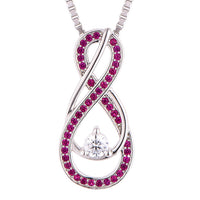
The piece they're describing → July Birthstone Necklace for Women — Ruby Red Infinity Pendant, 925 Sterling Silver (ES)
Personalize Yours

