


The short answer
A cocktail ring is a deliberately oversized, eye-catching ring — a big center stone or dramatic cluster — worn on the right hand purely to make a statement, with no engagement or wedding meaning attached. The three decisions that actually matter are stone choice (cubic zirconia for affordable everyday drama, moissanite or a colored gemstone for durable mid-range sparkle, fine diamond and solid gold for heirloom-tier pieces), fit and band (a statement ring is heavy and top-loaded, so an adjustable or precisely sized band keeps it from spinning), and balance (one big ring reads as chic; a big ring plus loud earrings and stacked bracelets reads as costume). Get those three right and a cocktail ring becomes the most versatile personality piece in your box.
The best cocktail rings are the ones that do their one job well — command attention on your hand — without fighting the rest of your outfit, and "best cocktail rings" is a search that spans an enormous range, from a $30 cubic zirconia showpiece you slip on for dinner to a five-figure gemstone cocktail ring that anchors a whole evening look. This guide treats the cocktail ring as what it actually is: an oversized, right-hand statement ring whose stone, band fit, and styling decide whether it looks expensive or costume. We'll give you a real stone-by-stone cost comparison, a plain-English guide to fitting a heavy statement band, the dinner-ring-versus-cocktail-ring distinction most posts skip, and specific AJLuxe picks so you can go from "I want one" to a piece that suits your hand and your budget.
We'll also cover two things most "best cocktail ring" roundups leave out entirely: how to balance a bold ring with the rest of your jewelry so it reads as intentional rather than cluttered, and how to shop the affordable-versus-fine decision honestly — because a great cubic zirconia cocktail ring and a fine gemstone one solve very different problems.

What makes a ring a cocktail ring
A cocktail ring is defined by intent and scale, not by a specific stone or price. It is deliberately oversized — a large center stone, a bold cluster, or a sculptural setting that sits high and wide on the finger — and it is worn for style alone, with none of the promise or milestone meaning of an engagement or wedding ring. The name traces to the 1920s cocktail party, where women wore big, unapologetic rings to signal glamour and independence, and the style has meant the same thing ever since: a ring you choose entirely for yourself. If you want the full history and symbolism, our guide to what a cocktail ring means covers where the tradition comes from and what it signals today.
The single detail that trips up new buyers is the hand. A cocktail ring is traditionally worn on the right hand, usually the ring or middle finger, specifically to keep it separate from the left-hand engagement and wedding stack. That placement is what lets a cocktail ring be as loud as it wants without being mistaken for a proposal. Because it is worn for pure self-expression, it is also the ring category where you can experiment most freely with color, size, and setting — closer in spirit to a fashion-forward midi ring stack than to a traditional bridal piece. (If it's the bridal piece you're after, see our guide to the best CZ engagement rings instead.) For an everyday statement ring you can wear well beyond one occasion, our guide to signet rings for women covers a different, more understated approach to standing out.
Best stone for a cocktail ring: CZ vs. moissanite vs. colored gemstone vs. diamond
This is the first thing most roundups get wrong: they assume a cocktail ring means a large mined diamond or precious gemstone, which prices out most shoppers and ignores the fact that the best-selling statement rings today are cubic zirconia and colored synthetic stones chosen for drama, not resale. Because a cocktail ring is bought for looks rather than investment, the stone is the single biggest driver of price, durability, and how the ring reads — so choose it on purpose.
| Stone | Typical price | Durability | Best for |
|---|---|---|---|
| Cubic zirconia (CZ) | $25–$70 | Softer (Mohs ~8); can cloud over years | Everyday drama, trying the look, budget gifting |
| Moissanite | $150–$1,500 | Very hard (Mohs 9.25); high fire | Durable daily wear with more sparkle than diamond |
| Colored gemstone (lab or natural) | $80–$8,000+ | Varies (sapphire and ruby Mohs 9; opal softer) | The classic cocktail-ring color statement |
| Diamond (lab or natural) | $1,500–$50,000+ | Hardest (Mohs 10); holds value | Heirloom-tier statement pieces |
The practical takeaway: if this is your first cocktail ring or you want something you can wear to dinner without a second thought, a well-made cubic zirconia piece on a genuine 925 sterling silver or quality gold-plated base gives you the exact oversized look for a fraction of the cost. Step up to moissanite if you want that drama to survive daily wear for years, and reach for a colored gemstone — an emerald green, sapphire blue, or ruby red center — when the color itself is the statement, which is the most traditional cocktail-ring move of all. Mined diamonds only make sense when heirloom status is part of the point.
One buying note that saves regret: on an affordable cocktail ring, the base metal under the stone matters more for comfort than the stone does. A genuine 925 sterling silver base is hypoallergenic; a brass or zinc-alloy base often contains nickel and can irritate skin once the plating wears — and cocktail rings, being large and worn often on the same finger, wear at their plating faster than a thin band. Always check what sits under the plating, not just the size of the stone.
Dinner ring vs. cocktail ring: the distinction most posts skip
This is the second gap most guides ignore: shoppers see "cocktail ring" and "dinner ring" used interchangeably and assume they're the same thing. They overlap heavily, but the distinction is worth knowing before you buy, because it changes what you should shop for.
| Cocktail ring | Dinner ring | |
|---|---|---|
| Design | One bold focal stone or dramatic cluster, sits high | Often longer and lower-profile, may span two fingers |
| Mood | Playful, colorful, party-forward | Refined, understated evening elegance |
| Origin | 1920s Prohibition cocktail parties | Formal dinner and evening dress |
| Worn on | Right hand, for style | Right hand, for style |
In everyday use the terms blur, and most retailers file both under "cocktail rings." The practical rule: if you want a colorful, high-set showpiece for parties and self-expression, shop cocktail rings; if you want a longer, more restrained evening ring, the "dinner ring" label points you toward the subtler end of the same category. Either way, both are right-hand statement rings with no bridal meaning — the same reason they pair so naturally with other for-yourself pieces like a promise ring on the other hand.
Sizing a statement ring: why big rings need a different fit
A cocktail ring is heavy and top-loaded, which means it behaves differently on the finger than a thin band — and getting the fit right is the difference between a ring you actually wear and one that spins, slides, or feels precarious all night. A large stone concentrates weight above the finger, so a band that fits a plain ring perfectly may let a cocktail ring rotate so the stone drifts sideways.
- Size slightly snugger, or choose adjustable. A statement ring should sit a touch more securely than a minimalist band so its weight can't spin it. An open, adjustable band is the most forgiving option — it hugs the finger, fits a range of sizes, and travels between fingers, which is ideal for a right-hand piece you may move around.
- Mind the knuckle. The band has to clear your knuckle but not gape at the base once past it. If your knuckle is much larger than your finger base, an adjustable band solves the gap a fixed size can't.
- Account for a wide band. Wide or ornate cocktail bands feel tighter than thin ones at the same nominal size, so if you're between sizes on a wide design, size up a quarter.
- Watch temperature and time of day. Fingers swell in heat and late in the day; a cocktail ring you'll wear to evening events should be comfortable at your largest, not your smallest.
If you like the flexibility of a band that adjusts to your finger and moves between hands, the same logic that makes adjustable midi rings so wearable applies to statement rings — an open band you can nudge to fit is far more practical for an occasion piece than a fixed size you can only wear on one finger.

When to wear a cocktail ring: occasions and outfits
A cocktail ring earns its name at parties, but it works far more broadly than the label suggests. Because it carries no bridal meaning, you can reach for it any time you want your hand to be the accent of an outfit.
- Cocktail parties and evening events: the original home of the style — a bold stone against a little black dress is the classic pairing.
- Weddings and galas as a guest: a colorful cocktail ring lets you dress up without competing with the couple, and photographs beautifully with a raised glass.
- Date nights and dinners: the "dinner ring" end of the category shines here — enough presence to feel dressed, not so much it overwhelms.
- Elevating everyday outfits: a single statement ring over jeans and a blazer is one of the easiest ways to make a casual look intentional.
- Gifting yourself a milestone: a promotion, a birthday, a personal win — the cocktail ring's whole history is about a ring you buy for your own achievements.
The style rule that carries across all of these: let the ring be the loudest thing on your hand. It is a solo act, not a chorus.
How to balance a cocktail ring with the rest of your jewelry
Here is the competitor-gap most thin roundups never address: a great cocktail ring can look cheap the moment you surround it with too much else. Because the whole point is a single dramatic focal point, the styling job is subtraction, not addition. Follow a simple hierarchy: pick one hero, keep everything else quiet.
- Keep the other hand and fingers bare or minimal. A stack of loud rings on both hands cancels the effect; let the cocktail ring have the stage.
- Downshift your earrings. Pair a big ring with studs or small huggies, not chandelier earrings — two statements fight each other.
- Match metals, not stones. Echo the ring's metal in a delicate bracelet or chain so the look feels cohesive, but don't try to match the stone color everywhere.
- Mind the neckline and sleeve. A cocktail ring reads best with a bare wrist and simple cuff; heavy bangles next to it create visual noise.
- One color story. If your ring has a colored stone, let that be the only strong color in your jewelry so it stays the accent.
This "one hero" principle is why a cocktail ring is such an efficient piece: it does the work of an entire jewelry look on its own. The same restraint applies whether you're styling a woman's statement ring or a bolder men's ring — one strong ring, everything else dialed back.
Affordable vs. fine cocktail rings: which to buy
Because cocktail rings are bought for style rather than investment, the affordable-versus-fine decision is more open here than in any other ring category — and it's worth making deliberately rather than by default.
| Affordable (CZ / plated) | Fine (gold / gemstone / diamond) | |
|---|---|---|
| Price | $25–$70 | $500–$50,000+ |
| Best for | Trend pieces, multiple looks, low-risk drama | One heirloom statement you keep for decades |
| Trade-off | Plating and CZ wear over years | High cost limits how boldly you experiment |
| Smart move | Own several colors and swap by outfit | Buy one you'll wear for a lifetime |
For most people, the smartest strategy is affordable-first: a cocktail ring is a fashion statement, and an affordable CZ or gold-plated piece lets you own the oversized look — even in several stone colors — for less than the sales tax on a fine one. Save the fine gemstone or diamond version for when you've found the exact style you want to keep forever. There's no wrong answer, only a mismatch between what you're paying for and what a cocktail ring is actually for.
Best cocktail ring picks and how to shop AJLuxe
AJLuxe's ring range is built around genuine 925 sterling silver and quality gold-plated bases with cubic zirconia stones — the exact affordable-but-hypoallergenic combination that makes an oversized cocktail look wearable without a fine-jewelry price. To go from "I want the statement look" to a specific piece:
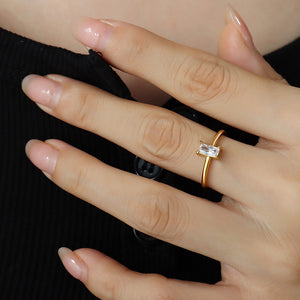
- Closest true cocktail ring (bold CZ statement): our 18K Gold Plated Statement Ring — a rectangular baguette-cut cubic zirconia flush-set into a bold, tapered 18K gold-plated band, the most cocktail-ring-forward piece in the collection at an everyday price.
- Sparkle-dense alternative: our Diamond CZ Stacking Ring — a pavé-covered band for edge-to-edge brilliance when you want shimmer over a single big stone.
- Bold, attention-first style: our CZ Chain Ring — a sterling silver statement band with presence for a more modern, unexpected cocktail look.
- Browse the full range: the complete rings collection for every finish and setting.
One honest note: AJLuxe's strength is affordable CZ and gold-plated statement rings rather than large colored-gemstone cocktail rings — so if you specifically want an emerald, sapphire, or ruby center stone, that's a colored-gemstone purchase in a different tier. The pieces above deliver the oversized, high-sparkle cocktail look on a hypoallergenic base at an everyday price, which is exactly what most shoppers searching for the style actually want.
Shop This Guide
Our 18K Gold Plated Statement Ring — an oversized crown setting around a large tarnish-resistant cubic zirconia center, the closest true cocktail-ring look in the collection and built for real evening wear without a fine-jewelry price.
Shop the 18K Gold Plated Statement RingHow to choose: a quick decision path
- Set your stone by budget and intent. Everyday drama and low risk → cubic zirconia on a quality base. Durable daily sparkle → moissanite. A color statement → colored gemstone. Heirloom → fine diamond or precious gemstone.
- Choose your scale. One large center stone for maximum impact, or a dense cluster or pavé band for all-over shimmer.
- Fit for weight. Size a touch snugger than a plain band, or pick an adjustable open band so the heavy stone can't spin.
- Commit to the right hand. Wear it on the right ring or middle finger to keep it clearly a style piece, not a bridal one.
- Style with subtraction. One hero ring, quiet earrings, minimal everything else — let the cocktail ring be the statement.
Written by the AJLuxe Team. Last updated: July 2026. According to Jewelers of America, buyers should inspect a ring's setting security and metal quality before purchase — advice that matters especially for cocktail rings, where a large, heavy stone sits high in its setting and depends on a well-made mount and a properly fitted band to stay secure through an evening of wear.
Frequently Asked Questions
What is the best cocktail ring for everyday wear?
For everyday wear, the best cocktail ring is a bold but not enormous statement piece on a hypoallergenic base — a large cubic zirconia center on 925 sterling silver or quality gold plating, or moissanite if you want daily durability. An adjustable or slightly snug band keeps the heavy stone from spinning, and a single mid-size stone reads as chic day to night rather than costume.
What exactly makes a ring a cocktail ring?
A cocktail ring is a deliberately oversized ring with a large center stone or dramatic cluster, worn on the right hand purely for style with no engagement or wedding meaning. The defining traits are its bold scale, its self-expression purpose, and its right-hand placement, which together separate it from bridal rings.
Which hand and finger do you wear a cocktail ring on?
A cocktail ring is traditionally worn on the right hand, usually the ring or middle finger. That placement keeps it clearly a fashion statement and separate from the engagement and wedding rings worn on the left hand, which is exactly why a cocktail ring can be as bold as you like.
What is the difference between a cocktail ring and a dinner ring?
They overlap heavily and are often used interchangeably, but a cocktail ring is typically a bold, high-set focal stone with a playful, party-forward mood, while a dinner ring is often longer and lower-profile with a more restrained, formal elegance. Both are right-hand statement rings worn for style rather than commitment.
Are cubic zirconia cocktail rings worth buying?
Yes, for most people a cubic zirconia cocktail ring is worth it because the style is a fashion statement rather than an investment. A well-made CZ piece on a genuine sterling silver or quality gold-plated base gives you the full oversized look for a fraction of the cost, so you can even own several stone colors and swap them by outfit.
How do I size a heavy statement ring so it doesn't spin?
Because a cocktail ring is top-loaded, size it slightly snugger than a thin band so its weight can't rotate it, or choose an adjustable open band that hugs the finger. Account for a wide band feeling tighter than a thin one at the same size, and make sure it clears your knuckle without gaping at the base.
What stone is best for a cocktail ring?
It depends on your goal. Cubic zirconia is affordable and ideal for trying the look or owning several, moissanite adds durability for daily wear, a colored gemstone like sapphire or emerald delivers the classic cocktail-ring color statement, and a fine diamond suits heirloom-tier pieces. Since cocktail rings are bought for style, most shoppers are well served by an affordable synthetic stone.
How do I style a cocktail ring without looking overdone?
Treat the cocktail ring as your single hero and keep everything else quiet. Wear small studs or huggies instead of chandelier earrings, keep the other hand bare or minimal, echo the ring's metal in a delicate bracelet rather than matching its stone color, and avoid stacking loud bangles beside it. One statement, everything else dialed back.
When is it appropriate to wear a cocktail ring?
A cocktail ring suits parties, evening events, weddings you attend as a guest, date nights, and dressing up an otherwise casual outfit like jeans and a blazer. Because it carries no bridal meaning, you can wear it any time you want your hand to be the accent, including as a gift to yourself for a personal milestone.
Can a cocktail ring be worn for a wedding?
Yes, a cocktail ring is a great choice for wedding guests because a colorful statement piece lets you dress up without competing with the couple and photographs beautifully. Wear it on your right hand and keep the rest of your jewelry restrained so the ring stays the accent rather than overwhelming your look.
How much should I spend on a cocktail ring?
It depends entirely on whether you want a trend piece or an heirloom. Affordable cubic zirconia and gold-plated cocktail rings run about $25 to $70 and let you experiment freely, while fine gold, gemstone, and diamond versions start around a few hundred dollars and climb into five figures. Since the style is about self-expression, many buyers start affordable and only invest in a fine version once they know the exact look they want to keep.
Is a cocktail ring the same as a statement ring?
A cocktail ring is a type of statement ring, but not every statement ring is a cocktail ring. A cocktail ring specifically refers to an oversized, gemstone-forward ring rooted in party glamour and worn on the right hand, while statement ring is a broader term that also covers bold sculptural bands, signet rings, and chunky designs without a large center stone.
Alle Marken, Markennamen und Produktnamen Dritter sind Eigentum ihrer jeweiligen Inhaber. AJLuxe steht in keiner Verbindung zu den in diesem Artikel genannten Marken Dritter und wird von diesen weder unterstützt noch gesponsert. Markennamen werden ausschließlich zur sachlichen vergleichenden Bezugnahme verwendet; Materialangaben entsprechen den eigenen veröffentlichten Produktangaben der jeweiligen Marke zum Zeitpunkt der Erstellung.
You Might Also Like

The piece they're describing → Zarte Stapelringe für Damen – 18K vergoldet, schmaler Ringsatz, minimalistisch
Personalize Yours


