


Quick answer: Mood necklace colors work exactly like mood ring colors — the stone changes based on your body temperature, which shifts with your emotions. Blue means calm or relaxed. Green means neutral or balanced. Purple means happy or romantic. Black or dark gray means stressed or cold. Yellow or amber means nervous or unsettled. The full color chart is below.

A mood necklace works on the same principle as a mood ring — a thermochromic stone that shifts color in response to body temperature. The colors and meanings are the same across both formats; the difference is purely the jewelry style. If you know your mood ring colors, you already know your mood necklace colors.
This guide covers every color you'll see on a mood necklace, what each one means, how the temperature-to-color mechanism works, and why two people wearing the same necklace can show different colors in the same room.
Mood Necklace Color Chart — All Colors and Meanings
| Color | Body Temp (approx.) | Emotional State | What It Signals |
|---|---|---|---|
| Deep Blue / Dark Blue | 98°F+ (36.7°C+) | Very calm, deeply relaxed | Happy, at ease, in a comfortable environment |
| Blue | 97–98°F (36.1–36.7°C) | Calm, relaxed | At ease, content — the most commonly cited "good mood" color |
| Blue-Green | 96–97°F (35.6–36.1°C) | Relaxed, slightly alert | Calm but engaged — transitioning between relaxed and neutral |
| Green | 95–96°F (35–35.6°C) | Neutral, normal, balanced | Average body temp, no strong emotional signal — "neutral" baseline |
| Purple / Violet | 98–99°F (36.7–37.2°C) | Happy, romantic, excited | Positive arousal — love, excitement, creativity |
| Red / Dark Red | 99°F+ (37.2°C+) | Passionate, energized, or angry | High energy emotional state — context determines if it's positive or negative |
| Yellow / Amber | 92–94°F (33–34°C) | Nervous, unsettled, mixed feelings | Slightly cooler body temp — anxiety, anticipation, or just a cool room |
| Gray | 88–92°F (31–33°C) | Anxious, stressed | Low circulation or stress response — hands and neck cooling |
| Black / Dark Gray | Below 82°F (27.8°C) | Very stressed, or simply cold | Lowest temp reading — often means cold environment, not necessarily distress |
What Does Blue Mean on a Mood Necklace?
Blue is the most sought-after mood necklace color — and it's the one people associate most with "good mood." A blue mood necklace means your body temperature near the stone is relatively high (around 97–98°F / 36–36.7°C), which correlates with a calm, relaxed, comfortable emotional state.
The deeper the blue, the warmer the reading. Dark blue or deep indigo typically means you're very at ease — deeply relaxed or genuinely happy. Medium blue is calm and content. Light blue or blue-green is a transition zone toward neutral.
Blue is common when you're at rest, in a comfortable room, or in a positive social situation. It's one of the reasons mood jewelry became associated with positive emotions in pop culture — when people are relaxed and happy, body temperature in the extremities rises, and blue is what shows.
What Does Green Mean on a Mood Necklace?
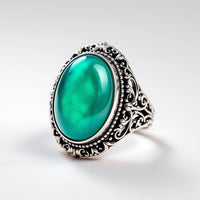
Green on a mood necklace indicates a neutral emotional state — not stressed, not especially excited. It's the baseline color for many people in normal resting conditions.
Green doesn't mean anything negative. It's the thermochromic stone's midpoint — the body temperature reading that sits between the lower readings (cooler colors like amber/gray) and the higher readings (warmer colors like blue/purple). Think of it as "normal" — you're not showing any strong physiological response in either direction.
If your necklace is always green, it likely means the stone is sitting slightly further from your skin than a ring would, resulting in a lower and more stable reading. Necklace pendants typically read a few degrees cooler than ring stones because they're not in constant contact with the fingertip's high circulation.
What Does Purple Mean on a Mood Necklace?
Purple or violet on a mood necklace is associated with happiness, romance, excitement, or creativity. It sits above blue on the temperature scale — your body is running slightly warmer than the blue-calm zone, which happens during positive emotional arousal: excitement, attraction, or enthusiastic engagement.
Purple is the color most associated with being "in love" in mood jewelry folklore, which has some physiological basis — attraction and excitement genuinely raise peripheral blood temperature.
What Does Black Mean on a Mood Necklace?
Black or very dark gray is the lowest temperature reading on a mood necklace. The most common reason: the stone is cold, not that the wearer is in distress. If you've just come inside from the cold, or if the necklace has been sitting away from your skin, it will read black until it warms up.
In emotional terms, black is traditionally associated with stress, tension, or anxiety — states where blood is redirected away from the extremities (vasoconstriction), cooling the skin surface. But context matters. A black necklace on a cold day says nothing about your emotional state.
How Mood Necklaces Work
Mood necklace stones — like mood ring stones — contain thermochromic liquid crystals. These are microscopic crystals that change their molecular structure in response to temperature changes, which changes how they absorb and reflect light — and therefore their visible color.
The liquid crystals in mood jewelry are calibrated to the range of human skin temperature (roughly 82–99°F / 28–37°C). Small shifts in skin temperature — driven by changes in blood flow near the surface — produce visible color changes in the stone.
Emotions affect blood flow because the autonomic nervous system controls vasodilation and vasoconstriction in response to emotional states. Stress narrows blood vessels in the skin (cooling it); relaxation and positive emotions dilate them (warming it). This is the physiological basis for why mood jewelry works as a rough emotional indicator — though it's reading temperature, not emotion directly.

Why a Mood Necklace Shows Different Colors Than a Mood Ring
The same person wearing a mood ring and a mood necklace at the same time will often see different colors — and this is expected, not a defect.
Fingertips have some of the highest blood circulation density of any body part. They're extremely temperature-responsive. A mood ring on your finger captures very precise emotional temperature fluctuations — it's the most sensitive placement.
A necklace pendant hangs against your chest or sternum, which is warmer and more stable in temperature. It also moves away from the skin when you move. The result: mood necklaces often show a more "average" reading — frequently settling in the green-to-blue-green range — rather than the more responsive fluctuations a ring shows.
Neither reading is more accurate. They're reading different parts of your body. For the most responsive reading, see our full guide: mood ring colors and meanings.
Frequently Asked Questions
What does blue mean on a mood necklace?
Blue on a mood necklace means calm and relaxed — your skin temperature near the stone is around 97–98°F, indicating good circulation and a comfortable emotional state. Dark blue means very calm or deeply happy. Blue-green is a transition toward neutral.
What does green mean on a mood necklace?
Green on a mood necklace means neutral or balanced — no strong emotional signal in either direction. It's the baseline color for many people at average body temperature (around 95–96°F near the stone). Green is normal, not negative.
What does purple mean on a mood necklace?
Purple on a mood necklace means happy, romantic, or excited. It reflects a slightly higher body temperature than blue — the result of positive emotional arousal. It's the color most associated with love and excitement in mood jewelry.
What does black mean on a mood necklace?
Black on a mood necklace usually means the stone is cold — you've just come inside from outdoors, or the pendant has been away from your skin. In emotional terms it's associated with stress or tension, but a cold environment is the more common cause.
What does yellow mean on a mood necklace?
Yellow or amber on a mood necklace means nervous, unsettled, or mixed emotions — a slightly cooler skin temperature reading than green. It can also simply mean you're in a cool room or the necklace is reading a less-warm area of your chest.
Are mood necklace colors the same as mood ring colors?
Yes — the color chart is identical. Both use the same thermochromic liquid crystal technology calibrated to the same temperature range. The difference is placement: rings read fingertip temperature (very responsive), while necklaces read chest/sternum temperature (more stable, often reads in the green-blue range). See: complete mood ring color chart.
Why does my mood necklace always show green?
A mood necklace that consistently shows green is reading your skin temperature as neutral — around 95–96°F near the stone. This is common because pendant necklaces sit against the chest, which is warmer and more temperature-stable than the fingertip. Your necklace may simply be reading your average resting temperature. This is normal — green means balanced, not broken.
You Might Also Like
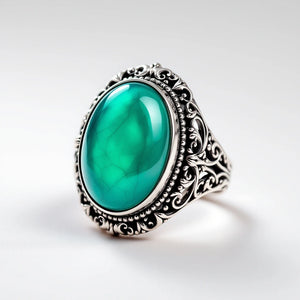
The piece they're describing → Bague d'humeur à changement de couleur — Pierre thermochromique avec nuancier
Personalize Yours

