


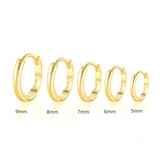
Huggie earring sizing is simpler than it looks — but getting it right makes the difference between an earring that sits perfectly and one that pinches or floats away from the ear. This guide covers every size, every piercing position, and how to choose correctly the first time so you don't need to exchange anything.
How Huggie Earring Size Is Measured
Huggie earring size refers to the inner diameter — the distance across the inside of the hoop circle. This is the measurement that determines how the earring fits against your lobe, because it's the space the lobe sits inside.
Some brands use outer diameter instead (which adds roughly 2–3mm for the metal width), so a brand listing 12mm outer is roughly equivalent to 9–10mm inner from a brand measuring inner diameter. If a size looks larger than expected in product images, check whether the brand specifies inner or outer diameter. When in doubt, use the product images with a scale reference.
For full hoop sizing context across all styles, see our hoop earring size guide.
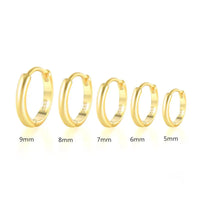
Huggie Earring Size Chart
| Size | Best piercing position | Lobe thickness | How it looks |
|---|---|---|---|
| 6mm | Tragus, forward helix, daith | Thin to standard | Ultra-close fit, barely-there |
| 8mm | Helix, conch, second lobe | Thin to standard | Dainty — the stacking standard |
| 10mm | First lobe — standard | Thin to medium | Classic huggie, most popular size |
| 12mm | First lobe — fuller presence | Medium to thick | Visible without being a statement |
| 14mm | First lobe — transitional | Standard to thick | Borders huggie and small hoop territory |
Sizing for Your First Lobe Piercing
The standard first lobe huggie size is 10mm. For most people with standard lobe thickness, a 10mm huggie clicks closed comfortably, sits flush against the front and back of the lobe, and looks proportional without being too small to notice or too large to cross into hoop territory.
Two situations where you'd adjust:
- Thick lobes: Go up to 12mm. A 10mm huggie on a thick lobe will feel tight when the clasp snaps shut. The earring should feel snug, not pinching.
- Very thin lobes or small earlobes: Try 8mm. A 10mm on a very small lobe can extend slightly below the lobe edge, which bridges into small-hoop territory and removes the flush-fit effect that defines huggie styling.
The fit check: when the clasp is closed, the inner circle of the earring should touch the front and back of your lobe lightly without pressing into the skin or leaving a red mark. If it pinches, go up two millimeters. If it feels loose, go down two.
Sizing for a Second Lobe Piercing
8mm is the standard huggie size for a second lobe piercing. The second hole is typically placed 6–8mm above the first, and an 8mm huggie sits clearly above the first-lobe earring without the two touching or crowding each other.
If your first and second piercings are placed further apart than average — some people have 10–12mm between holes — you can wear matching 10mm huggies in both. The visual key is that earrings shouldn't touch. If two 10mm huggies overlap or sit too close when both are worn, go down to 8mm in the second hole.
Sizing for Cartilage Piercings
Cartilage piercings have much less available space than lobes, and the tissue is less forgiving of an earring that's too large. The risk of a too-large huggie in cartilage is leverage: if the hoop extends too far from the cartilage surface, it can rotate or snag more easily.
- Helix piercing: 8mm is standard. Sits close to the ear rim without extending outward.
- Forward helix: 6mm or 8mm, depending on available space. Forward helix piercings are close to the inner ear curve, so 6mm is often the better fit.
- Tragus: 6mm. The tragus is the small cartilage flap directly in front of the ear canal — space is very limited.
- Conch: 8mm or 10mm. The conch sits in the bowl of the ear where there's more room than other cartilage positions.
- Daith: 8mm. The daith passes through the innermost cartilage fold — an 8mm huggie sits flush without extending into the ear canal.
Important: wait at least 12 weeks after a cartilage piercing before switching to a huggie. Cartilage heals slowly and a hinged clasp can irritate the tissue before it's fully healed. See our full guide to huggie earrings for cartilage for more on healing timelines and placement.
Sizing for Ear Stacking
The rule for a stacked huggie ear is: larger at the first lobe, smaller going up. This creates a graduated look that reads as intentional rather than mismatched.
Common stacking combinations:
- Two lobe piercings: 10mm (first) + 8mm (second)
- Two lobes + cartilage: 10mm (first) + 8mm (second) + 6mm (helix)
- Three lobes: 12mm (first) + 10mm (second) + 8mm (third)
- Mixed styles: 10mm huggie (first lobe) + flat-back stud (second) + 6mm huggie (helix)
The goal is visual graduation — each step up is a distinct, slightly smaller earring. If two adjacent sizes are too similar (e.g. 10mm + 10mm), they blend into each other instead of reading as a stack. A 2mm step down per position is the minimum; 2–4mm per step looks intentional.
For more on combining huggie earrings with other styles, see our guide to stacking huggie earrings.
Does Face Shape Affect Huggie Earring Size?
Face shape matters more for statement earring styles (drops, chandeliers) than for huggies. Since huggies sit at the ear rather than hanging below the jaw, their size effect is minimal relative to face shape.
That said, some general guidance:
- Round or full faces: 12–14mm huggie earrings add horizontal visual weight at the ear — fine for a stacked ear look but not for balancing face shape the way longer earrings would.
- Oval or angular faces: Any huggie size works. The proportion is more about personal preference and lobe size than face shape.
- Long or narrow faces: Larger huggie sizes (12–14mm) add width; smaller sizes (6–8mm) are less noticeable. For significant face-shape balancing, drop earrings are a better tool than huggies.
How to Choose
The short version: start with 10mm for a first lobe piercing, go down 2mm for each additional piercing going up the ear, and go up to 12mm only if you have thick lobes or want a fuller look. When in doubt, 10mm is the safe choice — it's the most universally flattering huggie size and the one most earring collections are built around.
If you have multiple piercings, buy a set that includes two or three sizes — one each of 8mm, 10mm, and 12mm — so you can experiment with the stacked look before committing to a specific combination. AJLuxe huggie earrings are available in multiple sizes, all 18K gold plated over 925 sterling silver, from $25.
For everything else about the style, including how they close, what metals to look for, and how to care for them, see our complete huggie earrings guide.
Once you've picked a size, our step-by-step guide to opening huggie earrings covers the hinge mechanism itself -- how to open and close it without forcing it, and what to do if a new pair feels stiff.
our heart huggie earrings guide covers a heart-accent huggie style specifically, including hinge and plating quality to check before buying.
For sizing guidance beyond earrings, see our plus size jewelry guide, covering rings, bracelets, and necklaces.
Frequently Asked Questions
What size huggie earrings should I get?
10mm is the standard starting size for a first lobe piercing. For cartilage piercings, use 6–8mm. For a second lobe piercing, 8mm pairs cleanly with a 10mm in the first hole. If you have thick lobes, go up to 12mm.
What is the most popular huggie earring size?
10mm is the most popular huggie earring size. It's the standard for a first lobe piercing and the middle of the huggie range, which gives the flush-against-the-ear look that defines the style without being too small to notice.
How do I measure huggie earring size?
Huggie earring size is measured as the inner diameter — the measurement across the inside of the hoop. Most brands use inner diameter; some use outer diameter (add 2–3mm to compare). When in doubt, check the product images for a scale reference.
What size huggie earrings for a second piercing?
8mm is the standard for a second lobe piercing. It's small enough to sit clearly above a 10mm first-lobe huggie without the two crowding each other. If your piercings are further apart, 10mm can work in both holes.
What size huggie earrings for cartilage?
6mm for tragus, forward helix, and tight cartilage positions. 8mm for helix, conch, and daith. Avoid 10mm+ in cartilage — the arc extends too far from the ear and increases snagging risk.
What size huggie earrings for thick earlobes?
Go up one size from the standard recommendation. If you'd normally wear 10mm, try 12mm. The huggie should feel snug when closed without any pinching. A 10mm huggie on a thick lobe will feel tight when the clasp snaps shut.
How tight should huggie earrings feel?
Snug but not tight. The inside of the hoop should touch the front and back of the lobe lightly without pressing into the skin or leaving a mark. If it pinches, go up two millimeters. If it floats away from the ear, go down two.
Can you wear different sizes in different ears?
Yes — very common. Many people have slightly different lobe thickness on each side. Wearing 10mm on one side and 12mm on the other for a better fit is perfectly fine and unnoticeable to anyone else.
What size huggie earrings for a helix piercing?
8mm is the most common helix size. It sits close to the cartilage ridge without extending too far outward. For a tight or high placement, 6mm gives a closer fit.
Do huggie earring sizes vary by brand?
Slightly — most measure inner diameter but some use outer diameter. A brand listing 12mm outer is equivalent to about 9–10mm inner. When comparing across brands, check whether they specify inner or outer diameter.
Toutes les marques, noms de marque et noms de produits tiers sont la propriété de leurs détenteurs respectifs. AJLuxe n’est affilié à aucune marque tierce citée dans cet article, ni approuvé ou sponsorisé par celle-ci. Les noms de marque sont utilisés uniquement à des fins de comparaison factuelle, et les descriptions de matériaux reflètent les spécifications produit publiées par chaque marque au moment de la rédaction.
You Might Also Like
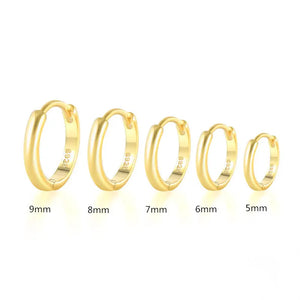
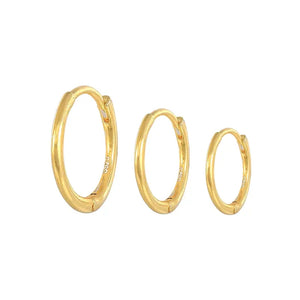
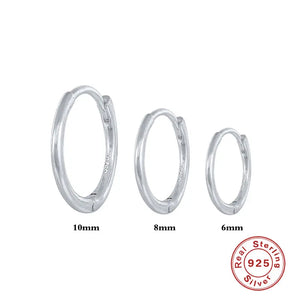

The piece they're describing → Boucles d'oreilles créoles dorées pour femme — Argent sterling 925, plaqué or 18 carats, minimalistes
Personalize Yours


