


Hessonite is a type of garnet — specifically a grossular garnet with an orange-brown to honey color — used in Vedic astrology as Gomed, the gemstone for Rahu (North Node of Moon). Red almandine garnet serves Mars. Both belong to the garnet family but govern different planets and carry different wearing rules.
TL;DR:
• Hessonite (Gomed) IS a garnet species — grossular — but looks nothing like deep red almandine garnet
• In Vedic astrology, hessonite rules Rahu; red garnet rules Mars — completely separate planetary remedies
• Wearing the wrong stone for the wrong planet can backfire; consult your birth chart before choosing
Walk into any gemstone market in India and ask for "garnet" — you might get a deep red stone or a honey-colored one, depending on who you ask. The confusion is real: hessonite and red garnet are both garnets, but they look different, cost differently, and serve entirely different purposes in Vedic astrology. If you've ever wondered whether garnet vs hessonite matters for your birth chart, the answer is yes — a lot. This guide breaks down every difference so you can make the right choice.
In This Guide
- What Is Hessonite Garnet?
- The Honey Stone: Hessonite Explained
- Hessonite (Gomed) in Vedic Astrology: The Rahu Stone
- Red Garnet in Vedic Astrology: The Mars Connection
- How to Buy and Wear Hessonite for Vedic Use
- Color and Jewelry Use Compared
- Frequently Asked Questions
- Final Thoughts
What Is Hessonite Garnet?
The garnet family is bigger than most people realize. It's not one mineral — it's a group of silicate minerals that share a similar crystal structure but vary in chemical composition and color. Almandine garnet gives you that classic deep red. Pyrope garnet runs toward crimson. Tsavorite garnet is vivid green. And hessonite garnet — also called cinnamon stone — ranges from warm orange to deep honey brown.
Hessonite is a variety of grossular garnet, a calcium-aluminum silicate. Its distinctive color comes from manganese and iron impurities. Under magnification, hessonite often shows a swirling, treacly internal texture that gemologists call a "scotch-in-water" or "heat-wave" effect — caused by high iron content disturbing the crystal growth. This internal character is actually considered a feature, not a flaw, in Vedic gem markets where the stone is prized.
The name hessonite comes from the Greek word hesson, meaning "inferior" — an unfair label that refers to its lower density compared to other garnets, not its quality or value. In Vedic traditions, it carries the Sanskrit name Gomed (sometimes spelled Gomedh or Gomedak) and is treated as one of the nine sacred Navaratna stones.
| Property | Hessonite (Gomed) | Red Almandine Garnet |
|---|---|---|
| Species | Grossular garnet | Almandine garnet |
| Color | Orange-brown, honey, cinnamon | Deep red to reddish-brown |
| Mohs Hardness | 7–7.5 | 7–7.5 |
| Vedic Planet | Rahu (North Node of Moon) | Mars (Mangal) |
| Price per Carat | $10–$200 | $20–$400 |
| Primary Sources | Sri Lanka, India, Brazil | India, Mozambique, Brazil |
The Honey Stone: Hessonite Explained
If you hold a hessonite next to a classic red garnet, the visual difference is immediate. Hessonite's warm amber and orange-brown tones look almost edible — like honey or dark caramel — while almandine garnet reads as a rich, wine-dark red. Both are beautiful, but you'd never mix them up side by side. The confusion happens mostly in writing, where both get called "garnet" without the variety specified.
Sri Lanka (historically called Ceylon) is the most famous source for high-quality hessonite. The finest stones come from the gem gravels of Ratnapura — the same region that produces blue sapphires and cat's-eye chrysoberyl. Indian hessonite also exists but tends to show more inclusions. Brazilian hessonite enters the market in larger sizes but sometimes with weaker color saturation.
From a jewelry standpoint, hessonite is a wearable everyday stone. At Mohs 7–7.5, it's similar in durability to standard garnets — harder than opal or moonstone, softer than sapphire or diamond. It can chip if struck hard against a sharp edge, so protective settings work better than exposed prong styles for rings. In pendants and earrings, it's very practical. The warm amber color pairs naturally with yellow gold and rose gold, though sterling silver works well too and gives it a more contemporary edge.
Quality factors for hessonite follow standard gem grading: color (deep honey orange with good saturation wins), clarity (eye-clean is strongly preferred, especially for Vedic use), cut (well-proportioned ovals and cushions maximize the internal fire), and carat weight. Vedic astrologers specifically require larger, heavier stones — typically at least 5 carats — because astrological gems are believed to need sufficient mass to exert their planetary influence. A 1-carat hessonite pendant is lovely jewelry; a 5-carat hessonite ring is a Vedic remedy.
Hessonite (Gomed) in Vedic Astrology: The Rahu Stone
In Vedic astrology (Jyotish), the universe operates through nine planets — the Navagrahas — each associated with a gemstone. Rahu, the North Node of the Moon, is one of the shadow planets (Chaya Graha). It's not a physical body but the mathematical point where the Moon's orbit crosses the ecliptic. Despite being invisible, Rahu is considered one of the most powerful and unpredictable forces in a birth chart.
Rahu governs ambition, obsession, materialism, sudden windfalls, foreign travel, technology, illusion, and radical change. When Rahu is strong and well-placed, it can catapult a person to fame, wealth, or unconventional success. When it's weak, afflicted, or placed in challenging houses, it can bring confusion, addictions, health issues (especially skin and nervous system), and a restless, unfocused energy. Gomed (hessonite) is prescribed to strengthen Rahu's positive influence.
Who should wear Gomed? Vedic astrologers recommend it primarily for:
- People born under Aquarius (Kumbha) rashi — Rahu is a friendly planet for Aquarius
- Anyone running Rahu mahadasha (the 18-year Rahu planetary period) or Rahu antardasha
- Charts where Rahu is placed in the 1st, 5th, 9th, or 11th house with good dignity
- Those experiencing career stagnation, confusion, or delays believed to stem from a weak Rahu
The traditional Vedic wearing protocol for Gomed is precise. The stone should be set in silver (silver resonates with Rahu's cool, shadowy energy) and worn on the middle finger of the right hand. The ideal day to begin wearing it is Saturday, during a waxing Moon. Before wearing, the stone is typically energized through a purification ritual — washed in Ganga water or raw milk, then consecrated with Rahu mantras. The minimum weight prescribed is 5–7 carats for adults. Stones should be eye-clean — any visible cracks, black spots, or dull patches are considered inauspicious and can negate or reverse the intended effect.
Red Garnet in Vedic Astrology: The Mars Connection
Red garnet — typically almandine or pyrope — is associated with Mars (Mangal) in Vedic astrology. Mars governs courage, physical strength, willpower, ambition in action (as opposed to Rahu's ambition in thought), brothers, property, and the military. Red coral (Moonga) is the primary Vedic stone for Mars, but red garnet is widely accepted as an alternative when coral isn't suitable or available.
Mars rules two zodiac signs: Aries (Mesha) and Scorpio (Vrishchika). People with these as their moon sign or ascendant, or those running Mars mahadasha (the 7-year Mars period), may be recommended red garnet or red coral. A strong Mars brings energy, leadership, and decisive action. A weak or afflicted Mars can manifest as anger issues, accidents, blood-related health concerns, or lack of drive.
The wearing rules for Mars garnet differ significantly from Gomed. The prescribed metal is copper or gold (both Mars metals — silver is specifically avoided because it's a Moon/Rahu metal). The stone goes on the ring finger of the right hand, and the ideal starting day is Tuesday (Mangalwar — literally Mars-day in Hindi). Minimum weight is 3–5 carats. As with all Vedic gems, clarity and no visible defects are required.
It's worth noting that Western gemology doesn't assign planetary properties to stones — these concepts are purely within the Vedic tradition. If you're buying garnet purely for jewelry, any variety you love is the right choice. If you're buying for Vedic purposes, the planet matters enormously: Gomed for Rahu, red garnet for Mars — and they are never interchangeable for astrological use.
How to Buy and Wear Hessonite for Vedic Use
Buying Gomed for astrological purposes requires more scrutiny than buying garnet for jewelry. The Vedic gem trade in India is sophisticated but also full of substitutions — cheaper orange stones like spessartine garnet, orange zircon, or even synthetic material get sold as hessonite. Always ask for a gemological certificate from a recognized lab (GIA, IGI, or SSEF) that identifies the stone as grossular garnet (hessonite variety). Color should be a warm, even honey-orange or cinnamon without gray or muddy overtones.
Here's what to look for when buying hessonite for Vedic use:
- Weight: Minimum 5 carats; 6–8 carats preferred for adults; some astrologers say 1/10th of body weight in carats
- Clarity: Eye-clean; internal "heat-wave" texture is acceptable, but no black spots, cracks, or milky patches
- Color: Medium to deep honey orange or cinnamon brown — avoid pale, colorless, or very dark stones
- Origin: Ceylon (Sri Lanka) hessonite commands the highest Vedic premium
- Setting: Ashtadhatu (8-metal alloy) or pure silver; the stone should touch the skin through an open-back setting
Price varies widely. Commercial hessonite runs $10–$50 per carat. Fine Ceylon hessonite with good color and clarity can reach $100–$200 per carat. For Vedic purposes, a 6-carat stone in a silver ring will typically cost $100–$600 depending on quality and origin premium. Compare this to blue sapphire (the stone for Saturn), which can cost thousands per carat — hessonite is one of the more accessible Navaratna stones.
One important caution: Vedic astrologers strongly advise getting your birth chart analyzed before wearing any planetary gemstone. Wearing Gomed when Rahu is not a functional benefic in your chart — or when Rahu is in a malefic position — can intensify problems rather than resolve them. Unlike a bracelet or earring you wear for aesthetics, Vedic gemstones are treated as active remedies with real effects, and the wrong remedy can backfire.
Color and Jewelry Use Compared
Even outside the Vedic context, hessonite and red garnet suit very different aesthetics. Red almandine garnet is a January birthstone classic — rich, saturated, and timeless. It works beautifully in vintage-style settings, alongside yellow gold and warm metals. Hessonite's amber-orange palette feels warmer and more earthy, reminiscent of amber or topaz. It photographs especially well in natural light, with an inner glow that deeper red garnets don't have.
For everyday jewelry, both are practical. The Mohs hardness is identical, so neither stone has a durability advantage. Hessonite tends to show inclusions more easily than almandine, so bezel or half-bezel settings work well to protect the stone's edges and minimize the visibility of any internal texture. Red garnet tends to be slightly cleaner internally, making prong settings more common in commercial jewelry.
| Feature | Hessonite Garnet | Red Almandine Garnet |
|---|---|---|
| Color family | Orange, honey, cinnamon brown | Deep red, wine red, reddish brown |
| Best metal pairing | Yellow gold, rose gold, silver | Yellow gold, copper, rose gold |
| Setting style | Bezel, half-bezel, cabochon | Prong, bezel, vintage cluster |
| January birthstone | No (not traditional) | Yes |
| Vedic planet | Rahu | Mars |
| Vedic ring finger | Middle finger, right hand | Ring finger, right hand |
| Vedic day to wear | Saturday | Tuesday |
| Price range/ct | $10–$200 | $20–$400 |
If you're shopping purely for aesthetics — say, a garnet necklace to wear with warm-toned outfits — hessonite's amber glow is distinctive and less common than the standard red. It'll draw compliments from people who notice it's "something different." Red garnet's appeal is more universal and easier to match with a wider wardrobe range. Both are beautiful; neither is "better" in a jewelry-only context. Check out our garnet birthstone guide to see the full range of garnet varieties and which one might suit your style.
Frequently Asked Questions
Is hessonite the same as garnet?
Yes — hessonite is a variety of garnet, specifically grossular garnet. All hessonite is garnet, but not all garnet is hessonite. The key difference is that hessonite has an orange-brown to honey color, while the most common garnets (almandine) are deep red. They share the same mineral family but different chemistry and color.

What is Gomed stone in English?
Gomed is the Sanskrit/Hindi name for hessonite garnet. In English, it's called hessonite, cinnamon stone, or honey garnet. The name Gomed (also spelled Gomedh or Gomedak) is used almost exclusively in Vedic astrology contexts to refer to this stone in its role as the Navaratna gem for Rahu.
Who should wear Gomed (hessonite)?
In Vedic astrology, Gomed is recommended for people with Aquarius (Kumbha) moon sign or ascendant, those running Rahu mahadasha or Rahu antardasha, and anyone whose birth chart shows a weak or afflicted Rahu that an astrologer determines can be strengthened. You should consult a qualified Jyotish astrologer before wearing any Navaratna stone.
Can I wear hessonite and red garnet together?
In Vedic astrology, this is generally not recommended without careful chart analysis. Rahu (hessonite) and Mars (red garnet) have a complex relationship — they can be mutually incompatible depending on your chart. Wearing both simultaneously without guidance could create conflicting planetary energies. For jewelry purposes only, there's no issue combining them aesthetically.
Which finger do you wear Gomed on?
The traditional Vedic prescription is the middle finger (Saturn's finger) of the right hand, set in silver. This differs from red garnet for Mars, which goes on the ring finger. The middle finger placement is specific to Rahu's association with shadow energy and transformation.
What day should you start wearing Gomed?
Saturday is the prescribed day for beginning to wear Gomed, ideally during the waxing phase of the Moon (Shukla Paksha) and in an auspicious Muhurta (time window) if possible. Saturday is associated with Saturn, and since Rahu and Saturn are considered friendly planets in Vedic astrology, Saturday is considered auspicious for Rahu remedies.
How many carats of hessonite do you need for Vedic use?
Most Vedic astrologers prescribe a minimum of 5–7 carats for adults. Some traditional texts suggest wearing hessonite equivalent to 1/10th of your body weight in carats (so a 60 kg person would wear 6 carats). Stones under 3 carats are generally considered too small to exert meaningful planetary influence.
What is the difference between Rahu and Mars in Vedic astrology?
Rahu governs obsession, illusion, foreign influences, sudden changes, technology, and shadow desires. Mars governs courage, physical energy, action, conflict, brothers, and property. They're very different energies — Rahu is subtle and illusory, Mars is direct and physical. The gemstones for each (hessonite vs red garnet) are never interchangeable for astrological purposes.
Is red garnet the January birthstone?
Yes. Red garnet (almandine) is the traditional January birthstone. Hessonite garnet is not traditionally listed as the January birthstone, though it belongs to the same mineral family. See our January birthstone guide for a full look at garnet varieties and their meanings.
Can hessonite replace red coral for Rahu?
Actually, it's the other way around — red coral is for Mars, not Rahu. Hessonite (Gomed) is the specific Navaratna stone for Rahu and has no standard substitute in traditional Vedic astrology. Some practitioners accept Zircon (Jarkan) as a secondary option for Rahu when high-quality hessonite is unavailable, but this is debated among astrologers.
How does hessonite compare to garnet in price?
Standard almandine garnet is one of the most affordable gemstones, running $20–$400 per carat depending on quality and size. Hessonite occupies a similar range at $10–$200 per carat, but top-quality Ceylon hessonite with ideal color and clarity can command a Vedic premium. Both are significantly more affordable than sapphire, ruby, or emerald.
What is the difference between garnet and ruby in terms of color?
Garnet (almandine) tends toward darker, more brownish-red or wine-red tones, while ruby is a more vivid, pure red. Ruby is corundum (Mohs 9) and much harder than garnet (Mohs 7–7.5). In Vedic astrology, ruby belongs to the Sun, not Mars. See our garnet vs ruby comparison for a full breakdown of the differences.
Shop Garnet Jewelry at AJLuxe
Our garnet water drop pendant necklace in 925 sterling silver keeps this stone close every day. Ready to shop? Browse all garnet necklaces and birthstone jewelry — every piece hypoallergenic, gift-ready, and backed by our 30-day returns.
Final Thoughts
Garnet vs hessonite comes down to one key insight: they're botanically the same family but functionally very different, especially in Vedic astrology. Hessonite (Gomed) is the planet stone for Rahu — shadow, ambition, and sudden transformation. Red garnet aligns with Mars — courage, action, and physical drive. Wearing the wrong stone for the wrong planet isn't just ineffective; it can amplify the wrong energies entirely.
For jewelry lovers, both are gorgeous and wearable. Hessonite's honey-amber glow is distinctive and underappreciated in Western markets. Red garnet's deep wine tones are timeless and universally flattering. If you're drawn to either for aesthetic reasons alone, wear what you love.
If you're considering either stone for Vedic purposes, invest in a real birth chart consultation first. The stone should match your planetary needs — not just your favorite color.
Shop our garnet birthstone necklace in sterling silver.
Toutes les marques, noms de marque et noms de produits tiers sont la propriété de leurs détenteurs respectifs. AJLuxe n’est affilié à aucune marque tierce citée dans cet article, ni approuvé ou sponsorisé par celle-ci. Les noms de marque sont utilisés uniquement à des fins de comparaison factuelle, et les descriptions de matériaux reflètent les spécifications produit publiées par chaque marque au moment de la rédaction.
You Might Also Like
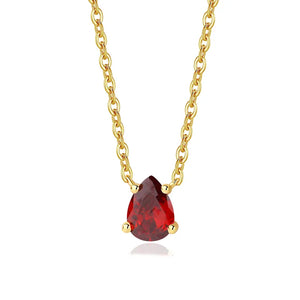
The piece they're describing → Collier pendentif grenat pour femme – Grenat rouge en forme de goutte, argent sterling 925
Personalize Yours


