


- Bvlgari is known for bold, colorful, Rome-inspired design — the coiled snake Serpenti collection, the coin-edge Bvlgari Bvlgari line, and the Colosseum-inspired B.zero1 ring — usually in warm yellow gold with colored gemstone accents, generally starting around $2,000–$3,500 for entry gold pieces.
- Cartier is known for bold, architectural, mostly monochrome design — the Love bracelet, the three-band Trinity ring, and Panthère de Cartier — in solid 18K gold, generally starting around $1,200–$2,000 for entry rings and $7,000+ for the Love bracelet.
- Both houses have real heritage (Bvlgari since 1884, Cartier since 1847) and solid precious-metal construction — but they sit under rival luxury conglomerates: Bvlgari under LVMH since 2011, Cartier under Richemont since the late 1980s.
- Bvlgari reads warmer, more colorful, and more overtly Italian; Cartier reads more restrained and architectural, almost always in plain gold rather than color. Most people are drawn to one design language more than the other.
- If you love the snake motif or the bold-gold look of either house but can't or don't want to spend four to six figures, the honest path is a plated, inspired-by piece — this guide closes with what that looks like, including exactly where it falls short of the real thing.
"Bvlgari vs Cartier" gets searched by people trying to place two of the biggest names in fine jewelry against each other, and the honest answer is that they're both legitimate, century-plus-old luxury houses — but they come from different countries, different design traditions, and, since 2011, different corporate parents entirely. Bvlgari built its identity in Rome on bold color, ancient coins, and the coiled snake; Cartier built its in Paris on architectural restraint, interlocking bands, and royal-court commissions. This guide compares what each house is actually known for, how pricing stacks up tier by tier, and which design language tends to suit different people — then closes with an honest look at how to get either look, specifically the Serpenti snake motif, without the five-figure commitment.
What Bvlgari Is Known For
Bvlgari is known for bold, colorful, distinctly Italian design rooted in ancient Greek and Roman motifs — the coiled Serpenti snake, the coin-inspired Bvlgari Bvlgari collection, and the Colosseum-inspired B.zero1 ring — almost always in warm yellow gold, frequently set with colored gemstones rather than only diamonds. Founded in Rome in 1884 by Sotirio Bulgari, a Greek silversmith, the house later Italianized its spelling to "Bvlgari" using a classical Roman "V" in place of the "U," a detail still visible in the brand's logo today. That Greco-Roman heritage still shapes the identity: Bvlgari pieces tend to read as warmer, more colorful, and more overtly sculptural than the restrained gold-only aesthetic of most French and American houses.
- Serpenti collection (1940s onward). Bvlgari's coiled-snake motif first appeared on bracelet-watches in the 1940s using the house's signature Tubogas technique — a flexible, seamless tube of gold links that coils like real snakeskin — and has since expanded into rings, bracelets, and full articulated necklaces, becoming Bvlgari's single most recognized silhouette.
- B.zero1 ring (1999). A spiral-banded ring inspired by the concentric rings of Rome's Colosseum, B.zero1 became one of Bvlgari's best-selling modern designs and is frequently cited alongside Cartier's Love and Trinity rings as one of the defining "architectural gold ring" silhouettes of the past few decades.
- Bvlgari Bvlgari collection (1975). Round pendants, rings, and bracelets engraved with the brand name in a coin-edge pattern, directly inspired by ancient Roman and Greek coins — a motif that ties the modern collection back to the house's earliest design language.
- Parentesi (1982) and Diva's Dream (2015). Parentesi's interlocking gold links were inspired by the gaps between Rome's cobblestone paving; Diva's Dream uses a fan-shaped mosaic pattern inspired by the ancient Baths of Caracalla — both examples of Bvlgari repeatedly drawing new collections directly from Roman architecture and history.
Bvlgari has been part of the French luxury group LVMH since 2011, when LVMH acquired the house in a deal reported at roughly €4.3 billion (about $5.2 billion) — one of LVMH's largest jewelry acquisitions and a direct answer, in corporate terms, to Richemont's ownership of Cartier and Van Cleef & Arpels.
What Cartier Is Known For
Cartier is known for bold, geometric design signatures — the screw motif of the Love bracelet, the three-band Trinity ring, and the spotted Panthère silhouette — built almost exclusively in solid gold, generally without the colored-gemstone emphasis that runs through Bvlgari's catalog. Founded in Paris in 1847 by Louis-François Cartier, the house earned the nickname "jeweler of kings, king of jewelers," a phrase widely attributed to England's King Edward VII around 1904, after Cartier supplied crowns and tiaras to European royal courts. That royal-supplier heritage still shapes the brand's identity: Cartier pieces tend to read as confident, architectural statements in plain gold rather than the warmer, color-driven pieces Bvlgari is known for.
- Love bracelet (1969). Designed by Aldo Cipullo, the Love bracelet locks onto the wrist with actual screws, traditionally fastened by a partner using a small screwdriver that comes with the piece — a design detail that turned a bracelet into a symbol of a specific kind of commitment.
- Trinity ring (1924). Louis Cartier's three interlocking bands in yellow, white, and rose gold are one of the most imitated ring silhouettes in jewelry, precisely because the concept — three tones, one continuous band — is so simple and so recognizable.
- Panthère de Cartier. The panther has appeared across Cartier's catalog since the early 20th century, championed by Jeanne Toussaint, Cartier's creative director from the 1930s onward, and remains the house's most storied and most collected motif today.
- Juste un Clou (1971). A nail bent into a bracelet or ring — deliberately industrial-looking jewelry that leans into Cartier's willingness to make a statement piece out of an ordinary object.
Cartier has been part of the Swiss luxury group Richemont since the late 1980s, which also owns Van Cleef & Arpels and Piaget — putting Cartier and Bvlgari on opposite sides of the two biggest luxury conglomerates in fine jewelry, Richemont and LVMH, a rivalry that plays out in real market competition rather than shared ownership.
Price Tier Comparison: Bvlgari vs Cartier
Bvlgari and Cartier sit in a similar overall price band, but Bvlgari's heavier use of colored gemstones and its fully articulated Serpenti pieces can push its upper range higher than Cartier's more restrained catalog. Treat the figures below as general, approximate ranges rather than exact current pricing — both brands adjust prices regularly, and specific stone quality, size, and metal choice move the number significantly. Always check each brand's current site for an exact quote before assuming either range.
| Category | Bvlgari (approx. range) | Cartier (approx. range) |
|---|---|---|
| Entry-level accessible piece | ~$2,000–$3,500 (Bvlgari Bvlgari pendant, thin B.zero1 ring) | ~$1,200–$2,000 (Trinity ring, thin Love ring) |
| Signature bracelet | ~$4,000–$6,000 (Parentesi, thin Serpenti Viper bracelet) | ~$7,000–$9,000+ (Love bracelet, no diamonds) |
| Signature ring | ~$3,000–$4,500 (B.zero1, Serpenti Viper ring, gold only) | ~$1,200–$2,500 (Trinity, thin Love ring) |
| Full articulated snake piece | ~$20,000–$60,000+ (fully articulated Serpenti gold bracelet/necklace) | Rare category for Cartier; no true equivalent |
| High jewelry / pavé pieces | Five to six figures | Five to six figures |
The clearest structural difference: Cartier's Love bracelet is more expensive than Bvlgari's equivalent entry bracelets, but Bvlgari's fully articulated gold Serpenti pieces — a snake bracelet or necklace built from hundreds of tiny gold scales that move like real skin — have no true Cartier equivalent and push Bvlgari's ceiling considerably higher. At the entry-ring level the two houses are close, with Cartier's Trinity and thin Love rings undercutting Bvlgari's B.zero1 by a few hundred to a thousand dollars.
Design Philosophy: Bold Italian Color vs. Architectural French Restraint
Bvlgari's design language is bold, warm, and color-driven — the coiled snake, ancient coin engravings, mosaic patterns lifted from Roman ruins — pieces that lean into Italy's classical history and aren't shy about combining gold with colored stones like carnelian, malachite, or mother-of-pearl. Cartier's design language is bold but more restrained and monochrome — screws, interlocking bands, a bent nail — almost always in plain gold, built to read as architectural rather than decorative.
Neither approach is objectively "more luxurious." They're different national design traditions aimed at different moods: Bvlgari for someone drawn to Rome's warmth, color, and ancient-world symbolism, Cartier for someone who wants jewelry to look considered and geometric without color competing for attention. A lot of people who search "Bvlgari vs Cartier" are really asking which national design tradition — Italian maximalism or French architectural minimalism — matches their own taste, and it's genuinely worth handling both in person if you can, since the snake motif's texture and Bvlgari's use of color rarely translate fully in photos.

Which to Choose for Different Occasions and Budgets
- Statement piece built around one strong motif: Bvlgari's Serpenti has the edge — the snake is one of the most recognizable single-motif jewelry silhouettes in the world, in a way that suits someone who wants one piece to do all the talking.
- Everyday stackable piece: Cartier's Trinity or Love ring and Bvlgari's B.zero1 both work here, but Cartier's pieces tend to sit quieter and more monochrome, while Bvlgari's read warmer and more sculptural — a genuine texture difference worth trying on.
- Gift with color and symbolism: Bvlgari's use of colored gemstones and ancient-coin engravings gives it an edge for buyers who want a piece that reads as more than just gold — something Cartier's catalog leans away from.
- Pure architectural minimalism: Cartier's Panthère or Juste un Clou pieces fit a shopper who wants a singular, geometric statement without color or ornamentation competing for attention.
- Neither budget fits right now: This is genuinely the most common position — both houses' entry points sit well above what most people spend on everyday jewelry. That's the gap the closing section of this guide addresses.
Material and Investment-Value Honesty
Both Bvlgari and Cartier construct their fine jewelry from solid precious metals — almost exclusively 18K gold for both houses — which is the core reason both hold real resale value. Solid gold pieces from either house typically retain meaningful resale value on the secondary market because the metal content alone has intrinsic worth, on top of brand demand; Bvlgari's Serpenti pieces and B.zero1 ring, along with Cartier's Love bracelet and Trinity ring, are among the most consistently resold pieces from either brand for exactly this reason.
This is the honest dividing line between authentic luxury jewelry and any affordable "inspired by" alternative, AJLuxe's included: solid gold carries real, lasting resale value, while gold-plated pieces on a base like sterling silver do not, beyond scrap silver worth. That's not a criticism of plated jewelry — it's simply a different product category, bought to wear and enjoy rather than to hold as an asset. If you're deciding between the two houses purely as an investment, both are reasonable choices at the solid-gold tier; if you're deciding because you like the aesthetic and don't need the resale value, that changes the calculation entirely, which is exactly where an affordable alternative becomes the more rational option.
Why Bvlgari and Cartier Are Real Corporate Rivals, Not Siblings
Unlike some jewelry-house comparisons where both brands turn out to share a parent company, Bvlgari and Cartier sit under genuinely competing luxury conglomerates: Bvlgari has been part of LVMH since a 2011 acquisition reported at roughly €4.3 billion, while Cartier has been part of the Swiss group Richemont since the late 1980s. LVMH and Richemont are the two largest luxury conglomerates in the world, and their jewelry divisions compete directly for the same shopper — LVMH also owns Tiffany & Co, while Richemont also owns Van Cleef & Arpels and Piaget. That means, unlike a Van Cleef vs Cartier comparison where shared Richemont ownership keeps the two houses closer creative cousins, Bvlgari vs Cartier is a comparison between two competing luxury empires, not two divisions of the same one.
Frequently Asked Questions
Is Bvlgari considered high end?
Yes. Bvlgari is a genuine high-end luxury jewelry house, founded in Rome in 1884 and owned by LVMH since 2011, producing solid 18K gold fine jewelry — including the Serpenti and B.zero1 collections — at price points that sit comfortably alongside Cartier, Van Cleef & Arpels, and Tiffany & Co at the top of the luxury tier.
Which is more luxury, Cartier or Tiffany?
Cartier is generally seen as slightly more prestigious within traditional fine-jewelry circles because of its royal-supplier heritage and its Richemont ownership alongside Van Cleef & Arpels, while Tiffany counters with near-universal cultural recognition and LVMH backing since 2021. Both are considered top-tier luxury houses, similar to how Bvlgari and Cartier are both considered top-tier despite different design languages — "more luxury" tends to come down to European jewelry-house pedigree versus cultural ubiquity, not any real quality gap.
Is Bvlgari better than Tiffany?
Neither is objectively "better" — both are legitimate luxury houses with solid gold or platinum construction and real resale markets, but they lean in different directions: Bvlgari toward bold, colorful, Roman-inspired design, and Tiffany toward romantic, classically American design with a lower accessible entry price through its sterling silver line. The better question is which design language, Bvlgari's Italian maximalism or Tiffany's American sentimentality, matches your own taste.
What brand is comparable to Cartier?
Bvlgari, Van Cleef & Arpels, Tiffany & Co, and Buccellati are the brands most commonly compared to Cartier, since all are century-plus-old fine jewelry houses working primarily in solid gold with strong resale markets. Bvlgari is the most direct rival in scale and price tier, but the least similar in design language — bold Roman color and the snake motif against Cartier's restrained, architectural gold.
What is Bvlgari best known for?
Bvlgari is best known for the coiled Serpenti snake collection (1940s onward), the Colosseum-inspired B.zero1 ring (1999), and the coin-edge Bvlgari Bvlgari collection (1975) — all built in solid 18K gold with a bold, colorful, Greco-Roman design signature rooted in the house's founding in Rome in 1884.
Is there a more affordable way to get the Bvlgari or Cartier look?
Yes — gold-plated jewelry in 925 sterling silver, like AJLuxe's snake-chain anklet, can capture the general silhouette of Bvlgari's Serpenti motif at a fraction of the price, without claiming to be either brand. It's an honest, different piece type (an anklet, not a bracelet or ring) in a genuinely different product category from solid-gold fine jewelry, not a substitute for the investment value either house offers.
The Affordable Way to Get the Serpenti Look
Most people searching "Bvlgari vs Cartier" aren't actually choosing between a $30,000 articulated gold Serpenti bracelet and a $7,000 Cartier Love bracelet this week — they're trying to work out which house's design language they're drawn to before deciding how, or whether, to save toward it. That's a completely reasonable way to shop, and it's worth being fully honest about the alternative in the meantime: nothing sold outside Bvlgari or Cartier is "a Bvlgari" or "a Cartier," and nothing in 925 sterling silver with gold plating replaces solid 18K gold construction, the Tubogas coiling technique, or the resale value either house offers.
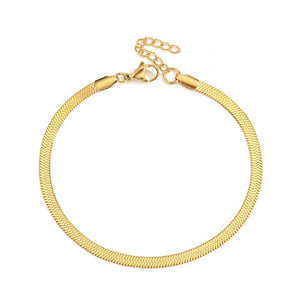
AJLuxe's Gold Serpentine Anklet is the closest honest match to Bvlgari's Serpenti motif in AJLuxe's catalog — a snake-link chain in 18K gold plating over 925 sterling silver that echoes the coiled, scaled look Bvlgari popularized. It's important to be direct about what this is and isn't: it's an anklet, not a bracelet or ring like the real Serpenti pieces, so it's a motif match rather than a piece-type match. It doesn't use Bvlgari's Tubogas construction, doesn't carry any Bvlgari branding, and isn't a substitute for the resale value of solid gold — it's simply an affordable, hypoallergenic way to wear a snake-chain silhouette day to day, priced under $35 instead of five figures.
Final Thoughts
Bvlgari and Cartier earn their reputations for genuinely different reasons — Bvlgari through bold, colorful, Roman-inspired design and the coiled Serpenti snake, Cartier through restrained, architectural gold and an unbroken royal-supplier heritage since 1847. Neither is "better" in any absolute sense, and the fact that they sit under rival conglomerates, LVMH and Richemont, only underscores that this is a real design and market rivalry, not two versions of the same house. If your budget realistically points you toward an affordable alternative for now, the honest move is choosing a simple, well-made piece that fits the aesthetic you're drawn to — not one pretending to be either brand — and revisiting the real thing later if it still matters to you.
Browse AJLuxe's anklet collection for snake-chain, minimalist, and everyday styles, or explore the pick above as a starting point.
Shop This Guide
The Gold Serpentine Anklet — an 18K gold-plated snake-chain anklet in 925 sterling silver, an honest motif-only echo of Bvlgari's Serpenti (not a bracelet or ring like the real pieces, just the closest snake-chain silhouette in AJLuxe's catalog).
Shop the Gold Serpentine AnkletWritten by the AJLuxe Team. Last updated: August 2026. This guide is independent and not affiliated with, endorsed by, or sponsored by Bvlgari or Cartier. Brand history and heritage details are drawn from each house's own published history and widely reported industry coverage.
Toutes les marques, noms de marque et noms de produits tiers sont la propriété de leurs détenteurs respectifs. AJLuxe n’est affilié à aucune marque tierce citée dans cet article, ni approuvé ou sponsorisé par celle-ci. Les noms de marque sont utilisés uniquement à des fins de comparaison factuelle, et les descriptions de matériaux reflètent les spécifications produit publiées par chaque marque au moment de la rédaction.
You Might Also Like
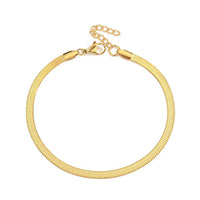
The piece they're describing → Cheville Serpentine dorée pour femme — Plaqué or 18 carats, chaîne serpent, ajustable
Personalize Yours


