



Buying a bracelet online without trying it on is a real problem — wrist sizes vary enough that a "one size" bracelet built for an average measurement doesn't fit everyone, and returns for sizing alone are one of the most common reasons online jewelry orders get sent back. An adjustable bracelet solves this directly, but "adjustable" covers several genuinely different mechanisms with different trade-offs. This guide breaks those down and covers how to actually use each type correctly.
What Makes a Bracelet "Adjustable"?
An adjustable bracelet has a built-in mechanism that changes its effective circumference without needing a different bracelet for a different wrist size. That's distinct from a bracelet that's simply flexible or stretchy throughout its full length (like a beaded elastic bracelet, which stretches to fit but isn't "adjusted" to a specific size and stays) — a true adjustable piece lets you set and lock in a specific fit.
The Main Adjustment Mechanisms
| Mechanism | How it works | Best for |
|---|---|---|
| Sliding knot | A cord knot that slides along the bracelet's length, tightened or loosened by hand | Casual, boho-style cord bracelets |
| Elastic/stretch | Stretches to fit a range of wrist sizes, no manual adjustment needed | Beaded bracelets, everyday stackable pieces |
| Extender chain | A short length of extra chain with multiple clasp attachment points | Chain bracelets, formal/delicate pieces |
| Open cuff | A rigid, open-ended band gently bent to widen or narrow the opening | Bangle-style bracelets, statement cuffs |
Sliding-knot and elastic mechanisms suit casual, everyday pieces best since they're quick to put on and adjust without tools. Extender chains are more common on delicate chain bracelets, where a rigid cuff-style adjustment wouldn't make sense. Open cuffs are the odd one out — they're "adjustable" in the sense that you can bend the metal to change the gap, but they're not meant to be re-adjusted constantly the way the other three are.
How to Actually Adjust Each Type
For a sliding-knot bracelet, hold the two knots and gently pull the bracelet ends apart to loosen, or pull the knots toward each other to tighten — small, gradual adjustments work better than one forceful pull, which can slide the knot too far or loosen it more than intended. Extender chains simply need the clasp moved to a different link along the extension — no bending or forcing required. Open cuffs should be adjusted slowly, gripping both sides evenly and widening or narrowing gradually; over-bending a metal cuff repeatedly can weaken the metal at the bend point over time, so it's worth getting the fit close to right the first time rather than repeatedly re-adjusting.
Keeping an Adjustable Bracelet From Falling Off
The most common complaint with sliding-knot and elastic bracelets is a fit that loosens gradually with wear, especially with hand-heavy activity. For sliding-knot pieces, adjust the knot slightly tighter than feels perfectly comfortable at rest — cord bracelets tend to loosen a little over the first few wears as the material relaxes. For elastic, buying true to your actual wrist measurement (not sizing up "to be safe") matters more than with most jewelry, since stretch cord loses some elasticity over time with repeated wear, and a bracelet that's already loose when new will only get looser.
Measuring Your Wrist Before Buying
Wrap a soft measuring tape (or a strip of paper, then measure the paper with a ruler) around your wrist where you'd normally wear a bracelet, snug but not tight. Most adjustable pieces are built to fit a range — commonly 6–8 inches — so as long as your measurement falls inside the stated range, the adjustment mechanism handles the rest. If your wrist measures outside a listed range on either end, that's the one case an "adjustable" piece won't necessarily solve, and checking the exact stated range before buying avoids a return.
Durability Considerations
Elastic cord is the mechanism most likely to wear out over time — repeated stretching gradually reduces elasticity, and most elastic bracelets have a functional lifespan of one to a few years of regular wear before needing replacement, depending on quality and how often they're worn. Sliding-knot cord and extender chains hold up longer since they're not relying on material stretch to function. Open cuffs are the most durable long-term but the least forgiving of frequent re-adjustment, since repeated bending is what eventually weakens metal at a stress point.
Why Adjustable Bracelets Make Good Gifts
Not knowing the recipient's exact wrist size is one of the most common reasons a bracelet gift misses — an adjustable piece sidesteps that entirely, fitting comfortably across a wide range without needing to guess or ask ahead of time and risk spoiling a surprise. This is part of why adjustable and stretch-fit bracelets show up so often in gift guides specifically, rather than fixed-size bangles or cuffs, which need a much more precise measurement to land right.
Material and Sensitive Skin
The adjustment mechanism itself doesn't determine whether a bracelet is hypoallergenic — that comes down to the base metal, same as any other piece. A sliding-knot or elastic bracelet built around a nickel-heavy base alloy can still cause a reaction regardless of how well the sizing works; look for 925 sterling silver, 316L stainless steel, or an explicitly stated nickel-free/hypoallergenic claim on the metal components specifically, not just the style description.
AJLuxe's Adjustable Bracelet
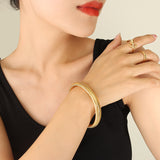
AJLuxe's Gold Elastic Bangle Bracelet uses a stretch-fit design in 18K gold-plated sterling silver — no manual adjusting needed, it simply stretches on and holds its shape. It's built to stack easily with other pieces (see AJLuxe's guide to stacking bracelets for pairing ideas) and priced $24.99–$79.99 like the rest of the women's line.
Adjustable Bracelets: Common Questions
- What is an adjustable bracelet called?
- There's no single umbrella term — it's usually described by its specific mechanism: a sliding-knot bracelet, an elastic or stretch bracelet, an extender-chain bracelet, or an open cuff, depending on how it adjusts.
- How do I keep adjustable bracelets from falling off?
- Adjust sliding-knot styles slightly snugger than feels perfectly loose (cord relaxes with wear), buy elastic pieces true to your actual wrist size rather than sizing up, and re-check the fit periodically since most adjustable mechanisms loosen gradually over time.
- What do I do with extra string on an adjustable bracelet?
- Trim it close to the knot with sharp scissors once you've set your final fit, leaving a small tail (about 1/4 inch) so the knot doesn't slip loose — cutting it flush against the knot risks the knot unraveling.
- How do I fasten an adjustable bracelet?
- It depends on the mechanism: sliding knots are pulled to the desired tightness by hand, extender chains clip onto whichever link matches your size, and elastic pieces simply stretch on with no fastening step at all.
- Are adjustable bracelets less durable than fixed-size ones?
- It depends on the mechanism — elastic cord does wear out faster than a fixed rigid bracelet since it relies on material stretch, but sliding-knot cord and extender chains hold up comparably to non-adjustable versions of the same style.
- What wrist size range do adjustable bracelets fit?
- Most are built for a roughly 6–8 inch wrist range, though this varies by specific product — checking the listed range against your own measured wrist size before buying is the most reliable way to confirm fit.
- Can I make a fixed bracelet adjustable myself?
- Adding an extender chain to an existing bracelet's clasp is a common DIY fix and doesn't require special tools, though it works better on chain bracelets than on rigid bangles or cuffs, which can't easily be retrofitted the same way.
- Do adjustable bracelets work for kids and adults with the same piece?
- Only within the stated size range — a bracelet built for a 6–8 inch adult wrist typically won't adjust small enough for most children's wrists, so check the specific product's minimum size rather than assuming "adjustable" means universally sized.
- How long do elastic bracelets last before they wear out?
- Typically one to a few years of regular wear, depending on quality and frequency of use — the elastic cord gradually loses stretch over time, and a bracelet that starts feeling noticeably looser than when it was new is showing normal wear rather than a defect.
Final Thoughts
Adjustable bracelets solve the real problem of not knowing your exact wrist size before checkout, but the mechanism matters — sliding knots and extenders hold their fit longer than elastic, which does gradually stretch out with wear. AJLuxe's Gold Elastic Bangle offers a no-fuss stretch fit in 18K gold-plated sterling silver, $24.99–$79.99.
Last updated: September 2026. Written by the AJLuxe team — specialists in personalized sterling silver jewelry.
Related reading: the bolo slide mechanism specifically, compared against cuffs, elastic, and extender chains.
Toutes les marques, noms de marque et noms de produits tiers sont la propriété de leurs détenteurs respectifs. AJLuxe n’est affilié à aucune marque tierce citée dans cet article, ni approuvé ou sponsorisé par celle-ci. Les noms de marque sont utilisés uniquement à des fins de comparaison factuelle, et les descriptions de matériaux reflètent les spécifications produit publiées par chaque marque au moment de la rédaction.
You Might Also Like

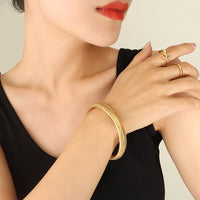
The piece they're describing → Bracelet jonc élastique doré pour femme — Plaqué or 18 carats, extensible, empilable
Personalize Yours


