


The short answer
“Square engagement ring” usually means princess cut -- a square modified brilliant with pointed corners, per GIA. It reads slightly smaller than a round diamond of the same carat weight, its corners are the most chip-prone point on the stone, and GIA doesn't issue it a formal cut grade the way it does round brilliants. “18K gold plated” is a regulated term (FTC 16 CFR Part 23): a genuine 22K+ gold electroplate at least 15 millionths of an inch thick over a base metal, not solid gold, and it wears with time.
Searching “square engagement ring” usually means one of two things: you're deciding between diamond cuts, or you like the geometric look and want an honest read on cost, durability and what the marketing terms actually mean before you buy. This guide covers both, using GIA's own cut terminology and the FTC's legal definition of “gold plated,” not marketing copy.

What does a square engagement ring actually mean?
A square engagement ring doesn't carry a fixed symbolic meaning the way, say, a solitaire signals tradition -- it's a style choice, not a category with its own folklore. What buyers are usually reacting to is the look: crisp geometric lines, an Art Deco-adjacent silhouette, and a face-up profile that reads bolder and more modern than a round stone of the same size. If you've seen it called a “statement” shape in recent bridal coverage, that's describing the visual effect, not a hidden meaning.
What is a square-cut ring actually called?
Most rings sold as “square cut” are princess cut, which GIA classifies as a square modified brilliant -- a brilliant-style facet pattern (like a round diamond's) arranged under a square outline with pointed corners. That's different from step-cut square shapes like the Asscher or emerald cut, which use long, flat, mirror-like facets instead of brilliant sparkle. One technical detail worth knowing before you shop: GIA does not issue a formal overall cut grade for princess cuts the way it does for round brilliants -- so proportions (a length-to-width ratio no higher than about 1.05:1, and a depth in the roughly 66-75% range) and in-person visual performance matter more than a single grade on paper.
Square vs. round, cushion & emerald: how the cuts actually compare
The biggest practical differences between square-cut styles and their alternatives come down to apparent size, corner durability, and price -- not just looks.
Is princess cut outdated?
No -- square and princess-cut styles have seen renewed interest in bridal and fashion jewelry over the past couple of years, not a decline. What has shifted is styling: today's square-cut rings show up more in stacking sets and mixed-metal looks than as a single oversized solitaire, which is part of why an affordable CZ version (see below) works as a low-commitment way to try the shape.
What "18K gold plated" actually means
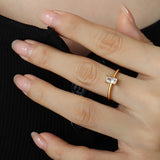
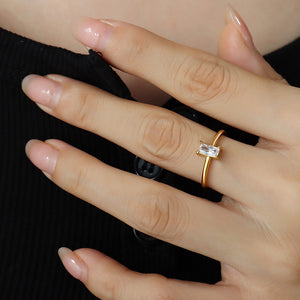
Under the FTC's Jewelry Guides (16 CFR Part 23), a product can only be marked “Gold Plated” or “Gold Electroplate” if it carries a genuine electrolytic deposit of gold or gold alloy of not less than 22 karat fineness, at least 15 millionths of an inch (about 0.38 microns) thick, applied to all significant surfaces. That's a real, regulated bar -- it's not the same as “gold filled” (a much thicker mechanically bonded layer) or solid gold, and a thinner deposit legally has to be called something weaker, like “gold flashed” or “gold washed,” not plain “gold plated.” The Square CZ Wedding Ring below is built on a 925 sterling silver base with a compliant 18K gold-plated finish -- not solid gold, and worth knowing that plating is a finish, not a permanent property: it wears thinner with friction and repeated contact over months to years, faster with daily wear, water, and lotion/perfume contact, slower if you take it off for those.
| Cut | Face-Up Size & Corners | Best For |
|---|---|---|
| Square / Princess Cut | Reads slightly smaller than a round diamond of equal carat weight; pointed corners are the most chip-prone point on any square stone | Modern, geometric, Art Deco-inspired looks; stacking sets; cost-conscious buyers |
| Round Brilliant | No pointed edges, so no corner-chip risk; classic brilliant-cut sparkle | Traditional engagement rings, maximum light return, resale familiarity |
| Cushion Cut | Softened, rounded corners reduce (but don't eliminate) chip risk vs. princess | A vintage-leaning square look with a gentler outline |
| Emerald Cut | Elongated rectangular step-cut with clipped corners, which lowers chip risk; large open facets show inclusions more readily | Minimalist, Art Deco, elongated-finger looks |
Shop This Guide
Not ready for diamond prices but love the square silhouette? The Square CZ Wedding Ring gives you the princess-cut (square modified brilliant) look on a 925 sterling silver band with an 18K gold-plated finish and a cubic zirconia center stone -- honestly a CZ stacking ring, not a diamond engagement ring, at $28.99.
Shop the Square CZ Wedding RingFrequently Asked Questions
What does a square engagement ring mean?
It doesn't have a fixed symbolic meaning -- it's a style choice. Most “square” rings are princess cut, prized for a bold, geometric, Art Deco-adjacent look rather than any specific tradition.
What is a square-cut ring actually called?
Princess cut. GIA describes it as a “square modified brilliant” -- a brilliant facet pattern under a square outline, distinct from step-cut square shapes like the Asscher or emerald cut.
Are square-cut diamonds more expensive than round?
Generally no -- princess-cut diamonds typically cost less per carat than round brilliants of comparable quality, because the cutting process wastes less of the rough stone.
Is princess cut outdated?
No. Square and princess-cut styles have seen renewed interest recently, often styled in stacking sets or mixed-metal combinations rather than as a single large solitaire.
How long will 18K gold plating last?
It varies with wear, but plating is a thin surface finish, not a permanent property -- expect it to thin with regular contact (water, lotion, friction) over months to a couple of years, and to last longer if you remove the ring for washing, swimming, and sleep.
Is 18K gold-plated jewelry worth it?
For an affordable, hypoallergenic way to wear the gold look without solid-gold prices, yes -- as long as it's honestly labeled. Under FTC rules, genuine “18K gold plated” requires a real 22K+ gold electroplate at least 15 millionths of an inch thick, not just a light gold tint.
Is it better to buy solid gold or gold-plated?
It depends on budget and how you'll wear it. Solid gold costs far more but doesn't wear thin. Genuine gold-plated jewelry (per the FTC's thickness standard) costs a fraction of the price and is a reasonable choice for a ring you expect to replace or rotate rather than wear daily for decades.
Alle Marken, Markennamen und Produktnamen Dritter sind Eigentum ihrer jeweiligen Inhaber. AJLuxe steht in keiner Verbindung zu den in diesem Artikel genannten Marken Dritter und wird von diesen weder unterstützt noch gesponsert. Markennamen werden ausschließlich zur sachlichen vergleichenden Bezugnahme verwendet; Materialangaben entsprechen den eigenen veröffentlichten Produktangaben der jeweiligen Marke zum Zeitpunkt der Erstellung.
You Might Also Like
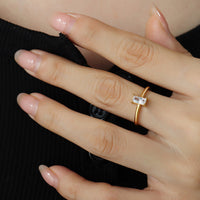
The piece they're describing → Quadratischer CZ-Ehering für Damen – 18K vergoldet, Prinzessinnenschliff Zirkonia
Personalize Yours


