


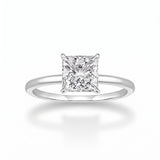
The short answer
Princess cut is the square, pointed-corner alternative to round brilliant -- modern and geometric, but the corners are the one thing to plan around: choose a setting built to protect them, and expect the stone to look a little smaller than the same-weight round.
Princess cut is the second most popular diamond shape after round brilliant, and it shows up constantly in engagement ring searches for a reason -- clean lines, a contemporary silhouette, and (for natural diamonds) a lower per-carat cost than round. This guide covers how it actually compares to round, cushion, and emerald cut, why the corners need a specific kind of setting, and what the real sizing math looks like before you buy.

What Is a Princess Cut Ring?
A princess cut ring features a square or slightly rectangular stone with sharp, pointed corners and a brilliant-style facet pattern underneath, designed to maximize sparkle the way a round brilliant does but inside straight edges instead of a circle. It was developed in the 1980s as an alternative to round brilliant and emerald step cuts, and it remains the most common non-round shape chosen for engagement rings.
Princess Cut vs. Round, Cushion, and Emerald Cut
The four shapes trade off face-up size, corner durability, and overall look -- there's no single "best" cut, only the right one for how the stone will be worn and set.
| Cut | Face-Up Size | Chip Risk at Corners | Best For |
|---|---|---|---|
| Princess | Faces up ~10% smaller than a round of the same carat weight | Higher -- sharp 90° corners need V-prong or bezel protection | A modern, geometric look at a lower face-up cost than round |
| Round brilliant | Largest face-up size per carat of the four; sets the size benchmark | Lowest -- no exposed corners | Maximum sparkle and the most universally recognized shape |
| Cushion | Similar to princess, slightly softer footprint from the rounded corners | Lower than princess -- corners are rounded, not pointed | A romantic, vintage-leaning look that still reads large |
| Emerald | Largest visual footprint per carat -- a step cut with a wide, open table | Lower -- corners are cut off (faceted), not sharp points | Clean, art-deco lines; shows inclusions more since it has fewer facets to hide them |
Why Princess Cut Corners Need Extra Protection
The 90-degree corners on a princess cut are its single weak point, because they sit close to a natural cleavage plane and take the full force of any direct knock. That's why V-shaped prongs -- metal tips that wrap around and shield each corner -- are the standard setting choice for a princess cut center stone, with a full bezel as the more protective (if less sparkly) alternative. Worn normally, a properly set princess cut holds up fine for daily wear; the risk is specifically an unprotected corner taking a hard direct hit.
Princess Cut Sizing: What the Numbers Actually Mean
A princess cut stone faces up roughly 10% smaller than a round stone of the same carat weight, because more of its weight is hidden in the pavilion depth rather than spread across a wider top surface -- a 1-carat princess cut measures about 5.5mm across versus about 6.5mm for a 1-carat round. If the goal is to visually match a round stone's footprint, that's the gap to plan for, not the carat number on its own.
Ring sizes themselves also follow different standards by region: ISO 8653 defines the circumference-based sizing system used across most of Europe, while AJLuxe sizes to the US system.
Shop This Guide
AJLuxe's Princess Cut ring pairs a genuine 925 sterling silver band with an 18K gold-plated finish and a square cubic zirconia (CZ) center stone -- hypoallergenic, sized US 5-9, and priced for everyday wear rather than a single occasion.
Shop the Princess Cut RingFrequently Asked Questions
What does a princess cut ring mean?
A princess cut ring simply refers to the stone shape -- a square (or slightly rectangular) cut with pointed corners and brilliant-style faceting underneath, not a specific style of proposal or symbolism. It became popular as a modern, geometric alternative to the traditional round brilliant.
Is a princess cut more expensive than a round cut?
For natural diamonds, princess cut typically costs less per carat than round brilliant because cutting a princess shape wastes less of the rough stone, while round brilliant cutting can waste more than half the rough material. That cost gap is specific to mined diamonds; it does not apply the same way to lab-made stones like cubic zirconia, where material cost is a much smaller share of the price.
Do princess cut corners chip easily?
Yes -- the 90-degree corners are the most vulnerable point on a princess cut stone, and jewelers commonly recommend a setting with V-shaped prongs that wrap and shield each corner, per guidance from GIA's own consumer blog and the International Gem Society. A protected setting worn normally holds up fine for daily wear; what to avoid is a hard direct knock on an unprotected corner.
Does GIA grade the cut quality of a princess cut stone?
No -- GIA issues a formal cut grade (Excellent to Poor) only for round brilliant diamonds. Princess cuts receive GIA polish and symmetry grades but not an overall cut grade, so buyers judging a princess cut have to look at table and depth percentage and length-to-width ratio directly rather than relying on a single grade.
Does a princess cut look as big as a round cut of the same size?
No -- a princess cut faces up roughly 10% smaller than a round cut of the same carat weight, because more of its weight sits hidden in the pavilion depth rather than spread across the top. A 1-carat princess cut measures about 5.5mm across versus roughly 6.5mm for a 1-carat round.
How hard is cubic zirconia (CZ), and will it scratch?
Cubic zirconia rates about 8 to 8.5 on the Mohs hardness scale, well below diamond's 10 but harder than most everyday surfaces except other gems, sapphire, and diamond, so light daily wear is fine but it can still be scratched by harder stones or rough contact. Note that CZ isn't independently graded by GIA the way diamonds are -- optical quality comes down to the individual cutter and sourcing.
Alle Marken, Markennamen und Produktnamen Dritter sind Eigentum ihrer jeweiligen Inhaber. AJLuxe steht in keiner Verbindung zu den in diesem Artikel genannten Marken Dritter und wird von diesen weder unterstützt noch gesponsert. Markennamen werden ausschließlich zur sachlichen vergleichenden Bezugnahme verwendet; Materialangaben entsprechen den eigenen veröffentlichten Produktangaben der jeweiligen Marke zum Zeitpunkt der Erstellung.
You Might Also Like
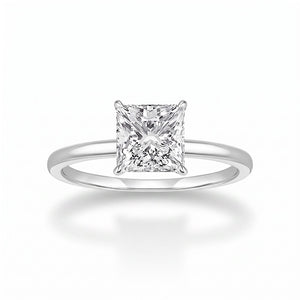

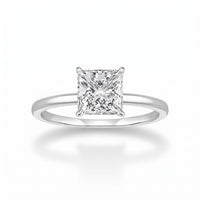
The piece they're describing → Prinzessschliff Zirkonia Verlobungsring für Damen — 925 Sterling Silber, quadratischer Zirkonia Solitär
Personalize Yours


