



The short answer
A halo ring surrounds a center stone with a ring of smaller accent stones, which reflects extra light back toward the center and reads visually larger than the same stone in a plain solitaire setting. It works with any center stone -- mined diamond, lab-grown diamond, moissanite, or cubic zirconia -- and typically costs less than buying a bigger single stone to get a comparable amount of visible sparkle.
Quick note before you keep reading: if you searched "halo ring" and landed here expecting a smart-ring health tracker, that's a different product with the same name (a wearable ring that tracks sleep and activity) -- this guide is about the jewelry setting, the one bridal and fashion rings have used for centuries.

What Is a Halo Ring?
A halo ring is a setting where a circle of smaller accent stones surrounds a center stone, following its outline. The style traces back to the Georgian era (1714-1837), making it one of the oldest engagement ring designs still in wide use today. The "halo" refers only to how the stones are arranged -- the center stone itself can be a mined diamond, a lab-grown diamond, moissanite, cubic zirconia, or a colored gemstone, since nothing about the setting requires a specific material.
Halo vs. Solitaire vs. Pave vs. Three-Stone
A halo setting adds a ring of accent stones around the center stone; a solitaire skips accents entirely, a pave setting spreads small stones along the band itself, and a three-stone setting flanks the center with two larger side stones. Each trades sparkle and visual size against how many contact points (prongs) need periodic checking.
| Setting | How it's built | Maintenance |
|---|---|---|
| Halo | Ring of accent stones around a center stone; extends sparkle and reads visually larger than the center stone alone | Most crevices to clean; shared prongs on mass-market pieces mean checking more contact points |
| Solitaire | Single center stone, no accents, on a plain band | Fewest crevices/prongs; simplest setting to keep clean and inspect |
| Pave | Rows of tiny stones set into the band itself, flush with the metal | Small stones can loosen individually over years of wear; low profile resists snagging |
| Three-stone | Center stone flanked by two side stones of equal or lesser size | Side stones each need their own prong check; no halo crevices to trap residue |
Does a Halo Setting Really Make the Center Stone Look Bigger?
Yes -- the halo's ring of smaller stones extends the area of visible sparkle and bounces extra light back toward the center stone, so the eye reads the whole cluster as one larger area of brilliance instead of measuring the center stone in isolation. That's an optical effect from the design, not a change to the actual stone -- nothing about the center stone's size or weight changes, the setting just changes how much of the ring catches light.
What's Actually in AJLuxe's Halo Ring
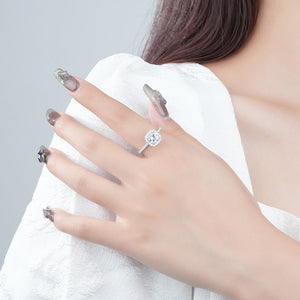
AJLuxe's halo ring uses a moissanite-style cubic zirconia (CZ) center stone in a halo setting, on a 925 sterling silver base with 18K gold plating. It is not a mined diamond and we don't sell it as a certified moissanite -- CZ is a lab-created stone that mimics the sparkle of diamond and moissanite at a fraction of the cost, and it's what's actually in this piece. On the Mohs hardness scale, cubic zirconia rates around 8.5 versus a mined diamond's 10, which is part of why it costs less and why gentle care (below) matters more than it would for a diamond.
Material breakdown
- Base metal: 925 sterling silver -- the standard purity mark for sterling silver jewelry and the reason it's hypoallergenic for most wearers.
- Plating: 18K gold plating over the sterling silver base. Under the FTC's Jewelry Guides (16 CFR Part 23), plated jewelry has to be sold and labeled as plated, not as solid gold -- AJLuxe lists this piece as gold-plated sterling silver, not solid gold.
- Center and accent stones: moissanite-style cubic zirconia, not a mined or lab-grown diamond.
- Price: $47.99.
Halo Ring Care and Maintenance
Wipe a halo ring with a soft, dry cloth after wearing it and store it separately in a pouch to keep the accent stones from scratching against other jewelry. Remove it before washing dishes, applying lotion, swimming, or exercising -- the halo's extra crevices trap residue more easily than a plain solitaire, and repeated moisture exposure is the fastest way to dull plating over sterling silver. On fine jewelry with genuine stones, a professional prong check every six months is standard advice, since mass-market halos often use shared prongs where one contact point holds two stones at once.
Shop This Guide
AJLuxe's halo ring pairs a moissanite-style cubic zirconia center stone with a halo of smaller accent stones, set in 925 sterling silver with 18K gold plating -- $47.99, not a diamond substitute priced like one.
Shop the Moissanite-Style Halo RingFrequently Asked Questions
What does a halo engagement ring mean?
A halo ring is a setting style, not a symbol on its own -- it means a center stone is encircled by a ring of smaller accent stones that follow its outline. The design dates back to the Georgian era (1714-1837) and is one of the oldest engagement ring styles in Western jewelry, prized for making the center stone look brighter and more prominent.
Can a halo ring be an engagement ring?
Yes -- halo is one of the most common engagement ring settings sold today, alongside solitaire, pave, and three-stone styles. It works with a mined diamond, a lab-grown diamond, moissanite, cubic zirconia, or colored gemstones as the center stone; nothing about the halo setting itself requires a particular stone type.
Are halo engagement rings still in style?
Yes -- halo remains one of the steadiest-selling engagement ring styles because it answers a specific budget question: it gives more visible sparkle and a larger-looking center for less money than buying a bigger solitaire stone outright.
Does a halo setting actually make the center stone look bigger?
Yes, by design. The ring of smaller stones extends the sparkle across a wider surface area and reflects extra light back toward the center stone, so the eye reads the whole cluster as one larger area of brilliance rather than measuring the center stone alone.
What are the downsides of a halo ring?
The two real trade-offs are maintenance and repair cost. The extra prongs and crevices around a halo trap lotion, dirt, and oils more easily than a plain solitaire, and mass-market halos often use shared prongs (one prong holding two stones), which means a loosened prong can put two stones at risk instead of one -- worth an occasional prong check on fine jewelry with genuine stones.
Can a halo ring use moissanite or cubic zirconia instead of a diamond?
Yes -- halo is a setting style, not a stone requirement, so moissanite, cubic zirconia, lab-grown diamonds, and mined diamonds all appear in halo rings across the market. AJLuxe's own halo ring uses a moissanite-style cubic zirconia (CZ) center stone rather than a certified diamond or lab-verified moissanite -- see the honest breakdown below.
How do you clean and take care of a halo ring?
Wipe the ring with a soft, dry, lint-free cloth after wear and store it in a pouch away from other jewelry to avoid scratching the accent stones. Remove it before washing dishes, applying lotion, swimming, or exercising -- residue buildup in the halo's crevices and repeated moisture exposure are the two fastest ways to dull the sparkle or wear down plating over 925 sterling silver.
What ring size should I order for a halo ring?
Order to your standard US ring size (most halo rings, including AJLuxe's, run US sizes 6-9) -- international sizing systems like the ISO 8653 standard use a different numbering scale entirely, so convert first if you're used to a UK, EU, or Japanese size rather than guessing.
Alle Marken, Markennamen und Produktnamen Dritter sind Eigentum ihrer jeweiligen Inhaber. AJLuxe steht in keiner Verbindung zu den in diesem Artikel genannten Marken Dritter und wird von diesen weder unterstützt noch gesponsert. Markennamen werden ausschließlich zur sachlichen vergleichenden Bezugnahme verwendet; Materialangaben entsprechen den eigenen veröffentlichten Produktangaben der jeweiligen Marke zum Zeitpunkt der Erstellung.
You Might Also Like
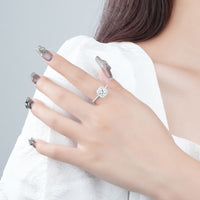
The piece they're describing → Moissanit-Halo-Ring — Sterlingsilber, 18 Karat Weißgold, Zirkonia
Personalize Yours


