


Search "earring on a chain" and you'll land on a handful of fine-jewelry sites selling delicate gold studs with a chain attached — and very little in the way of a plain-English explanation of what you're actually looking at. That's because the style has picked up a few different names (chain earring, chain stud, connector earring, front-to-back chain earring) depending on which retailer you're browsing, and it's easy to confuse it with threader earrings, which look similar in photos but work completely differently.
This guide breaks down the two real construction styles, how each is worn, who it works best for, and what to know before you buy — plus a hypoallergenic, budget-friendly stud from AJLuxe's own catalogue if you like the delicate aesthetic but aren't ready to commit to a dedicated chain-stud piece.
What Is an Earring on a Chain?
An earring on a chain is a stud (or small decorative element, like a bar or a cluster of stones) with a fine metal chain attached to it, rather than a plain post-and-back construction on its own. The chain is the design feature — it adds movement and a second point of visual interest without the size or weight of a full dangle or drop earring. Unlike a plain stud, which sits flat and still, the chain gives the piece a bit of sway and catches light differently depending on how it's worn.
There isn't one single agreed-on name for this style across the jewelry industry. You'll see it listed as a "chain earring," "chain stud earring," "connecting earring chain," or "front-to-back chain earring" depending on the retailer — they're all describing close variations of the same basic idea: a stud plus an attached chain.
The Two Real Styles: Front-to-Back vs. Two-Piercing Connector
Almost every chain-stud design on the market falls into one of two categories, and the difference matters for how many piercings you need and how the earring physically stays on.
| Style | Piercings Needed | How It Stays On | What It Looks Like |
|---|---|---|---|
| Front-to-back chain earring | One (standard lobe) | Stud goes through the piercing as normal; the chain drapes down and around, fastening to a small clasp or hook behind the earlobe | A single stud with a delicate chain trailing behind the ear — subtle from the front, more visible from the side or when hair is up |
| Two-piercing connector | Two (usually two lobe piercings, or a lobe plus a second hole) | A stud sits in each piercing; a chain links the two studs together across the ear | Two visible studs bridged by a short chain, most often used with a first and second lobe piercing |
Both versions are typically sold as a single earring, not a pair — you buy one and wear it on one ear (or buy two if you want the look on both sides), which is standard practice across fine-jewelry retailers selling this style. The chain length and attachment point are usually fixed to the specific piece, so sizing is less about "does it fit" and more about whether your piercings are spaced right for a connector style, or whether you're comfortable with a chain resting against the back of your ear for a front-to-back style.

Earring on a Chain vs. Threader Earrings — Not the Same Thing
A chain-stud earring is not a threader earring, even though both involve a thin chain and both search results tend to blend the two together. The difference is in the mechanism: a threader earring is one continuous thin chain or wire with no post — you push it through the piercing hole from front to back, and the chain hangs freely on both sides once it's through. There's no fixed stud component at all.
A chain-stud earring, by contrast, has a real stud with a standard post and back that sits in the piercing exactly like any other stud — the chain is an attachment, not the entire earring. That's a meaningful practical difference: a stud-and-chain earring is generally more secure for everyday wear because it closes the same way a normal stud does, while a threader relies on the chain staying threaded through the hole and can slip out more easily if it catches on something.
AJLuxe's complete guide to earring types covers threader earrings and every other major earring style in detail if you want the full breakdown of how threaders specifically work.
How to Wear an Earring on a Chain
Front-to-back style: This works with a single standard lobe piercing, so it's the easier entry point if you don't already have a second hole. Because the chain rests behind the ear, it reads more clearly when hair is pulled back or up — with hair down, most of the chain is hidden, which some people prefer for a subtler effect. Expect a small clasp or hook at the back where the chain fastens; check this closure before buying if you're prone to losing earring backs, since it's an extra step compared to a standard push-back stud.
Two-piercing connector style: This requires two piercings spaced closely enough for the chain to comfortably bridge them without pulling — most commonly a first and second lobe piercing. Because the chain runs between two separate points on your ear, there's more visible movement and it reads as more of a statement than the front-to-back version. It's also less forgiving if your piercings are positioned unevenly, since an uneven spacing shows more with a fixed-length chain connecting two fixed points.
For either style, treat it the way you'd treat any dangle-adjacent earring: it's not the best choice for sleep, workouts, or anything where fabric or hair is likely to catch on it repeatedly, since the added chain is one more point of contact that a plain stud doesn't have.
Who This Style Works Best For
The front-to-back version is the more accessible entry point — one piercing, a familiar stud-and-back closure, and a subtler daily-wear profile. It suits anyone who likes the idea of a little extra movement and detail without changing how their ear looks from the front.
The two-piercing connector version is better suited to people who already have a second lobe piercing and want to do something more deliberate with it than two unrelated studs. It's a popular pick for building out a curated, layered ear — AJLuxe's complete earring guide covers curated-ear styling principles (anchor piece, varied shapes, one metal family) that apply directly to a connector chain earring as the "supporting" piece across two piercings.
Metal and Sensitive Ears
Because a chain-stud earring has more surface area and more moving links than a plain stud, metal quality matters more here, not less — a chain made from a nickel-heavy base metal has more total contact points against the skin than a single stud does. Nickel allergy affects an estimated 10–17% of the population according to the American Academy of Dermatology, and reactions typically show up as redness, itching, or swelling within a day or two of contact.
925 sterling silver and 18K gold plating over a sterling silver base are both nickel-free and considered safe for most sensitive-ear wearers — the same standard that applies to any other earring style. If you're shopping for a dedicated chain-stud piece, confirm the base metal (not just the plating color) before buying, since a thin gold-tone finish over brass will fade and expose the nickel-containing base underneath within months of regular wear.
AJLuxe doesn't currently carry a dedicated chain-stud earring in either the front-to-back or connector construction. If you like the delicate, minimalist look this style is going for but want something available today, the Dainty Gold Stud Earrings ($42.99, 18K gold plated 925 sterling silver) capture the same understated, everyday aesthetic — small, simple, and hypoallergenic — even though they're a standard stud rather than a chain style. They're a reasonable stand-in for the look while you decide whether a dedicated chain-stud piece is worth seeking out from a specialty retailer.
Frequently Asked Questions About Earrings on a Chain
What is an earring with a chain called?
It's most commonly called a "chain earring" or "chain stud earring," and sometimes a "connecting earring chain" or "front-to-back chain earring" depending on the specific construction and the retailer. There's no single standardized industry name — all of these terms describe close variations of a stud with an attached chain.
Do chain earrings need two piercings?
No — it depends on the construction. A front-to-back chain earring works with a single standard lobe piercing, with the chain draping from the stud and fastening behind the ear. A two-piercing connector style does require a second piercing, since its chain links a stud in each hole. Check the specific product description before buying to know which version you're getting.
Are chain earrings the same as threader earrings?
No. A threader earring is a single continuous thin chain or wire with no fixed stud — you pull it through the piercing hole and it hangs freely on both sides. A chain-stud earring has a real post-and-back stud that sits in the piercing normally, with a chain attached as a separate design element. The stud construction generally makes chain-stud earrings more secure for daily wear than threaders.
What is an "ear chain," and is it the same thing?
Not usually. "Ear chain" is also used to describe a different accessory entirely — decorative chains that connect an earring to a hairpin or headpiece, mostly seen in bridal and South Asian jhumka-style jewelry, rather than a chain-and-stud earring worn entirely on the ear. If you're specifically shopping for the stud-plus-chain style covered in this guide, search "chain stud earring" or "connecting earring chain" to avoid hair-jewelry results.
Will a chain earring catch on hair or clothing?
It's more likely to catch than a plain stud, simply because the chain is an additional moving part, though less likely than a longer dangle or a loose fish-hook earring. Front-to-back styles that rest close against the back of the ear catch less than two-piercing connector styles, where the chain has more room to move between the two attachment points. As with any dangle-adjacent style, it's not the best choice for sleep or high-movement activities like workouts.
What's the safest metal for a chain earring if I have sensitive ears?
925 sterling silver and 18K gold plating over a sterling silver base are both nickel-free and well tolerated by most sensitive-ear wearers, the same standard that applies to any other earring style. Confirm the base metal specifically — a gold-tone finish over a brass or nickel-alloy base will fade with wear and can trigger a reaction even if the surface layer itself is nickel-free.
Final Thoughts
An earring on a chain is a simple idea — a stud plus a chain — that gets confusing mostly because of naming overlap with threaders and because the two real construction styles (front-to-back vs. two-piercing connector) need different things from your piercings. If you already have a second lobe piercing and want a more deliberate look than two separate studs, the connector style is worth seeking out. If you just want the delicate movement without adding a piercing, look for a front-to-back design.
Explore AJLuxe's full earring collection — all pieces in 18K gold plated 925 sterling silver or 925 sterling silver, nickel-free and hypoallergenic.
Written by the AJLuxe team — specialists in 18K gold plated sterling silver jewelry. Last updated: August 2026.
You Might Also Like
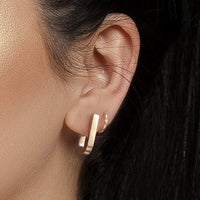
The piece they're describing → Filigrane Goldohrstecker für Damen – Sterlingsilber 925, 18 Karat vergoldet, minimalistisch
Personalize Yours


