


The daith sits in the smallest, most tightly folded piece of cartilage in the ear — the little shelf just above the ear canal opening — which makes it one of the more anatomy-dependent piercings to size correctly. It's also one of the most searched piercings for a reason that has nothing to do with jewelry: a long-running, unproven claim that it can relieve migraines. This guide covers what jewelry actually works for a daith, honestly separates the migraine claim from the facts, and gives real healing and sizing numbers.
What a Daith Piercing Is
The daith runs through the innermost cartilage fold of the ear, right above the ear canal, where the crus of the helix curves back on itself. Because that fold is small and curved rather than flat, a straight stud often can't sit correctly — this is one of the few cartilage piercings where a curved or hooped shape is standard starting jewelry rather than something you switch to later.
Starting Jewelry: Curved Barbell or Small Hoop
Most piercers use one of two shapes for a fresh daith:
- Curved barbell (bent barbell) — follows the fold of the daith cleanly and is easy to clean; a common first choice.
- Captive bead ring or seamless/segment hoop, typically 6–10mm — sits naturally in the fold's curve and is the other common starting option, unusual for a fresh cartilage piercing but standard here specifically because of the daith's shape.
Whichever shape you start with, the material still has to meet the same bar as any other fresh piercing: implant-grade titanium (ASTM F136), niobium, or nickel- and cadmium-free solid 14K+ gold, per the APP's jewelry standards for initial piercings. Gold-plated, gold-filled, vermeil, and sterling silver are excluded from that list — fine for finished jewelry once you're healed, not for the piercing itself.

Sizing a Daith Hoop
Daith hoops run smaller than most other cartilage hoops because the fold itself is small:
- 6mm — the tightest common fit, for smaller anatomy
- 8mm — the most common size once healed
- 10mm — for larger anatomy or a slightly looser, more visible sit
Post/wire gauge is typically 16 gauge (1.2mm), occasionally 14 gauge (1.6mm) depending on the piercer's equipment and your anatomy. Buying a replacement hoop after healing means matching both numbers — the diameter for fit, the gauge for the post to actually go through the hole.
The Migraine Claim, Honestly
Daith piercings became widely popular partly on the claim that they mimic acupuncture pressure points and relieve migraines. This idea isn't supported by controlled clinical research — the studies that exist are small, uncontrolled, or anecdotal, and mainstream headache and neurology organizations don't endorse daith piercing as a migraine treatment. Some people report feeling better after getting one; others don't, and there's no reliable way to know in advance which you'll be, or whether any change is from the piercing itself versus normal migraine fluctuation. If migraines are why you're considering a daith, talk to a doctor about treatments with actual evidence behind them — get the piercing because you want the piercing.
Healing Timeline
Daith piercings typically take 6–9 months to fully heal, on the faster end of cartilage piercings but still much slower than a lobe's 6–8 weeks, because cartilage heals by diffusion rather than direct blood supply. Expect swelling and tenderness for the first few weeks, with your piercer checking in before any downsizing. Most piercers recommend waiting until healing feels completely resolved — no tenderness, discharge, or redness when bumped — for several months before switching jewelry.
Piercing elsewhere on the ear? See our conch piercing jewelry guide and rook piercing jewelry guide for the same honest breakdown on those placements.
An Honest Note on Buying From Us
We don't stock implant-grade titanium or niobium body jewelry — for the piercing itself and the healing period after it, go to a licensed piercer or body-jewelry specialist who can match your exact gauge and diameter. What we carry is 925 sterling silver and 18K gold-plated small huggie hoop earrings, which some people wear as a styling swap in a fully healed daith once cleared for regular fashion jewelry by their piercer — not as initial or healing hardware. If you're comparing cartilage placements, our tragus earrings guide covers sizing and healing for that spot specifically.
Daith Piercing Jewelry: Common Questions
- What is the best jewelry for a daith piercing?
- For a fresh piercing, a curved barbell or small captive bead hoop (6–10mm) in implant-grade titanium, niobium, or solid 14K+ gold. Once fully healed, you have more flexibility, but the metal standard for anything you're wearing regularly against healing-adjacent skin doesn't change much.
- Should a daith be pierced with a hoop?
- It's one of the few cartilage piercings where a hoop-shaped starting piece (a captive bead ring or seamless ring) is common and generally fine, because the daith's fold is curved rather than flat. A curved barbell works just as well — it comes down to piercer preference and your anatomy.
- Does a daith piercing actually help migraines?
- There's no accepted clinical evidence that it does. The claim is popular and anecdotal, not backed by controlled studies, so it shouldn't be your main reason for getting one.
- How much does a daith piercing hurt?
- Most people rate it as moderately painful — noticeably more than a lobe, comparable to or slightly more than a helix, since it's on thicker, tightly folded cartilage. Pain tolerance varies a lot between people.
- Can I wear a regular gold-plated hoop in a fresh daith?
- No — gold-plated jewelry isn't on the accepted materials list for a fresh or healing piercing. Once you're fully healed and your piercer has cleared you for fashion jewelry, a disclosed gold-plated swap is a personal choice, not initial hardware.
- Why does my daith feel tight or pinch months after piercing?
- Cartilage in a tight fold like the daith can feel different from other piercings well into healing — occasional mild pressure isn't unusual. Increasing pain, swelling, redness, or discharge is what warrants a check-in with your piercer, not ordinary tightness.
This guide covers general piercing-industry standards and jewelry sizing conventions. It isn't medical advice — for anything specific to your piercing, healing, anatomy, or migraines, talk to a licensed professional piercer or a doctor.
Alle Marken, Markennamen und Produktnamen Dritter sind Eigentum ihrer jeweiligen Inhaber. AJLuxe steht in keiner Verbindung zu den in diesem Artikel genannten Marken Dritter und wird von diesen weder unterstützt noch gesponsert. Markennamen werden ausschließlich zur sachlichen vergleichenden Bezugnahme verwendet; Materialangaben entsprechen den eigenen veröffentlichten Produktangaben der jeweiligen Marke zum Zeitpunkt der Erstellung.
You Might Also Like
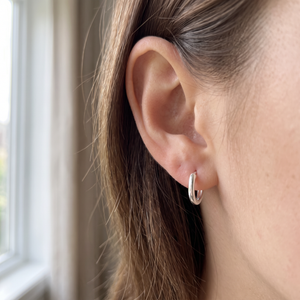
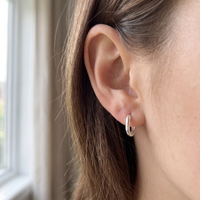
The piece they're describing → Silberne Huggie-Ohrringe für Damen — 925er Sterlingsilber, hypoallergen, minimalistisch
Personalize Yours


