


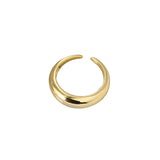
The short answer
Band width is measured in millimeters across the front of the ring, and thinner isn't automatically weaker -- a well-made thin band in a durable metal holds up fine for daily wear, though very thin bands (under about 1.5mm) are more prone to bending out of round with rough handling than a standard-width band. AJLuxe's thin band ring is 925 sterling silver with 14K gold plating, sized specifically for stacking.
Thin band rings are chosen mainly for two reasons: a minimalist look on their own, and a stackable width that lets you wear several without the combined bulk of standard bands. This guide covers how band width is actually measured, real durability considerations, and how to stack thin bands well.

How ring band width is actually measured
Band width is measured in millimeters across the front-facing surface of the ring, at its widest point if the band tapers. There's no single universal industry cutoff for what counts as "thin," but a commonly used rough guide is under 2mm for thin/narrow, 2-4mm for a standard everyday band, and 6mm or wider for a chunky or statement band. Ring listings should state the width in millimeters directly -- a listing that just says "thin" or "dainty" without a number leaves you guessing how it'll actually look and stack.
Width vs. durability
A thinner band isn't automatically weaker, but it does have less metal mass to resist bending out of round from a hard knock or repeated pressure. For most everyday activities, a well-made thin band in a durable metal (925 sterling silver, 14K gold, or similar) holds up fine -- the practical risk shows up mainly with very thin bands (under roughly 1.5mm) subjected to heavy manual work or frequent impact, where a slightly wider band would resist deformation better. If you want the minimalist look but do a lot of hands-on work, a mid-range thin width (around 1.5-2mm) is a reasonable middle ground.
Stacking thin bands well
Thin bands exist largely to be stacked -- three or four bands at roughly 1-1.5mm each add up to a look closer to one standard-width band, but with more visual texture and the flexibility to mix finishes, stone accents, or slightly different widths within the stack. Keep total stack width to something you can comfortably close your hand around; a stack that's too tall or wide across the knuckle will feel awkward with regular use, even if each individual band is thin.
Getting the size right
Ring sizing itself doesn't change with band width -- it's still measured against the international ISO 8653 standard using internal circumference -- but a thinner band tends to feel slightly looser at the same numeric size than a wider band would, since there's less surface area gripping the finger. If you're between sizes, sizing down slightly is often the better call for a genuinely thin band specifically.
| Band width | Typical use | Durability note |
|---|---|---|
| Under 2mm (thin/narrow) | Minimalist look, stacking | Fine for daily wear; slightly more prone to bending under heavy impact |
| 2-4mm (standard) | Everyday single-ring wear | Good balance of comfort and durability |
| 6mm+ (wide/statement) | Standalone statement pieces | Most resistant to bending; heaviest feel on the hand |
Shop This Guide
A 925 sterling silver minimalist ring with 14K gold plating, built at a thin band width designed specifically for stacking with other rings.
Shop the Thin Band RingFrequently Asked Questions
What are thin rings called?
They're commonly called thin band rings, narrow band rings, or minimalist/dainty rings -- all describing the same general category of a band under about 2mm wide, chosen for a subtle look or for stacking multiple rings together.
How thin is too thin for a ring band?
There's no fixed cutoff, but bands under roughly 1.5mm are more prone to bending out of round under heavy impact or manual work compared to a standard 2-4mm band. For most everyday wear, a well-made thin band in a durable metal holds up fine -- "too thin" mainly becomes a practical issue for people doing frequent hands-on manual work.
What is a good band width for a ring?
It depends on the use: 2-4mm is the standard everyday-comfortable width, under 2mm suits a minimalist look or stacking, and 6mm or wider suits a standalone statement piece. There's no universally "correct" width -- it's a fit and style preference.
How is ring band width measured?
Across the front-facing surface of the band in millimeters, taken at the widest point if the band tapers or narrows toward the back. A listing should state this number directly rather than using vague terms like "thin" or "dainty" alone.
Can I stack multiple thin band rings?
Yes -- thin bands are specifically popular for stacking, since two, three, or four thin bands together add up to a look closer to one standard-width band while giving more texture and mix-and-match flexibility than a single ring.
Do thin band rings work for daily wear?
Yes, in a durable metal like 925 sterling silver or 14K gold -- a thin band isn't automatically less durable for normal daily activities. The main durability tradeoff shows up with very thin bands under heavy manual work or repeated impact, not typical everyday wear.
Related reading: how an open-band construction compares to a thin closed band on sizing flexibility and durability.
Toutes les marques, noms de marque et noms de produits tiers sont la propriété de leurs détenteurs respectifs. AJLuxe n’est affilié à aucune marque tierce citée dans cet article, ni approuvé ou sponsorisé par celle-ci. Les noms de marque sont utilisés uniquement à des fins de comparaison factuelle, et les descriptions de matériaux reflètent les spécifications produit publiées par chaque marque au moment de la rédaction.
You Might Also Like
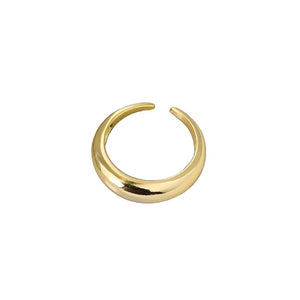
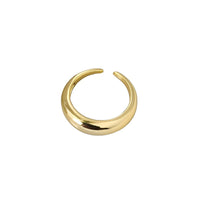
The piece they're describing → Bague Minimaliste en Or pour Femme — Argent Sterling 925, Plaqué Or 14 Carats, Bande Fine
Personalize Yours


