


Type "black crystals" into a search bar and you'll get a list that spans half the mineral kingdom — a jagged tourmaline crystal, a polished onyx sphere, glassy obsidian, metallic hematite. They don't share a chemical formula or a family tree. What they share is a color, a look, and — in crystal-healing circles — a reputation for grounding, protective energy.
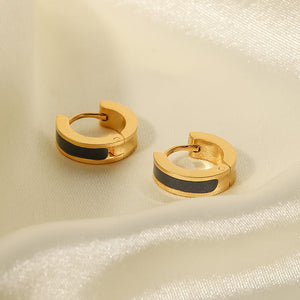
AJLuxe doesn't currently carry a loose black gemstone piece — no onyx rings, no black tourmaline pendants in the catalogue right now. If you love the black aesthetic, our black hoop earrings (925 sterling silver, 18K gold-plated hardware) are the closest thing we stock: a black-toned, everyday piece rather than a literal black crystal.
This guide breaks down what actually makes a crystal "black," profiles the six stones that come up again and again under that label, compares their hardness and everyday wearability side by side, and answers the real questions people search alongside it.
What Makes a Crystal Black?
There's no single mineral family behind "black crystals" — the color comes from several different causes, and knowing which one applies to a given stone tells you a lot about how durable it is:
- Iron content. Hematite is iron oxide — its dark, metallic-gray-to-black color and even its name (from the Greek haima, "blood," for the red streak it leaves when scratched) come directly from iron.
- Carbon. Shungite is a rare carbon-based mineral — up to nearly pure carbon — found almost exclusively in Karelia, Russia. Jet is also carbon-based, but organic: fossilized wood compressed for millions of years, which is why it's unusually light for a "stone."
- Dense mineral inclusions. Black tourmaline's opacity comes from its complex boron-silicate structure and trace iron; black diamonds get their color from a heavy concentration of graphite and other mineral inclusions rather than a chemical impurity.
- Rapid cooling with no crystal structure at all. Obsidian isn't technically a mineral — it's volcanic glass, formed when lava cools too fast to form crystals, which is also why it fractures into glassy, razor-sharp edges instead of cleaving like a true crystal.
That mineralogical variety is why care and durability advice differs so much stone to stone below — "black crystal" tells you almost nothing about how hard or fragile a given piece actually is.
The 6 Black Crystals, Compared
1. Black Tourmaline — The Reference Point
Black tourmaline (mineral name schorl) is the stone most people picture first when they hear "black crystal." It typically grows in long, ridged, rod-like formations and is opaque black in natural light. In crystal-healing tradition it's considered the grounding and protective stone — associated with the root chakra, and reached for to buffer stress, block out negative energy, and create an energetic boundary against difficult people or environments.
Mohs hardness: 7–7.5 — genuinely durable, comparable to quartz. Good for everyday wear: yes, including rings and bracelets that see regular knocks.
See our full guide: Black Tourmaline Meaning: Protection, Grounding & The Science Behind the Stone
2. Black Onyx — The Classic Jewelry Stone
Black onyx is a banded variety of chalcedony, prized for jewelry for over 5,000 years — much of the deep, uniform black seen in modern jewelry is dyed for consistency, since natural onyx often carries faint white or gray banding. In tradition it's linked to strength, self-discipline, and calming anxious or scattered energy.
Mohs hardness: 7 — resistant to scratching and, because it has no cleavage plane, holds up well to knocks and chips. One of the most jewelry-friendly black stones there is.
See our full guide: Black Onyx Meaning: Protection, Strength, and 5,000 Years of History
3. Black Obsidian — The Volcanic Glass
Obsidian forms when lava meets water or air and cools so fast it never develops a crystalline structure — technically, it's a glass, not a mineral. That's also the source of its mirror-like shine and its history: Aztec priests ground obsidian into ceremonial mirrors and blades. In crystal-healing circles it's considered the most intense of the black stones, associated with confronting difficult emotions rather than simply blocking them out.
Mohs hardness: ~5–5.5 — softer than tourmaline or onyx, and its glass-like fracture means it chips more easily than it scratches. Better suited to pendants and earrings than everyday rings.
See our full guide: Obsidian Meaning: Healing Properties, Types & Protective Powers
4. Hematite — The Metallic One
Hematite is iron oxide, and it looks it: a dark gunmetal-gray to black surface with a distinctive metallic sheen when polished, sometimes even mistaken for a metal alloy rather than a stone. Ancient Roman soldiers carried it into battle for both its weight and its associations with courage and mental focus; today it's reached for grounding and clarity.
Mohs hardness: 5.5–6.5 — moderately durable, but its density makes it noticeably heavier than other stones of the same size, which is worth knowing before choosing it for a large piece.
5. Jet — The Lightweight Historical Stone
Jet isn't a mineral at all — it's fossilized wood, compressed under extreme pressure over millions of years into a deep, matte-to-glossy black material that's unusually light to hold. Victorian mourning jewelry made jet famous in the West, where it symbolized grief and remembrance; in crystal tradition it's still associated with processing loss and heavy emotion.
Mohs hardness: 2.5–4 — soft and easily scratched or scuffed. Jet pieces are better treated as occasional wear than daily jewelry, and should be kept away from water and harsh cleaning.
6. Shungite — The Rarest of the Six
Shungite is a lustrous black stone that's almost pure carbon, found in significant quantity in only one place on Earth: Karelia, Russia. It's the newest entrant to mainstream crystal-healing circles, often marketed for its purported ability to absorb electromagnetic frequencies from phones and Wi-Fi routers — a claim with no peer-reviewed physical backing, though the stone's grounding and detoxifying reputation predates that specific marketing angle.
Mohs hardness: roughly 2–3 — quite soft, and generally used in raw or tumbled form (pocket stones, phone cases, water-filtering, home decor) rather than cut for rings or bracelets.
A Note on Smoky Quartz
Smoky quartz gets grouped into "black crystal" lists constantly, and it's worth a mention here, but it's genuinely translucent brown-to-gray rather than opaque black — the color comes from natural radiation acting on trace aluminum in ordinary quartz. It's harder and more everyday-durable than most of the truly black stones above (Mohs 7), which is part of why it shows up so often as the "gentle, wearable" pick in black-stone roundups.
See our full guide: Smoky Quartz Meaning: Grounding, Protection & Spiritual Symbolism

Black Crystals Comparison Table
| Crystal | What It Is | Mohs Hardness | Key Meaning | Everyday Wear? |
|---|---|---|---|---|
| Black Tourmaline | Boron-silicate mineral | 7–7.5 | Protection, grounding | Yes — very durable |
| Black Onyx | Banded chalcedony | 7 | Strength, discipline | Yes — very durable |
| Obsidian | Volcanic glass | ~5–5.5 | Shadow work, truth | Careful wear — chips easily |
| Hematite | Iron oxide mineral | 5.5–6.5 | Grounding, focus | Yes — moderate care |
| Jet | Fossilized wood (organic) | 2.5–4 | Grief relief, protection | Occasional wear only |
| Shungite | Near-pure carbon mineraloid | 2–3 | Detox, grounding | Rarely cut for jewelry |
| Smoky Quartz* | Quartz (translucent brown-gray) | 7 | Gentle grounding | Yes — very durable |
*Technically translucent brown-gray, not opaque black — included because it's so often grouped with black crystals.
Choosing a Black Stone for Jewelry
If everyday wear matters — a ring or bracelet you won't take off — black tourmaline, black onyx, and smoky quartz are the practical picks: all sit at Mohs 7 or above, resist scratching, and hold up to daily knocks. Hematite works for daily wear too, but its weight makes it better suited to earrings and pendants than rings. Obsidian, jet, and shungite are softer and better reserved for pendants, pocket stones, or occasional-wear pieces rather than something that takes daily impact.
AJLuxe Doesn't Stock Loose Black Gemstones — Here's the Closest Match
Our catalogue is 925 sterling silver + 18K gold-plated jewelry, not raw or cut gemstones. If you want the black look rather than the literal mineral, our black hoop earrings ($28.99) are the nearest thing we carry.
Shop Black Hoop Earrings → Browse Crystal Jewelry →Frequently Asked Questions: Black Crystals
What kind of crystals are black?
The stones most commonly called "black crystals" are black tourmaline, black onyx, obsidian, hematite, jet, and shungite — plus smoky quartz, which is technically translucent brown-gray rather than true black but gets grouped in constantly. They aren't related minerals; each gets its dark color from a different cause, from iron content (hematite) to volcanic glass formation (obsidian) to fossilized organic material (jet).
Which black crystal is the most powerful?
In crystal-healing tradition, black tourmaline and obsidian are the two most frequently named as the "strongest." Black tourmaline is usually recommended as the everyday protective stone — strong shielding without being overwhelming. Obsidian is considered more intense, associated with confronting difficult emotions head-on rather than simply blocking them out, which is why it's often suggested for people with some experience rather than complete beginners.
Who cannot wear black obsidian?
There's no physical health restriction on wearing obsidian — the caution that comes up in crystal-healing circles is about intensity rather than safety. Obsidian is often described as "too much, too fast" for people newer to crystal work or in an emotionally fragile period, since its associated shadow-work effect is meant to surface buried feelings rather than soothe them. If that sounds unappealing, black tourmaline or black onyx are the gentler starting points.
What are the benefits of black crystals?
Across crystal-healing traditions, black stones are consistently associated with grounding, protection, and emotional stability — the idea of creating a buffer against negative energy, difficult people, or a chaotic environment, and anchoring you to a calmer, more present state. It's worth noting plainly: none of this has peer-reviewed scientific backing. What is well documented is that intention-setting and carrying a meaningful object can shift how someone carries themselves in stressful situations, which is a real, if different, kind of benefit.
Who should not wear black tourmaline?
As with obsidian, there's no physical safety concern — this is about intensity and personal preference rather than restriction. Some practitioners suggest that people actively working on expansive, manifestation-focused energy (rather than grounding) may find tourmaline's heavy grounding effect works against what they're trying to cultivate in that moment. For daily protective wear, most people find it well tolerated.
What is the rarest black gemstone?
Black diamond (also called carbonado) is generally considered the rarest true black gemstone — a natural diamond whose black color comes from a dense concentration of graphite and other mineral inclusions rather than a separate chemical structure, and one of the hardest gem materials that exists at Mohs 10. Among the more accessible black crystals covered here, shungite is the rarest by geography: it's found in meaningful quantity in essentially one region of the world, Karelia, Russia.
How do I tell what black crystal I have?
Weight, luster, and translucency are the fastest clues. Hematite feels noticeably heavier than its size suggests and has a metallic sheen. Obsidian is glassy and can show translucency at thin edges when held to light. Jet is surprisingly light for a "stone." Black tourmaline often shows natural ridges or striations along its length, while black onyx is smooth and uniformly opaque. If it's genuinely see-through at the edges with a smoky brown-gray cast rather than true black, it's likely smoky quartz, not one of the opaque black stones.
Final Thoughts
"Black crystals" isn't one stone or even one mineral family — it's a color-based grouping that spans a hard, durable silicate (tourmaline), a soft organic fossil (jet), and literal volcanic glass (obsidian). That variety is exactly why it's worth knowing which specific stone you're looking at before you decide how to wear or care for it: black tourmaline and onyx are built for daily wear, while jet, shungite, and obsidian ask for a gentler hand.
AJLuxe doesn't currently stock loose black gemstones or cut black-stone jewelry, so if the mineral itself is the goal, a specialty crystal retailer is the more honest recommendation. If it's the black aesthetic you're after in a piece you can wear daily, our sterling silver black hoop earrings are the closest match in our current catalogue.
You Might Also Like
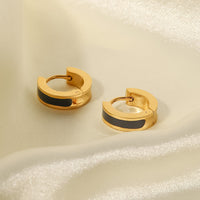
The piece they're describing → Boucles d'oreilles créoles noires pour femme — Plaqué or, créoles émaillées ouvertes en forme de C
Personalize Yours


