


- String/paper method: wrap around the base of your finger, measure the overlap in millimeters, match to a size chart
- Measuring an existing ring's inside diameter is the most accurate home method — no string tension to account for
- US ring sizes run roughly 4–13, matching a 14.8mm–22mm internal diameter
- Phone AR sizing apps can land within about half a size but aren't a substitute for a physical measurement
- Landed between two sizes? Size up, or choose an adjustable band
- Print any ring sizer at 100 percent scale — “fit to page” shrinks the file and throws off the result
Getting your ring size wrong is the single most common reason a beautiful ring ends up back in its box waiting on a resize. Done carefully, an at-home measurement takes about five minutes and gets you within a size of what a jeweler's mandrel would tell you in-store. Here's exactly how to do it, how to read the numbers, and which method is actually worth your time.
The 3 Ways to Measure Your Ring Size at Home
You can measure your ring size with a string or paper strip wrapped around your finger, by tracing the inside diameter of a ring you already own, or with a printable or plastic ring sizer — the string method is the most accessible, and measuring an existing ring tends to be the most accurate of the three.
1. The String or Paper Strip Method
Wrap a strip of paper or a piece of non-stretchy string snugly around the base of your finger, mark where the ends meet, then lay it flat against a ruler to read the circumference in millimeters. Match that number to the chart below. If you're sizing for your dominant hand, measure that hand specifically — fingers on your dominant hand often run about half a size larger than the other.
2. Measure an Existing Ring
Find a ring that already fits the intended finger well, lay it flat on a ruler, and measure the inside edge-to-edge diameter in millimeters. That number converts directly to a US ring size on the chart below, with no wrapping or string tension to throw off the result — which is why it's generally the most reliable of the home methods.
3. A Professional Ring Sizer (Mandrel)
A metal ring mandrel or a set of graduated plastic ring sizers gives the closest result to an in-store measurement because it mimics the actual tool jewelers use. Slide the rings on one at a time until you find the size that fits snugly over your knuckle but still takes a little effort to remove — that's your true size.
US Ring Size Conversion Chart
US ring sizes 4 through 10 correspond to an internal diameter of roughly 14.8mm to 19.8mm — find your measured diameter or circumference below to read off your US size.

| US Size | Diameter (mm) | Circumference (mm) | Circumference (inches) |
|---|---|---|---|
| 4 | 14.8 | 46.5 | 1.83 |
| 5 | 15.7 | 49.3 | 1.94 |
| 6 | 16.5 | 51.9 | 2.04 |
| 7 | 17.3 | 54.4 | 2.14 |
| 8 | 18.2 | 57.0 | 2.24 |
| 9 | 19.0 | 59.5 | 2.34 |
| 10 | 19.8 | 62.1 | 2.44 |
What Is 7 Inches in Ring Size?
7 inches (about 178mm) is far larger than any real adult finger circumference — even the largest standard US size, 13, is only about 2.75 inches (70mm) around — so a 7-inch reading almost always means centimeters were misread as inches, or a whole hand was measured instead of a single finger. If you actually meant 7 centimeters, that's close to a US size 13; re-measure one finger with a snug, flat wrap before you order anything.
Can My Phone Measure My Ring Size?
Yes, with caveats — camera or AR-based sizing apps can land within about half a size of your true measurement if you follow the calibration step exactly, usually placing a credit card or coin in frame for scale. They're still less reliable than a physical string measurement or a mandrel, so treat a phone app as a quick first pass and confirm with the string method or an existing ring before buying anything you can't easily return.
How Do You Use a Printable Ring Sizer?
Print the sizer at 100 percent scale — never “fit to page,” which shrinks the file and throws off every size printed on it — then cut out the strip, wrap it snugly around your finger, and read the size where the arrow lines up through the slot. Check the printed calibration square against a real ruler first, since even a small printer scaling error is enough to shift the result a full size.
Common Ring-Sizing Mistakes to Avoid
- Measuring a cold finger. Fingers shrink in the cold and swell in heat or humidity — measure at room temperature, ideally in the evening.
- Sizing too tight. A ring that barely clears your knuckle will feel tight all day; you want light resistance at the knuckle only, then an easy fit past it.
- Ignoring band width. A wide band (6mm or more) fits tighter than a thin band at the same labeled size, so many jewelers recommend going up half a size for wider styles.
- Guessing on an in-between size. If your measurement lands between two sizes, size up rather than down — a slightly loose ring is far easier to fix than a too-tight one.
Which Ring-Sizing Method Should You Use?
If you already own a ring that fits the intended finger, measure that one first — it's the fastest and most accurate of the home methods, and it skips the string-tension guesswork entirely. If you're buying blind, whether it's a surprise gift or you simply can't get a confident measurement, an adjustable band sidesteps the problem altogether: the Diamond CZ Stacking Ring ($34.99) is crafted in 925 sterling silver with 18K gold plating and pave-set cubic zirconia, and its adjustable band flexes across a couple of sizes so a slightly-off measurement doesn't mean a ring that won't fit. Like every AJLuxe piece, it's nickel-free and hypoallergenic, arrives gift-boxed at no extra charge, and ships from a store that's outfitted more than 40,000 customers.

Frequently Asked Questions
How do I measure my ring size at home?
Wrap a non-stretchy string or paper strip around the base of your finger, mark where it overlaps, measure that length in millimeters, and match it to a ring size chart — or, more accurately, measure the inside diameter of a ring that already fits. Both methods take under five minutes and get you within a size of an in-store measurement if you measure at room temperature and check the result twice.
What is 7 inches in ring size?
7 inches (about 178mm) is too large to be a real finger circumference — even the largest standard adult size, US 13, is only about 2.75 inches around — so a 7-inch reading almost always means centimeters were misread as inches, or the whole hand was measured instead of one finger. If you meant 7 centimeters, that's close to a US size 13; re-measure a single finger to be sure.
Can my phone measure my ring size?
Yes, with an AR or camera-based sizing app and a reference object like a credit card for scale, a phone can get you within about half a size of your actual measurement. It's less precise than a physical string measurement or a mandrel, so treat it as a starting point rather than a final answer for an expensive piece.
How do I use a printable ring sizer?
Print the sizer at 100 percent scale — never “fit to page” — cut along the guide, wrap it around your finger, and read the size where it lines up through the slot. Check the printed calibration box against a ruler first, since even small printer scaling errors are enough to shift the result a full size.
What if I'm between two ring sizes?
Size up rather than down — a slightly loose ring can often be tightened with sizing beads or a jeweler's adjustment, while a too-tight ring frequently can't be resized without cutting and re-soldering the band. An adjustable ring is also a reliable option whenever your measurement falls between two sizes.
Does ring size ever change?
Yes — finger size shifts with temperature, humidity, time of day, and factors like weight change or pregnancy, typically by up to half a size. Measure in the evening at room temperature for the most representative everyday size, and re-measure if it's been more than a year or two since your last sizing.
Toutes les marques, noms de marque et noms de produits tiers sont la propriété de leurs détenteurs respectifs. AJLuxe n’est affilié à aucune marque tierce citée dans cet article, ni approuvé ou sponsorisé par celle-ci. Les noms de marque sont utilisés uniquement à des fins de comparaison factuelle, et les descriptions de matériaux reflètent les spécifications produit publiées par chaque marque au moment de la rédaction.
You Might Also Like
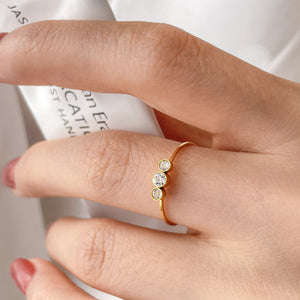
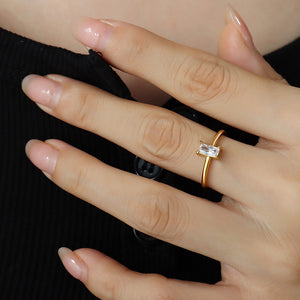

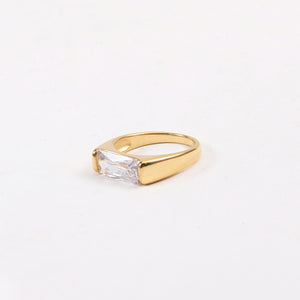
The piece they're describing → Bague empilable en diamant CZ pour femme — Plaqué or 18 carats, style pavé de diamants, ajustable
Personalize Yours


