


TL;DR:
- The tooth test is the fastest at-home check: real pearls feel gritty, fake pearls feel smooth.
- Real pearls are cool to the touch at first and warm up slowly; plastic and glass imitations warm up almost instantly.
- Under magnification, real pearls show tiny surface irregularities; fakes look perfectly uniform.
- Drill holes tell the truth: real pearls have small, clean holes with nacre visible inside; fakes often show flaking paint or coating around a larger hole.
- If a "pearl" strand sells for under $20 and is perfectly round and uniform, it is almost certainly imitation — real pearls are never that cheap or that perfect.
- For high-value pieces, a professional gemological lab (GIA or an independent appraiser) can X-ray or endoscope the pearl to confirm nacre thickness and structure.
If you're staring at a strand of pearls — inherited, thrifted, or bought online — and wondering whether they're the real thing, you're not alone. Learning how to tell real vs fake pearls apart doesn't require a gemologist's toolkit. With a few simple at-home tests (and a couple of professional-grade backups for anything valuable), you can get a confident answer in under five minutes. This guide walks through every test that actually works, what each one is telling you, and how to avoid the common mistakes that trip people up.
Why Fake Pearls Are So Common
Pearls are one of the most imitated gems in jewelry, for one simple reason: they're easy to fake convincingly. A glass or plastic bead coated in "pearl essence" (a lacquer made from fish scales or synthetic resin) can look nearly identical to a real pearl in a photo or under store lighting. Shell pearls — made from crushed mother-of-pearl shell coated in the same lacquer — are a step up in quality and a step harder to detect. Because the visual difference can be so small, the reliable tests are tactile and structural, not just visual.
It also matters what "real" means here. Natural pearls (formed entirely by chance in a wild mollusk) are exceptionally rare and expensive. The vast majority of "real" pearls sold today are cultured — freshwater, Akoya, Tahitian, or South Sea — meaning a technician inserted an irritant into a farmed mollusk to trigger nacre growth. Cultured pearls are 100% genuine pearls; they are not fakes. The authenticity question in this guide is about genuine nacre-formed pearls (natural or cultured) versus imitation pearls made of glass, plastic, or shell with no nacre at all.
The 7 At-Home Tests: Step-by-Step
Here's a step-by-step checklist you can run through in under five minutes with no special equipment. Do at least three of these before drawing a conclusion — no single test is 100% reliable on its own.
- Tooth test. Hold the pearl firmly and gently rub it against the biting edge of your front teeth (not the flat surface). A real pearl feels slightly gritty or sandy, like fine-grain sandpaper, because of the microscopic overlapping layers of nacre. A fake pearl feels smooth and slippery, almost like glass or plastic, because it has no layered structure.
- Weight test. Real pearls are denser than most imitations. Hold the pearl in your palm — a real pearl feels slightly heavier than you'd expect for its size, especially compared to a hollow plastic or wax-filled shell bead. This test is less reliable against solid glass beads, which can be just as heavy or heavier, so pair it with the tooth or temperature test.
- Temperature test. Touch the pearl to your cheek or inner wrist. Real pearls feel cool for the first one to two seconds, then gradually warm to skin temperature. Plastic and resin-coated imitations warm up almost immediately because they don't conduct heat the same way.
- Magnifying glass test. Examine the surface under a jeweler's loupe or even your phone camera zoomed in. Real pearls show tiny ridges, minor bumps, or subtle surface irregularities — nature isn't perfectly smooth. Imitation pearls look flawlessly uniform, almost like a marble or a ball bearing.
- Luster and reflection test. Look at how light bounces off the surface. Real pearl luster has depth — you can almost see into the layers, and reflections look soft and three-dimensional. Fake pearls have a flat, glassy, one-dimensional shine that sits only on the surface.
- Rub-together test (for strands). If you have two pearls next to each other on a strand, gently rub them together. Real pearls produce a faint gritty friction and a soft, dull sound. Fake pearls slide smoothly and click together with a harder, hollow sound.
- Drill hole inspection. Look closely at the hole where the pearl is strung. Real pearls have small, precisely drilled holes, and you can often see the nacre layers like tree rings inside the hole. Imitation pearls often have larger, rougher holes, and you may spot the coating flaking, chipping, or peeling away right at the hole's edge — a dead giveaway.
If a pearl passes at least three of these tests with results consistent with "real," you can be reasonably confident. If it fails two or more, it's very likely imitation.

Real vs Fake Pearls: Side-by-Side Comparison
| Trait | Real Pearl (Natural or Cultured) | Fake / Imitation Pearl |
|---|---|---|
| Surface texture | Slightly gritty on teeth; minor irregularities under magnification | Smooth, glassy, uniform even under a loupe |
| Weight | Noticeably dense for its size | Lighter (plastic) or occasionally too heavy (solid glass) |
| Temperature | Cool at first, warms slowly against skin | Warms almost instantly |
| Luster | Deep, layered, three-dimensional glow | Flat, one-dimensional shine |
| Shape and uniformity | Slight natural variation pearl to pearl | Machine-perfect, identical pearls throughout a strand |
| Drill hole | Small, clean hole, visible nacre layering inside | Larger, rougher hole; coating may flake at the edge |
| Typical price (single strand) | Roughly fifty dollars and up for freshwater; several hundred for Akoya or South Sea | Often under twenty dollars |
Price Sanity Check: What Real Pearls Actually Cost
Price is one of the most overlooked clues, and it's often the fastest filter before you even touch the pearl. Genuine cultured freshwater pearls — the most affordable real pearl type — typically start around fifty dollars for a modest strand and climb from there based on size, luster, and roundness. A single well-made freshwater pearl stud or drop earring pair generally runs somewhere in the range of thirty to over a hundred dollars depending on the metal setting. Akoya pearls, prized for their high luster and near-perfect roundness, usually start in the low hundreds for a strand. South Sea and Tahitian pearls, the rarest cultured varieties, can run into the thousands.
If you see a "pearl" necklace advertised for eight or ten dollars, or a large lot of "genuine pearls" priced like costume jewelry, that price alone tells you almost everything you need to know. Legitimate pearl farming, harvesting, and grading is a labor-intensive process — no seller can profitably offer real cultured pearls at throwaway prices. Treat an unrealistically low price as a red flag that should trigger the physical tests above, not skip them.
Professional Authentication: When to Get an X-Ray or Gemological Report
The at-home tests above are reliable for everyday decisions — buying online, checking a thrift-store find, or confirming a gift is genuine. But if you've inherited a valuable strand, are insuring a piece, or are buying a significant investment-grade pearl, it's worth getting professional confirmation. A gemological lab, or many independent jewelers with the right equipment, can:
- X-ray the pearl to see its internal structure. Natural and cultured pearls show concentric growth rings; imitation pearls show a solid, structureless bead or a uniform glass core.
- Use an endoscope through the drill hole to examine nacre thickness directly, which also distinguishes natural pearls from cultured ones (a distinction that matters enormously for value, even though both are "real").
- Test under UV light — many real pearls fluoresce faintly under long-wave UV, while plastic imitations typically do not, though this test alone isn't conclusive.
- Issue a written identification report that documents pearl type, treatment, and (for valuable pieces) an estimated origin — useful for insurance and resale.
For anything you plan to insure, sell, or pass down, a professional report is worth the modest fee. It removes any ambiguity the at-home tests can't fully resolve.

Cultured vs Natural vs Freshwater vs Akoya: Does the Type Affect Authenticity Testing?
All of the tests above work the same way regardless of pearl type, because they're testing for the presence of real nacre, not for a specific pearl variety. That said, it helps to know what you might be holding:
- Natural pearls form entirely without human intervention and are extremely rare outside of antique or estate jewelry today.
- Cultured freshwater pearls are the most common and affordable real pearl on the market, grown in mussels, usually in China. They tend to be slightly less round and less uniformly lustrous than Akoya, but they are 100% genuine nacre pearls.
- Akoya pearls, cultured mainly in Japan, are known for near-perfect roundness and mirror-like luster, and they command a higher price than freshwater.
- South Sea and Tahitian pearls are larger, cultured in saltwater oysters, and represent the top end of the cultured pearl market.
None of these are "fake" — they're all genuine nacre-formed pearls, just from different mollusks, waters, and culturing methods. The tests in this guide will confirm any of them as real; they simply won't tell you which specific type you have. For that, look at overall roundness, luster intensity, and color, or ask a jeweler.
Common Mistakes When Testing Pearls
A few habits lead people astray even when they're using the right tests:
See also: Akoya vs Freshwater Pearls: The Full Comparison.
- Relying on one test alone. Weight can mislead against solid glass beads; the tooth test can feel ambiguous on a heavily lacquered shell pearl. Always combine at least three tests.
- Testing on painted or coated fashion pearls and assuming the result applies to all pearls in a mixed lot. Test each individual pearl, especially in an inherited or secondhand collection where quality can vary piece to piece.
- Confusing "cultured" with "fake." As covered above, cultured pearls are genuine — don't let a low price relative to natural pearls make you assume a cultured strand is imitation.
- Skipping the drill hole check. It's one of the most reliable visual tests and the one people forget most often because it requires a closer look than a casual glance.
- Ignoring context clues. Where you bought the piece, how it was priced, and any accompanying paperwork (a jeweler's receipt, a gemological certificate) are legitimate evidence too — use them alongside the physical tests.
Frequently Asked Questions
Yes. Cultured pearls are grown inside a living mollusk with human assistance, but the nacre formation process is entirely natural. They are genuine pearls, not imitations — the word "fake" only applies to glass, plastic, or shell beads with no real nacre.
Check the weight, look for a cool touch that warms slowly, examine the surface for tiny natural irregularities under a magnifying glass, and inspect the drill hole for visible nacre layering. Combining three of these gives you a confident answer without ever touching the pearl to your teeth.
Real pearls feel noticeably heavier than plastic imitations of the same size, though they can feel similar in weight to solid glass beads. Weight alone isn't conclusive — pair it with the temperature or tooth test.
Rarely. Most real pearls, especially freshwater ones, show slight variations in shape and size from pearl to pearl on the same strand. A strand where every pearl is machine-perfect and identical is a strong sign of imitation.
Real pearls tolerate brief contact with water, but prolonged exposure to chlorine, saltwater, or harsh soap can dull the nacre over time. It's best to put pearl jewelry on after applying perfume, lotion, and hairspray, and to wipe them with a soft cloth after wear.
A quality clasp — often in gold, gold-plated, or sterling silver with a secure fishhook or box design — is a good sign but not proof on its own. Cheap costume jewelry sometimes uses decent clasps too, so treat this as a supporting clue, not a stand-alone test.
Yes, over time the lacquer coating on glass or plastic imitation pearls can chip, peel, or flake, especially around the drill hole or after contact with perfume and skin oils. Real pearls do not peel because the nacre is a natural, integrated structure, not a coating.
Real pearl luster has depth — light seems to glow from within the layers of nacre, producing a soft, almost three-dimensional sheen. A fake pearl's shine sits flat on the surface, closer to the reflection you'd see off a glass marble or plastic bead.
Freshwater pearls are real pearls — they're simply a more affordable cultured variety compared to Akoya or South Sea. Quality varies by luster, roundness, and surface cleanliness within any pearl type, so a high-grade freshwater pearl can outshine a low-grade Akoya pearl.
Many local jewelers will do a quick visual and tactile check at no charge, though a full written identification report from a gemological lab usually carries a fee. It's worth asking your jeweler directly, since policies vary by shop.
Yes, rubbing two real pearls together produces a subtle gritty friction and a soft, dull sound, because of the microscopic nacre layers. Fake pearls slide smoothly and click together with a harder, more hollow sound.
Final Thoughts
Telling real pearls from fake ones comes down to combining a handful of simple, physical checks: the gritty feel against your teeth, a slow warm-up against your skin, natural surface irregularities under a loupe, and a clean drill hole with visible nacre. None of these require special tools, and running through three or four of them together will give you a confident answer in a few minutes. For anything valuable enough to insure or resell, a professional gemological report is a small cost for complete certainty. And remember — cultured pearls, whether freshwater, Akoya, or South Sea, are genuine pearls. The only real "fake" is a bead with no nacre at all.
Shop This Guide
Looking for genuine pearl jewelry you can trust? Explore our pearl collection, including gold-plated pearl drop earrings and a dainty freshwater pearl necklace.
Shop Pearl JewelryMore Authentication Guides
- How to Tell If Gold Is Real at Home
- How to Tell If Silver Is Real
- How to Tell If Jewelry Is Real Gold
- Is Cubic Zirconia Real? A Buyer's Guide
- How to Identify Real Serpentine Stone
Author: AJLuxe Team — Last updated: July 2026. For further reading on pearl quality and authentication, see the GIA guide to pearl quality factors.
Toutes les marques, noms de marque et noms de produits tiers sont la propriété de leurs détenteurs respectifs. AJLuxe n’est affilié à aucune marque tierce citée dans cet article, ni approuvé ou sponsorisé par celle-ci. Les noms de marque sont utilisés uniquement à des fins de comparaison factuelle, et les descriptions de matériaux reflètent les spécifications produit publiées par chaque marque au moment de la rédaction.
You Might Also Like
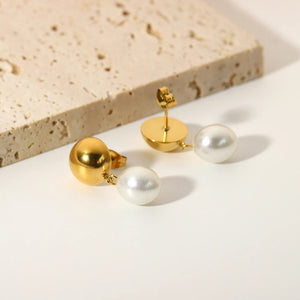

The piece they're describing → Boucles d'oreilles pendantes en perles pour femme — Plaqué or 14 carats, perle blanche naturelle, prêtes à offrir
Personalize Yours


