


Few natural symbols cross as many cultures and centuries as the palm tree. From the triumphal entry into Jerusalem to the shores of ancient Egypt, from Caribbean fishing villages to modern beach tattoos, the palm tree carries a consistent core meaning: life, victory, and resilience in paradise.
Below is a complete guide to palm tree symbolism — what it means spiritually, what it represents across cultures, and what it says when you wear it.
Shop our Shell Heart Necklace — where the shoreline meets the palms. A natural shell pendant on an 18K gold-plated chain, perfect for the beach-at-heart.
What Does a Palm Tree Symbolize?
At its core, the palm tree carries these primary meanings across most cultures:
- Victory and triumph — palm fronds were waved and laid down for conquering heroes in ancient Rome and Jerusalem
- Resilience — palms bend in hurricanes but rarely break; their roots hold even in sand
- Paradise and abundance — palm trees grow in warm, fertile climates and provide food, shade, and shelter
- Immortality and longevity — date palms live 100+ years and produce fruit for nearly their entire lives
- Peace and rest — the shade beneath a palm tree was sacred rest in desert cultures
The consistent thread across all these meanings is the palm's paradox: it is both tropical ease and fierce endurance. The same tree that signals vacation and paradise is also the tree that outlives storms and thrives where nothing else can grow.
Palm Tree Symbolism in the Bible

The palm tree appears throughout the Old and New Testament, always carrying associations of righteousness, victory, and divine blessing.
The most quoted passage is Psalm 92:12: "The righteous shall flourish like a palm tree, they shall grow like a cedar in Lebanon." This verse established the palm as a symbol of the person who lives in alignment with God — tall, fruitful, and enduring even in difficult soil.
Palm trees lined the Temple of Solomon in Jerusalem, carved into its walls and doors as a symbol of life and divine favor. In the Book of Ezekiel, the ideal temple is described as having alternating palm trees and cherubim on every wall — the palm representing both God's presence and the flourishing of the faithful.
The most dramatic New Testament moment is Palm Sunday — when crowds waved palm branches and laid them in the path of Jesus entering Jerusalem (John 12:13). In the ancient world, palm fronds were the victory symbol — they were laid before kings returning from battle. The crowd was declaring Jesus a conquering king. This single act permanently wove the palm into Christian tradition as a symbol of divine triumph and ultimate victory.
In the Book of Revelation, palm branches appear in the hands of the redeemed standing before the throne of God — a final vision of ultimate paradise and eternal peace.
Palm Tree Symbolism in Ancient Egypt and the Middle East
The date palm (Phoenix dactylifera) was the tree of life in ancient Egypt. Its Latin genus name — Phoenix — is no accident; the Egyptians connected it to the mythical phoenix, the bird that rises from its own ashes.
In Egyptian hieroglyphics, a palm branch represented the concept of time and years — a new frond grew each month, making the palm a living calendar. Images of the god Thoth sometimes show him notching a palm rib while recording the years of a pharaoh's reign — the palm measured time itself.
In Mesopotamia (modern-day Iraq and Syria), the date palm was so central to civilization that ancient Babylonian texts describe it as the "tree of life." It provided food, building material, rope, baskets, and shade — a complete subsistence system in a single tree. Sumerian and Akkadian art frequently shows the palm flanked by protective divine figures, suggesting it was considered sacred.
In Arabic culture, the palm tree (nakhla) holds a status similar to the olive tree in Mediterranean cultures — it represents home, rootedness, and the sweetness of life. The Quran mentions the date palm 23 times, often in descriptions of paradise. The Prophet Muhammad is said to have compared the believer to a palm tree: always productive, always standing tall.
Palm Tree Symbolism in Ancient Greece and Rome
To the ancient Greeks, the palm was sacred to Apollo — the god of the sun, music, and prophecy. According to mythology, Apollo was born under a palm tree on the island of Delos. Delos subsequently became one of the most sacred sites in the Greek world, and the island's single surviving palm tree became an object of reverence.
Greek athletes who won at the ancient games received palm branches alongside their laurel wreaths. The palm frond became the symbol of Nikē (Victory) and was carried by victors in battle, athletics, and civic life.
The Romans adopted this tradition completely. Palmam dare ("to give the palm") was a Roman expression meaning "to award the prize." Victorious generals returning from campaigns carried palm fronds, and Roman coins frequently depicted personified Victory (Victoria) holding or distributing palm branches.
Palm Tree Spiritual Meaning
Across spiritual traditions, the palm tree carries one of the most powerful lessons in nature: strength through flexibility, not rigidity.
This isn't metaphor — it is structural fact. Palm trees have no rigid trunk the way oaks or maples do. Instead, their trunks are bundles of flexible fibers that move as a unit in wind. In a hurricane, a palm might bend its crown completely horizontal, its fronds nearly parallel to the ground. But the root system holds, and the tree springs back upright once the storm passes. This has made the palm a near-universal symbol of:
- Resilience under pressure — the capacity to bend without breaking
- Adaptability — palms grow in sand, salt air, and tropical heat where most trees cannot survive
- Reaching toward the light — the palm always grows upward toward the sun, even when it starts at a severe angle
- Slow, patient transformation — some palm species spend years underground before sending up a shoot, then bear fruit for decades
In many spiritual communities, the palm is associated with personal power and the solar plexus chakra — the energy center of confidence, resilience, and inner authority. Visualizing a palm tree in meditation is said to help a person stay grounded under pressure while remaining open to change.
Palm Trees Around the World
In the Caribbean and Pacific Islands, the coconut palm is more than a symbol — it is a survival story. It provides drinking water, food, cooking oil, lumber, fiber, and shade. For island cultures, it represents complete abundance: the gift of everything a person needs from a single source. To have a coconut palm near your home was traditionally considered a blessing.
In Southeast Asia, different palm species hold different symbolic values. The Talipot palm, which blooms only once in its entire lifetime (after 30–80 years), is an emblem of once-in-a-generation moments — in Sri Lanka it is used in ceremonial fans for Buddhist clergy, marking its flowers as sacred rarities.
In contemporary Western culture, the palm tree carries a very specific meaning: vacation, leisure, and the freedom from ordinary life. Palm trees appear in logos for everything from travel agencies to cocktail brands because they immediately signal warmth, relaxation, and escape. In the modern imagination, a palm tree means "I am somewhere beautiful and I am finally free."
What Does Palm Tree Jewelry Mean?

When someone wears a palm tree charm or pendant, they are usually expressing one or more of these meanings:
- A love of travel and the ocean — the palm is the universal shorthand for beach life and warm places
- A reminder of resilience — "I bend but I don't break" — often worn as a personal mantra after a hard season
- A connection to a specific place — many people wear palm jewelry to carry the memory of a trip, a childhood home, or a place they long to return to
- A spiritual alignment with growth — always reaching upward, even from difficult soil
Palm tree jewelry works especially well as a meaningful gift for someone who has been through hardship and come through it. The "I bent but didn't break" message is universal. It also works beautifully as a travel keepsake, a graduation gift (reaching new heights), or an anniversary gift for couples whose most meaningful memories are set beside the sea.
Shop our Shell Heart Necklace — natural shell from the shoreline beneath the palms, on an 18K gold-plated chain. A beautiful daily reminder of beaches past and beaches ahead.
Palm Tree Symbolism: Frequently Asked Questions
- What do palms mean spiritually?
- Spiritually, palms symbolize resilience, victory over adversity, and the power of bending without breaking. Most spiritual traditions also associate palms with paradise, divine blessing, and reaching upward toward the light.
- What do palm trees represent in the Bible?
- In the Bible, palm trees represent righteousness, victory, and divine favor. Psalm 92:12 compares the righteous to a flourishing palm tree. Palm branches were waved at Jesus's triumphal entry into Jerusalem on Palm Sunday (John 12:13).
- What do palm trees symbolize in love?
- Palm trees symbolize paradise found, enduring commitment, and the sweetness of life shared together. Their longevity — date palms live over 100 years — makes them a symbol of lasting love and the romantic ideal of paradise built with someone you love.
- What is special about a palm tree?
- Palm trees can bend nearly horizontal in hurricane-force winds and spring back upright without breaking. They grow in sand, salt air, and intense heat where most trees cannot survive, and date palms fruit for up to 100 years.
- What does a palm tree tattoo symbolize?
- Palm tree tattoos symbolize resilience and flexibility under pressure, a love of travel and beach life, connection to a personal place of peace, and the spiritual quality of always reaching toward the sun.
- Do palm trees symbolize luck?
- Yes — in Arabic tradition the date palm is a sign of abundance, and in Pacific Island cultures a coconut palm near your home is considered a blessing and sign of good fortune.
- What does palm tree jewelry mean?
- Wearing a palm tree expresses a love of travel and the ocean, a personal reminder of resilience, a connection to a meaningful place, or a spiritual alignment with growth. It works beautifully as a travel keepsake, graduation gift, or gift for someone who has come through a hard season.
What a Palm Tree Symbolizes Today (and Why It's a Popular Gift)
Outside of scripture and mythology, the palm tree has picked up a distinctly modern meaning: it's become shorthand for starting over. Because a palm can be bent nearly flat by a hurricane and stand upright again days later, it's one of the most common tattoo choices for people marking recovery — from addiction, illness, a divorce, or any period they had to "bend without breaking." Unlike a phoenix or a lotus, which symbolize rebirth through destruction, the palm's message is survival without loss of self: the tree doesn't die and regrow, it just holds on and keeps standing.
That's part of why palm tree jewelry has become a quiet staple in gift-giving, especially for milestones that don't have an obvious "gift category" the way weddings or birthdays do:
- Moving or relocating — the palm's paradise associations make it a natural symbol for a fresh start somewhere new
- Sobriety or health milestones — leaning on the resilience meaning rather than the tropical one
- Graduation or a new job — echoing the Psalm 92:12 image of flourishing and growing tall
- "Thinking of you" after a hard year — a subtler alternative to more literal strength symbols like an anchor or a mountain
There's also a simpler, non-symbolic reason it's popular: the palm silhouette reads as unmistakably warm-weather and low-key, which is why it shows up so often as a minimalist charm rather than a bold statement piece — it doesn't need embellishment to be recognizable. On a necklace or bracelet, a single palm silhouette tends to carry more visual weight than an intricate one, since the meaning depends on the shape being read instantly rather than examined closely.
Worth noting: unlike the anchor (steadfastness) or the compass (direction), the palm tree doesn't have a single fixed "meaning chart" in modern jewelry symbolism — its interpretation shifts with context, which is exactly why it works equally well as a beach-vacation memento and as a resilience gift for someone who's been through a hard season.
Toutes les marques, noms de marque et noms de produits tiers sont la propriété de leurs détenteurs respectifs. AJLuxe n’est affilié à aucune marque tierce citée dans cet article, ni approuvé ou sponsorisé par celle-ci. Les noms de marque sont utilisés uniquement à des fins de comparaison factuelle, et les descriptions de matériaux reflètent les spécifications produit publiées par chaque marque au moment de la rédaction.
You Might Also Like
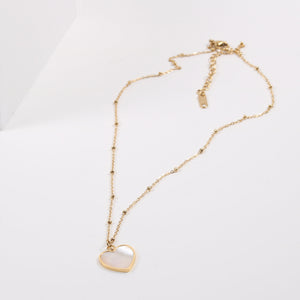

The piece they're describing → Collier Cœur Coquillage pour Femme — Pendentif Coquillage Naturel, Chaîne Plaqué Or, Bohème
Personalize Yours


