


- Most common men's size: US 10 — inside diameter 19.8 mm, inside circumference 62.1 mm. Most men land between 8 and 12.
- Men's and women's sizes are the same scale. There is no separate men's system; men simply cluster at the larger end of it.
- Measure the circumference, not the diameter. Wrap a strip of paper around the base of the finger, mark the overlap, measure the length in mm, then read it off the chart below.
- Wide bands fit tighter. At 6 mm and up, go a half size larger; at 8 mm and up, a full size.
A men's ring size chart is a conversion table, nothing more: it turns one measurement — the inside circumference of the ring in millimetres — into the US size number a jeweller will actually cut. Everything else about sizing is about getting that one measurement right. The chart below covers US sizes 6 through 16 in half-size steps, which is the full range almost any men's ring is made in.
Men's Ring Size Chart (US Sizes 6–16)
US ring sizes run on a fixed scale: every full size adds roughly 2.55 mm of inside circumference, or about 0.81 mm of inside diameter. That relationship is why the numbers below are not rounded guesses — they are the standard conversion, and they match the published charts used by Brilliant Earth and by jewellers cutting to US sizes.
| US / Canada size | Inside circumference | Inside diameter | Circumference (inches) |
|---|---|---|---|
| 6 | 51.9 mm | 16.5 mm | 2.04" |
| 6.5 | 53.1 mm | 16.9 mm | 2.09" |
| 7 | 54.4 mm | 17.3 mm | 2.14" |
| 7.5 | 55.7 mm | 17.7 mm | 2.19" |
| 8 | 57.0 mm | 18.1 mm | 2.24" |
| 8.5 | 58.2 mm | 18.5 mm | 2.29" |
| 9 | 59.5 mm | 18.9 mm | 2.34" |
| 9.5 | 60.8 mm | 19.4 mm | 2.39" |
| 10 (most common) | 62.1 mm | 19.8 mm | 2.44" |
| 10.5 | 63.3 mm | 20.2 mm | 2.49" |
| 11 | 64.6 mm | 20.6 mm | 2.54" |
| 11.5 | 65.9 mm | 21.0 mm | 2.59" |
| 12 | 67.2 mm | 21.4 mm | 2.64" |
| 12.5 | 68.5 mm | 21.8 mm | 2.70" |
| 13 | 69.7 mm | 22.2 mm | 2.75" |
| 13.5 | 71.0 mm | 22.6 mm | 2.80" |
| 14 | 72.3 mm | 23.0 mm | 2.85" |
| 14.5 | 73.6 mm | 23.4 mm | 2.90" |
| 15 | 74.8 mm | 23.8 mm | 2.95" |
| 15.5 | 76.1 mm | 24.2 mm | 3.00" |
| 16 | 77.4 mm | 24.6 mm | 3.05" |
Measurements are the inside of the band. A ring measured across the outside, or measured over a wide band's edge, will read too large.
What Is the Average Men's Ring Size?
The most commonly sold men's ring size is US 10, and the great majority of men fall between size 8 and size 12. That is the figure jewellers size their default stock around, and it is the right guess if you genuinely have nothing else to go on — but it is a guess, and a size 10 on a size 8 finger is loose enough to spin and eventually to lose.
Hand size tracks build more than height, which is why "he's tall, so order a 12" goes wrong so often. A slim 6'2" man frequently wears a 9; a stocky 5'8" man who works with his hands can wear a 12. If you are buying blind, the useful ranges are roughly: slim hands 8–9, average hands 9–11, large or heavily-built hands 11–13. Treat these as starting points for a measurement, not a substitute for one.
How to Measure a Man's Ring Size at Home
The most accurate home method is measuring an existing ring that already fits the correct finger: lay it flat, measure the inside diameter in millimetres across the widest point, and read the diameter column above. It beats every finger-wrapping method because a ring is a rigid object and a finger is not.

If there is no ring to measure, use the paper-strip method. Cut a strip of paper about 6 mm wide — not string, which stretches, and not a tape measure, which is too stiff to sit flat against the skin. Wrap it around the base of the finger, snug enough that it will not slide off but loose enough to turn, mark where it overlaps, then measure from the end to the mark with a ruler in millimetres. That number is the inside circumference; find it in the chart.
Three things quietly ruin a home measurement, and all three are easy to control:
- Time of day. Fingers are smallest in the morning and largest in the evening. Measure at the end of the day, when the size you get is the size that has to still fit at dinner.
- Temperature. Cold hands measure up to half a size small. Warm the hand first; do not measure straight after coming in from the cold or straight out of a swim.
- The knuckle. The ring has to pass the knuckle, not just sit at the base. If the knuckle is noticeably wider than the base of the finger, size to the knuckle and accept a slightly loose seat — a ring that fits the base but not the knuckle simply cannot be put on.
Phone apps that size a finger from a camera photo are worth exactly what they cost. They are fine for narrowing a range before you measure properly; they are not accurate enough to order from.
How to Find His Ring Size Without Him Knowing
The reliable way to size a surprise ring is to borrow one he already wears and measure the inside diameter with a ruler while it is off his hand — overnight, or while he showers — then put it straight back. Measure the ring, not the finger; you cannot measure a sleeping hand accurately and you will wake him trying.
If borrowing is not possible, the workable alternatives, roughly in order of how well they hold up:
- Press a ring into soap or clay. Take an existing ring, press it flat into a bar of soap, and measure the impression's diameter. This takes seconds and leaves the ring where it was.
- Ask someone with a legitimate reason to know. A sibling, a parent, a close friend — someone who can raise jewellery in conversation without it reading as a signal.
- Buy deliberately large and resize after. A plain metal band can normally be sized up or down two sizes by any jeweller. This is the honest fallback: it costs a resize fee and it removes the risk of a ring he cannot get on at the moment it matters.
What does not work: comparing his hand to yours, guessing from glove size, or ordering a size 10 because it is the average. The average is a population statistic, not a fact about him.
Band Width Changes the Fit — Here Is the Rule
A wider band fits tighter at the same nominal size, because it presses against more of the finger and has to clear the knuckle over a longer surface. The standard jeweller's adjustment is: at 6 mm wide and above, order a half size up from your measured size; at 8 mm and above, order a full size up. Below 6 mm, order your measured size.
This matters more for men than for women simply because men's bands are wider on average — 6 mm and 8 mm are ordinary men's widths, where 2 mm and 3 mm are ordinary women's widths. If a man measures a 10 and is buying an 8 mm band, he is buying an 11. Ordering the 10 because "he's a 10" is the single most common men's sizing mistake, and it is why so many wide bands end up in for resizing within a month.
Comfort-fit bands — the ones with a domed, rounded interior rather than a flat one — run the opposite way. The rounded inside slides over the knuckle more easily, so a comfort-fit band typically needs a half size smaller than the same width in a standard fit.
How Big Is a Size 10 Men's Ring? (And a Size 7?)
A size 10 men's ring has an inside diameter of 19.8 mm and an inside circumference of 62.1 mm — about 2.44 inches around the inside of the band. It is the most commonly sold men's size and sits comfortably in the middle of the normal men's range.
A size 7 ring has an inside diameter of 17.3 mm and an inside circumference of 54.4 mm. On the men's scale that is small — it is the most common women's size, and on a man it usually means slim fingers or a pinky. A size 7 is not unusual for a man; it is simply at the lower end, and there is nothing to correct about it.
For the two other sizes people ask about most: a size 9 is 18.9 mm across and 59.5 mm around, slightly below average for a man and completely ordinary. A size 12 is 21.4 mm across and 67.2 mm around, at the larger end but well within standard stocked sizes.
What If He Falls Between Two Sizes?
Size up, not down — but only if the larger size still needs a small tug to come off. A ring that spins slightly is a ring you keep; a ring that will not clear the knuckle is a ring that lives in a drawer. This is the opposite of the advice usually given for women's rings, and the reason is the knuckle: men's knuckles are proportionally more prominent, so the pass-over is the binding constraint far more often than the seat is.
Two exceptions. If the ring is a wide band, the half-size-up rule above already accounts for the gap, so do not size up twice. And if his fingers swell noticeably in heat or after exercise, size to the swollen state rather than the resting one — a ring that has to be cut off is a worse outcome than one that turns.
Where AJLuxe Fits — Stated Honestly
We do not currently make men's rings, and we would rather say so than route you to a women's band and call it unisex. AJLuxe's men's line opened in August 2026 and starts with necklaces in 316L stainless steel — a genuinely different material from our women's 925 sterling silver and 18K gold plating, chosen because it holds up to daily wear without a plating layer to wear through.
If you are here because you are buying a gift and the ring size has turned into an obstacle, a chain sidesteps the problem entirely: it has no size to get wrong, and it does not need resizing if you guess badly. That is a real reason to consider one, not a pivot.
No size to guess and nothing to resize: our Men's Cross Necklace is an adjustable cuban link chain in 316L stainless steel — hypoallergenic, no plating to wear off, and it fits whoever you are buying for.
Shop the Men's Cross NecklaceCan a Men's Ring Be Resized?
Most plain metal bands can be resized up or down about two sizes by a jeweller, which is the practical safety net behind every sizing decision on this page. Sterling silver and gold resize easily. What generally cannot be resized: tungsten carbide, ceramic, and most titanium — these are cut or pressed to size and are replaced rather than altered. Rings with stones set all the way around the band (full eternity settings) also cannot be resized without rebuilding the setting.
If you are buying in a material that cannot be resized, the measurement stops being approximate and starts being the whole purchase. Measure twice, and buy from somewhere with an exchange policy.
The chart at the top is the part worth bookmarking. Everything else here is about making sure the number you look up is the right number.
Toutes les marques, noms de marque et noms de produits tiers sont la propriété de leurs détenteurs respectifs. AJLuxe n’est affilié à aucune marque tierce citée dans cet article, ni approuvé ou sponsorisé par celle-ci. Les noms de marque sont utilisés uniquement à des fins de comparaison factuelle, et les descriptions de matériaux reflètent les spécifications produit publiées par chaque marque au moment de la rédaction.
You Might Also Like
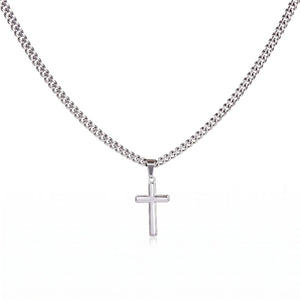
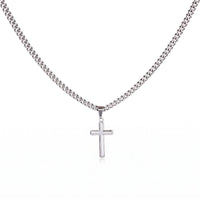
The piece they're describing → Men's Cross Necklace — Adjustable Cuban Link Chain, 316L Stainless Steel
Personalize Yours


