


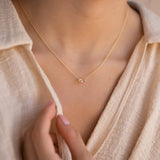
- Mejuri (Toronto) builds its everyday line on 14K/18K gold vermeil over 925 sterling silver, plus a solid 10K/14K gold "fine" line — prices run roughly $50 to $1,500+.
- Gorjana (California) builds most of its bestselling core line on 14K gold-plated brass, with a smaller sterling silver and solid-gold fine collection — prices run about $28 to $400.
- The "Mejuri controversy" refers to a 2026 consumer-law investigation into complaints of premature tarnishing, fading, and skin irritation on pieces marketed as everyday-durable vermeil.
- Both brands' plated/vermeil pieces will eventually fade with daily wear — Mejuri's sterling-silver base tends to age more gracefully than Gorjana's brass-core pieces, but neither is permanent.
- AJLuxe uses the same base-metal tier as Mejuri's everyday line — 925 sterling silver with 18K gold plating — at $24.99–$79.99, making it the more affordable option that doesn't drop down to a brass core.
Typing "mejuri vs gorjana" into Google usually means one of two things: you're deciding which brand to buy from, or you already own a piece from one and are wondering whether the other does it better. Both are direct-to-consumer jewelry brands built around a dainty, gold-forward, layer-friendly aesthetic — but they're not the same product at different price points. They use different base metals, different gold thicknesses, and they've each had their own quality controversies surface in reviews and, in Mejuri's case, in an active 2026 legal investigation. This guide breaks down the honest head-to-head: price, materials, tarnish behavior, the "Mejuri controversy" people are searching for, and style — then shows where AJLuxe fits as the affordable 925 sterling silver option if both brands are outside your budget.
Mejuri at a Glance
Mejuri launched in 2015 out of Toronto with a clear pitch: fine-jewelry aesthetics without the boutique markup or the "special occasion only" mentality. The brand's everyday collection is built on 14K and 18K gold vermeil — a real gold layer (at least 2.5 microns, per FTC rules) electroplated onto a 925 sterling silver base. Mejuri also sells a "fine jewelry" line in solid 10K and 14K gold, some set with natural or lab-grown diamonds, where prices climb well past $500.
What Mejuri does well: a consistent, polished, editorial-minimalist look — thin chains, signet rings, huggie hoops, and simple pendants that photograph like they cost more than they do. What it doesn't do: serve the truly budget-conscious shopper. Even Mejuri's entry-level chain necklaces start around $50–$65, and the brand ships from Canada, so US orders typically take 5–10 business days unless you pay for expedited shipping.
Gorjana at a Glance
Gorjana has been in business since 2004, built in California around a warmer, beachier, more "stack it all on" aesthetic than Mejuri's restrained minimalism. Its bestselling core collections — bar necklaces, initial pendants, chain-link bracelets, huggie earrings — are made with 14K gold plating over a brass base, not sterling silver. Gorjana does carry a smaller sterling silver line and a "fine jewelry" collection in solid 14K gold, but the brass-plated core is what most shoppers actually buy, and it's what stocks the shelves at Nordstrom and Anthropologie.
Price is Gorjana's clearest edge: most of the core collection sits between $28 and $85, with fine-gold pieces reaching $150–$400. That's meaningfully below Mejuri's everyday vermeil pricing for a comparable style. The tradeoff is the base metal — brass isn't as skin-friendly or as slow-to-tarnish as sterling silver once the gold plating starts to thin.
Mejuri vs. Gorjana: Full Head-to-Head Comparison
Here's the side-by-side, with AJLuxe added as the affordable 925-silver option for context. Tap a row to compare.
| Category | Mejuri | Gorjana | AJLuxe |
|---|---|---|---|
| Price range | $50–$1,500+ (vermeil to solid-gold fine line) | $28–$400 (plated core to solid-gold fine line) | $24.99–$79.99 |
| Base metal | 925 sterling silver (vermeil line); solid 10K/14K gold (fine line) | Gold-plated brass (core line); sterling silver & solid 14K gold (fine line) | 925 sterling silver |
| Gold layer | 14K/18K gold vermeil, 2.5+ micron electroplate (FTC minimum) | 14K gold plating over brass on most bestsellers | 18K gold electroplate |
| Tarnish / durability | Vermeil typically fades in 1–3 years of daily wear; 2026 investigation into premature-fading complaints | Brass-core pieces show wear fastest (often under 1–2 years); sterling/fine lines hold up longer | Sterling base resists the green-skin issue; plating wears like any plated jewelry over time |
| "Mejuri controversy" | Active 2026 consumer-law investigation (premature fading, skin irritation on "everyday wear" vermeil) + a settled David Yurman design-copying lawsuit | No comparable legal investigation; scattered reviews cite plating wearing thin on cheaper pieces | No comparable controversy at this scale — smaller, newer catalog |
| Style | Polished, editorial, restrained minimalism | Warm, beachy, stack-and-layer "California" aesthetic | Dainty, sentimental — birthstone, initial, and heart pieces |
| Ships from | Toronto, Canada (5–10 business days to US) | United States | United States |
| Best for | Shoppers ready to invest in a sterling-silver or solid-gold base | Budget layering sets and in-store try-on at Nordstrom/Anthropologie | Hypoallergenic sterling-silver base at the lowest starting price |
The "Mejuri Controversy": What Shoppers Are Actually Searching For
If you searched "mejuri vs gorjana" and landed here after also seeing "Mejuri controversy" in autocomplete, here's the honest answer. In April 2026, the law firm Migliaccio & Rathod LLP opened a consumer-protection investigation into Mejuri's gold vermeil jewelry. The complaints center on a specific pattern: customers bought pieces marketed as durable, "everyday wear" gold vermeil, then reported the gold finish fading or wearing off after only a handful of wears — in some cases within weeks, not years. A subset of complainants also reported skin turning green or becoming irritated, which points to the underlying sterling silver or alloy showing through faster than the marketing implied.
Separately — and this is an older, unrelated dispute — David Yurman sued Mejuri in 2023 alleging "serial" design copying (trade dress infringement on cable and chain-link motifs). Mejuri countersued, and the two settled in 2024. That lawsuit was about design similarity, not product quality, and it's worth keeping the two controversies distinct: one is about whether Mejuri's jewelry lasts as advertised, the other was about whether its designs looked too much like a competitor's.
None of this means Mejuri jewelry is universally low quality — the brand has a large, loyal customer base and plenty of positive long-term wear reports, especially on its solid-gold fine line. But if premature fading and durability are your top concern, it's a real, documented pattern worth weighing before you buy the vermeil line specifically.
Does Gorjana or Mejuri Tarnish? The Honest Durability Answer
Neither brand is tarnish-proof on its plated or vermeil pieces — that's true of any gold-plated or gold-vermeil jewelry, not a flaw unique to either company. What differs is how gracefully each one ages and what's underneath once the gold layer thins.
Mejuri's vermeil sits on a 925 sterling silver base. When the gold layer eventually wears — typically 1–3 years of regular wear — what shows through is silver, which tarnishes to a warm gray tone rather than triggering skin reactions for most wearers. Gorjana's core collection sits on brass. Brass contains copper and zinc, and when the plating wears through, it can oxidize against skin oil and sweat, which is the mechanism behind the "green necklace" reviews you'll find scattered across Gorjana's product pages and TikTok. Gorjana's own care guide recommends keeping pieces away from water, lotion, and alcohol-based products specifically to slow this process — a tell that the plating is the vulnerable layer.
Per the Jewelers of America guidance on plated metals, the base metal underneath any gold layer is the real predictor of long-term skin comfort and tarnish behavior — not the brand name on the box. Sterling silver bases (Mejuri's vermeil line, AJLuxe's full catalog) are the more hypoallergenic and slower-tarnishing choice once plating wears thin; brass bases (most of Gorjana's core line) are the more budget-friendly choice with a shorter honeymoon period before the base metal starts to show.
Style & Aesthetic: Which Look Actually Fits You
Beyond materials, Mejuri and Gorjana read very differently on the body, and that matters as much as price for most buyers.
Mejuri leans restrained and editorial. Think one clean chain, a single signet ring, a pair of small huggies — pieces designed to look expensive in isolation, not to be piled on. It photographs well for a minimalist, "quiet luxury" wardrobe.
Gorjana leans maximalist-by-default. The brand's entire merchandising strategy is built around layering — bar necklaces meant to be worn three at a time, stacking rings, ear-party earring sets. It's warmer, more casual, and more forgiving if your style is "more is more."
AJLuxe sits closer to Mejuri's restraint but leans sentimental rather than editorial — birthstone pendants, initial necklaces, heart motifs, and dainty Y-necklaces designed as meaningful, giftable pieces rather than fashion-forward statements. If you love Gorjana's layering energy or Mejuri's polish but want it on a hypoallergenic 925 base without the price climb, that's the gap AJLuxe fills.
The Affordable Third Option: Where AJLuxe Fits
Here's the gap in the Mejuri-vs-Gorjana debate that neither brand's own marketing will point out: Mejuri's material quality (925 sterling silver base) is genuinely better than Gorjana's brass-core bestsellers — but Mejuri also costs more for it. Gorjana is cheaper, but you're often trading down to brass to get there. AJLuxe doesn't ask you to make that trade. Every AJLuxe piece — including the dainty cubic zirconia Y-necklace pictured below — is built on the same 925 sterling silver base Mejuri uses for its everyday vermeil line, finished with 18K gold plating, starting at $24.99 and topping out at $79.99. You're not stepping down to brass to save money, and you're not paying Mejuri's premium for a base metal AJLuxe already uses.
That's not a claim that AJLuxe replaces either brand's solid-gold fine jewelry — solid 14K gold doesn't plate off, full stop, and if that's what you want, Mejuri's and Gorjana's fine lines are the honest choice. But for the everyday-vermeil-vs-everyday-plated comparison most "mejuri vs gorjana" searchers are actually making, AJLuxe is the affordable option that matches the better of the two base metals without the wait for Canadian shipping or the layering-set upsell.
If you want the fuller picture on either brand specifically, see our deep dives on Mejuri alternatives, Gorjana alternatives, and is Mejuri worth it, or browse the wider field in our best affordable jewelry brands ranking and our Caitlyn Minimalist alternatives guide.

How to Choose Between Mejuri and Gorjana (or Neither)
Choose Mejuri if: you want the more durable base metal in the everyday-price tier (925 sterling silver over brass), you're comfortable with a 5–10 business day ship time from Canada, and you're open to eventually investing in the solid-gold fine line.
Choose Gorjana if: price and in-person try-on (Nordstrom, Anthropologie) matter most, you want to layer three or more pieces at once without spending Mejuri money to do it, and you're comfortable re-buying plated pieces every year or two.
Choose an affordable third option like AJLuxe if: you want Mejuri's sterling-silver base metal without Mejuri's price or shipping wait, you want more budget headroom than Gorjana's core line to still land on a hypoallergenic base, or you simply want to test the minimalist gold-necklace look before committing to either brand's higher price points.

Related reading: What Is Affordable Luxury Jewelry? A 2026 Buyer's Guide.
Related reading: 8 Best Lovisa Alternatives for Trendy, Affordable Jewelry (2026).
Frequently Asked Questions
Which is better, Gorjana or Mejuri?
Mejuri is the better material quality overall — most pieces use a 925 sterling silver base versus Gorjana's brass-core bestsellers. Gorjana wins on price and layering variety, with most pieces $28–$85 versus Mejuri's $50–$250+ everyday range. Neither is "better" in every category; it depends on whether base-metal quality or price is your priority.
What is the Mejuri controversy?
In April 2026, law firm Migliaccio & Rathod LLP opened a consumer-protection investigation into Mejuri's gold vermeil jewelry following reports of premature fading, gold finish wearing off after only a few wears, and some customers reporting skin irritation, despite the pieces being marketed as suitable for "everyday wear." This is separate from Mejuri's earlier, settled 2023–2024 design-copying lawsuit with David Yurman, which was about trade dress, not product quality.
Is Gorjana jewelry good quality?
Gorjana's fine jewelry and sterling silver lines are solidly made and hold up well with normal wear. Its bestselling core collection, though, is gold-plated brass, which shows wear faster than sterling silver or solid gold — typically within one to two years of regular wear, especially with water, sweat, or lotion exposure.
For a full standalone review — not just the Mejuri comparison — see our Gorjana jewelry reviews and quality verdict.
What brands are better than Mejuri?
"Better" depends on the metric. For solid gold at lower prices, Quince and Aurate beat Mejuri. For gold-fill durability at accessible prices, Gorjana and Miranda Frye compete well. For a 925 sterling silver base at the lowest starting price, AJLuxe undercuts Mejuri while matching its base-metal tier. See our full Mejuri alternatives roundup for the complete list.
Is Gorjana or Mejuri more expensive?
Mejuri is more expensive on comparable everyday pieces — a simple chain necklace runs $50–$65 at Mejuri versus $28–$45 for a similar style at Gorjana. Both brands' solid-gold "fine jewelry" lines climb into the $300–$1,500+ range, where pricing is closer between the two.
Do Mejuri and Gorjana jewelry tarnish?
Both brands' plated and vermeil pieces will eventually show wear — that's inherent to any gold-plated or gold-vermeil jewelry, not a flaw specific to either brand. Mejuri's sterling-silver base tends to age more gracefully once the gold thins; Gorjana's brass-core bestsellers are more prone to visible wear and, for some wearers, skin discoloration once the plating wears through.
What is Mejuri jewelry made of?
Mejuri's everyday collection is 14K or 18K gold vermeil — a gold layer of at least 2.5 microns electroplated onto a 925 sterling silver base, per FTC vermeil requirements. Mejuri's "fine jewelry" line uses solid 10K and 14K gold, some pieces set with natural or lab-grown diamonds.
What is Gorjana jewelry made of?
Gorjana's bestselling core collection uses 14K gold plating over a brass base. The brand also carries a smaller sterling silver line and a solid 14K gold "fine jewelry" collection, but brass-plated pieces make up most of what's actually sold and stocked at retail partners like Nordstrom.
Is there a cheaper alternative to both Mejuri and Gorjana?
Yes. AJLuxe uses the same 925 sterling silver base metal as Mejuri's everyday vermeil line, finished with 18K gold plating, priced $24.99–$79.99 — below Mejuri's everyday range and competitive with Gorjana's core pricing, without dropping to a brass base to get there.
Does Mejuri ship from Canada?
Yes. Mejuri is based in Toronto, and standard shipping to US customers typically takes 5–10 business days. Expedited shipping options are available at an added cost. Gorjana and AJLuxe both ship from within the United States.
Is Gorjana jewelry hypoallergenic?
It depends on the piece. Gorjana's sterling silver and solid-gold fine jewelry lines are hypoallergenic for most wearers. Its bestselling brass-core plated pieces are not guaranteed hypoallergenic — as the gold plating wears, the exposed brass (copper and zinc) can trigger reactions in people with sensitive skin.
Is Mejuri or Gorjana better for layering necklaces?
Gorjana is the stronger choice specifically for layering — its bar necklaces, chain sets, and pendant styles are designed and merchandised to be worn two or three at a time at accessible individual prices. Mejuri's pieces layer well too, but the brand's aesthetic and pricing lean toward one standout piece rather than a full stack.
Final Thoughts
Mejuri vs. Gorjana isn't really a "which is the better brand" question — it's a "which trade-off matches your priorities" question. Mejuri gives you a sterling-silver (or solid-gold) base metal with a more restrained aesthetic, at a higher price and a longer ship time, plus a documented 2026 pattern of premature-fading complaints worth knowing about before you buy the vermeil line specifically. Gorjana gives you accessible pricing and an easy, layer-heavy aesthetic, at the cost of a brass core on most bestsellers that won't age as gracefully once the plating wears thin.
If neither trade-off sits right with you — you want Mejuri's base-metal quality without the price or wait, or Gorjana's price without stepping down to brass — that's the exact gap AJLuxe was built to fill: 925 sterling silver with 18K gold plating, $24.99 to $79.99, shipping from the US. It won't replace either brand's solid-gold fine jewelry line, and we say that plainly. But for the everyday, wear-it-daily minimalist necklace both Mejuri and Gorjana are actually known for, it's the honest affordable option to try first.
Shop the AJLuxe pick — same sterling silver base as Mejuri's everyday line
Shop the Dainty CZ Y-Necklace — $28.99Shop This Guide
Browse the full necklace collection for more dainty, sentimental pieces on the same 925 sterling silver and 18K gold-plated base as the pick above.
AJLuxe Team. Last updated: July 2026. AJLuxe is not affiliated with, endorsed by, or connected to Mejuri or Gorjana. Sources: Jewelers of America.
Toutes les marques, noms de marque et noms de produits tiers sont la propriété de leurs détenteurs respectifs. AJLuxe n’est affilié à aucune marque tierce citée dans cet article, ni approuvé ou sponsorisé par celle-ci. Les noms de marque sont utilisés uniquement à des fins de comparaison factuelle, et les descriptions de matériaux reflètent les spécifications produit publiées par chaque marque au moment de la rédaction.
You Might Also Like


The piece they're describing → Collier pendentif breloque pierre de naissance pour femme — Pendentif CZ baguette, argent sterling 925
Personalize Yours


