


The short answer
A tennis necklace is a continuous, flexible line of same-size stones — usually round brilliants — each set in its own link so the piece drapes and catches light all the way around. The three decisions that actually matter are stone type (cubic zirconia for an affordable everyday sparkle, moissanite for durability at a mid price, lab or natural diamond for heirloom value), length (16 inches sits at the base of the neck, 18 inches falls just below the collarbone), and clasp security (a box or lobster clasp with a backup safety chain, because a line necklace has no pendant to catch a dropped strand). Match those three to how often you'll actually wear it and you've found your piece.
The best tennis necklaces are the ones built correctly for how you'll wear them — and "best tennis necklaces" is a search that hides a huge range of budgets, from a $40 cubic zirconia line you can wear to the office every day to a five-figure natural diamond heirloom. This guide cuts through that by treating the tennis necklace as what it actually is: a continuous, flexible row of matched stones, where the stone type, the length, and the clasp determine whether you love it or leave it in a drawer. We'll give you a real stone-by-stone cost comparison, an inches-to-fit length chart, a plain-English breakdown of clasp security most product pages skip, and specific AJLuxe picks so you can go straight from "I want one" to a piece that suits your neck and your budget.
We'll also cover two things most "best tennis necklace" roundups leave out entirely: how stone width (measured in millimeters, not carats alone) changes how a necklace reads on your neckline, and how to judge clasp and safety-chain security before you buy — the single most common failure point on a line necklace.

What makes a tennis necklace a tennis necklace
A tennis necklace is defined by construction, not by a specific stone or price. Every link holds one stone, the links connect flexibly, and the result is a single unbroken line of sparkle that follows the curve of your neck. There's no central pendant and no gap at the back — the stones (or a discreet chain) run the whole way around. That continuous line is exactly why the style looks equally at home over a t-shirt and under a black-tie neckline. If you want the full origin and etymology, our guide to what a tennis necklace is covers where the name comes from, and what a tennis necklace means as a gift and symbol.
Because it's a line of individually set stones rather than a solid chain, a tennis necklace behaves differently from other necklace styles: it drapes, it moves, and it needs a genuinely secure clasp. If you're comparing it to other constructions first, our overview of types of chain necklaces shows where the tennis line sits alongside cable, rope, and box chains. If you prefer a personal, collectible take on a necklace instead of an unbroken line of stones, our best charm necklaces guide covers that route.
Best stone for a tennis necklace: CZ vs. moissanite vs. lab vs. natural diamond
This is the first thing most roundups get wrong: they treat "tennis necklace" as automatically meaning natural diamond, which prices out most shoppers and ignores the fact that the best-selling tennis necklaces today are cubic zirconia and moissanite. The stone is the single biggest driver of price, durability, and long-term look, so choose it deliberately.
| Stone | Typical price (16") | Durability | Best for |
|---|---|---|---|
| Cubic zirconia (CZ) | $30–$80 | Softer (Mohs ~8); can cloud over years | Everyday sparkle, trying the style, gifting on a budget |
| Moissanite | $200–$2,000 | Very hard (Mohs 9.25); high brilliance | Daily wear that lasts, more fire than diamond |
| Lab-grown diamond | $2,000–$6,000 | Hardest (Mohs 10); identical to natural | Heirloom look at a lower price than mined |
| Natural diamond | $5,000–$100,000+ | Hardest (Mohs 10); holds resale value | Investment pieces, milestone gifts |
The practical takeaway: if this is your first tennis necklace or you want something you can wear daily without worrying about it, a well-made cubic zirconia piece on a genuine sterling silver base gives you the exact look for a fraction of the cost. If you want it to last decades and keep its sparkle, step up to moissanite. Diamonds only make sense when resale value or heirloom status is part of the point. For a deeper head-to-head on the two most-compared options, see our dedicated CZ tennis necklace vs. diamond breakdown.
One buying note that saves regret: the base metal under a CZ or plated tennis necklace matters more than the stone for skin comfort. A sterling silver base is hypoallergenic; a brass or zinc-alloy base commonly contains nickel and can irritate skin once plating wears. Always check what's under the plating, not just the stone.
Tennis necklace length: how each size sits on your neck
This is the second gap most guides skip: they list lengths in inches without telling you where each one actually lands, so you can't picture it. Because a tennis necklace has no pendant to draw the eye down, length changes the look dramatically — a 14-inch piece reads as a collar, an 18-inch piece frames the collarbone. Use this chart to translate inches into where the necklace will sit.
| Length | Where it sits | Best for |
|---|---|---|
| 14 inches | Snug collar, high on the neck | Choker look, high or open necklines |
| 16 inches | Base of the neck | The classic, most versatile everyday length |
| 17–18 inches | Just below the collarbone (princess) | Layering, crew necklines, a softer drape |
| 20 inches+ | Below the collarbone, onto the chest | Statement drape, higher necklines, layering base |
If you're between sizes, 16 inches is the safest first buy for most necks — it clears the throat but stays close enough to read as a refined line. An adjustable clasp that lets you shorten to a 15-inch choker or extend to 17 inches gives you two looks from one piece. If you like the higher, closer fit specifically, our guide to types of choker necklaces covers where the choker and tennis styles overlap.
Stone width: the millimeter number that changes the whole look
Carat weight gets all the attention, but on a tennis necklace the number that actually determines how the piece reads is stone width in millimeters — the diameter of each round across the line. A 2mm line is delicate and disappears into an everyday outfit; a 4mm line is bold and photographs as a statement even at the same length.
| Stone width | Visual weight | Best use |
|---|---|---|
| 1.5–2mm | Fine, delicate line of light | Everyday minimalism, layering under other chains |
| 2.5–3mm | Classic, clearly visible sparkle | The most versatile width — day to evening |
| 3.5mm+ | Bold statement line | Occasion wear, photos, red-carpet drama |
For a piece you'll wear most, a 2.5–3mm line hits the balance of visible-but-not-heavy. Save the 3.5mm+ widths for a second, dressier piece once you know you love the style.

Clasp and safety-chain security: the failure point buyers ignore
A tennis necklace is one continuous line with no pendant to catch it if the clasp lets go — which makes the clasp the most important mechanical part of the whole piece, and the part cheap versions cut corners on. There are three clasp types you'll see, and they are not equal in security.
- Box clasp: A tab that snaps into a box housing, often the traditional choice on fine tennis pieces. Secure and low-profile when well made; look for one with an audible, positive click. Many pair with a figure-eight safety catch for backup.
- Lobster clasp: The spring-loaded claw common on modern and affordable tennis necklaces. Very secure, easy to operate one-handed, and the most forgiving for everyday on-and-off wear.
- Spring ring: A small round spring clasp. Fine for lightweight CZ lines, but the tiny lever can be fiddly and wears faster than a lobster clasp over years of daily use.
Whatever the clasp, the single feature worth prioritizing is a safety chain or figure-eight backup catch — a short secondary link that keeps the necklace on you even if the primary clasp opens. On a line necklace this is not a luxury detail; it's the difference between a slipped clasp being a non-event and losing the piece entirely. If a listing doesn't mention clasp type or a safety catch, treat that as a quality red flag.
Tennis necklace vs. tennis bracelet: which to buy first
Shoppers new to the style often can't decide between the necklace and the matching bracelet. They share the same continuous-line construction, but they wear and price differently.
| Tennis necklace | Tennis bracelet | |
|---|---|---|
| Where worn | Neck, 14–18 inches | Wrist, 6.5–7.5 inches |
| Visual impact | Frames the face and neckline | Subtle, catches light on the wrist |
| Typical cost | Higher (more stones, longer line) | Lower entry point |
| Best first buy if | You want maximum impact and a face-framing piece | You want an everyday, budget-friendly starter |
If your budget only stretches to one, the bracelet is the lower-cost entry to the look and the necklace is the higher-impact statement. Many people start with the bracelet and add the necklace later so the pair matches. For the full comparison, see our tennis necklace vs. tennis bracelet guide — and if you decide the wrist is where you want to start, our roundup of the best tennis bracelets applies the same stone-and-clasp framework to bracelets.
Best tennis necklace picks and how to shop AJLuxe
Here's the direct answer up front: AJLuxe does not currently carry a genuine continuous-line tennis necklace — every necklace in the range is a single-CZ-stone pendant or choker, not a line of stones set link-to-link. We'd rather tell you that than call a pendant a tennis necklace. If a true tennis-construction piece at the neck is non-negotiable, the honest move is to shop that construction elsewhere for now. If you're open to the same everyday CZ sparkle in a different construction, here's how the range breaks down:
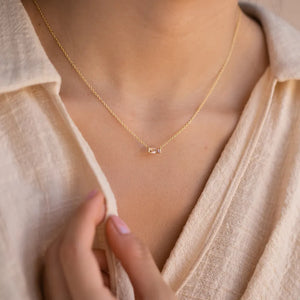
- Single CZ pendant, silver tone: our Silver Zircon Choker Necklace — a 925 sterling silver base with 18K gold plating and one CZ centerpiece stone on an adjustable choker, hypoallergenic. Not a tennis-style line, but the closest everyday CZ sparkle in the collection.
- Single CZ pendant, gold tone: our Gold Zircon Choker Necklace — an adjustable 18K gold-plated choker with one CZ center stone at the throat.
- Diamond-style single pendant: our Round Brilliant Cut CZ Necklace — a round-brilliant CZ pendant on a 925 sterling silver base for diamond-style fire.
- Genuine tennis construction (wrist, not neck): our Rainbow Moonstone Tennis Bracelet — a real continuous line of bezel-set stones running the full length of the band. If the wrist works for you, see our tennis necklace vs. tennis bracelet guide.
- Browse the full range: the complete necklaces collection for every length and finish.
To restate it plainly: none of the three necklaces above is a tennis necklace by construction — they're single-CZ-pendant chokers, and the only genuine continuous-line tennis piece AJLuxe carries is the bracelet above, not a necklace. If a full CZ or diamond tennis line at the neck is what you specifically want, that's a purchase to make elsewhere for now. Once you have your piece, our guides to how to style a tennis necklace and how to layer gold necklaces show how to wear it solo or stacked.
Shop This Guide
Our Silver Zircon Choker Necklace — a genuine 925 sterling silver base with 18K gold plating and one hypoallergenic CZ pendant stone. It's a single-pendant choker, not a tennis-style line, but it's the closest everyday CZ sparkle in the collection and built for real daily wear.
Shop the Silver Zircon Choker NecklaceHow to choose: a quick decision path
- Set your stone by budget and use. Everyday and affordable → cubic zirconia on a sterling base. Daily wear that lasts → moissanite. Heirloom or resale → lab or natural diamond.
- Pick a length by where it should sit. Collar look → 14 inches. Classic everyday → 16 inches. Below the collarbone or for layering → 17–18 inches.
- Choose a stone width for the impact you want. Delicate everyday → 1.5–2mm. Most versatile → 2.5–3mm. Statement → 3.5mm+.
- Demand clasp security. Lobster or box clasp with a safety chain or figure-eight backup catch, always.
- Check the base metal. Any skin sensitivity → 925 sterling silver or solid gold base only; skip brass or zinc-alloy plating.
Written by the AJLuxe Team. Last updated: July 2026. According to Jewelers of America, the security of a necklace's clasp and setting is a core quality factor buyers should inspect before purchase — advice that applies directly to tennis necklaces, where a single continuous line of stones depends on a secure clasp and, ideally, a backup safety catch.
Related reading: Earrings for square face.
Related reading: What does a tennis bracelet mean.
Floating diamond necklace vs. tennis necklace: what's the difference
A floating diamond necklace suspends one or a few stones on a nearly invisible wire or fine chain so they appear to hover directly on the skin with no visible metal around them, while a tennis necklace is an unbroken line of same-size stones set link-to-link all the way around — two completely different constructions built to solve the same "I want it to sparkle" impulse. If you searched for one and landed on a guide about the other, here's how to tell which look you actually want.
The "floating" effect comes from how the stone is set, not from the stone itself. Most floating pieces use an illusion setting — a slim metal frame or prong cage sized close to the stone's own outline — or a bezel setting on a thin box or cable chain, so from a normal viewing distance the metal disappears and the stone reads as if it's resting on bare skin. A tennis necklace, by contrast, deliberately shows its construction: every stone sits in its own visible link, and the row of links is the point, not something to hide.
| Floating diamond necklace | Tennis necklace | |
|---|---|---|
| Stone count | One stone, or a few spaced along the chain | Dozens of same-size stones, edge to edge |
| Visual effect | A single point of light that appears to hover on the skin | A continuous line of light across the collarbone |
| Setting style | Illusion or bezel, metal minimized on purpose | Prong or channel per stone, metal visible as part of the design |
| Best for | A minimalist, single-focal-point look; layering under a fuller piece | A statement line that reads from across the room |
The two styles aren't mutually exclusive, either — a floating solitaire on a delicate chain is one of the most common pieces to layer just above a tennis necklace, since the thin floating chain sits higher and closer to the throat while the tennis line falls a little lower. If that's the combination you're picturing, revisit the length guide above: pair a 14–16 inch floating piece with a 17–18 inch tennis necklace so the two lines don't compete at the same height.
One honest note, the same way we flagged it for the tennis necklace picks above: AJLuxe's current necklace range is built around single-CZ-pendant and choker styles on genuine 925 sterling silver with 18K gold plating, not continuous lines and not illusion-set floating pieces. If the floating look is specifically what you're after, browse the necklaces collection for the closest delicate, single-pendant options, and pair one with the tennis bracelet from this guide for a layered effect.
Frequently Asked Questions
What is the best tennis necklace for everyday wear?
For everyday wear, the best tennis necklace is a 2.5–3mm continuous line of round stones on a hypoallergenic base — a cubic zirconia line on 925 sterling silver for an affordable option, or moissanite if you want daily durability. A 16-inch length with a secure lobster or box clasp and a safety chain is the most versatile, worry-free choice.
Is a CZ or diamond tennis necklace better?
It depends on your priority. Cubic zirconia is far cheaper and gives the same look for everyday wear, but is softer and can cloud over years. Natural and lab diamonds are the hardest stones, keep their sparkle for decades, and hold resale value, but cost thousands more. Moissanite sits in between — nearly as hard as diamond at a fraction of the price.
What is the difference between a tennis necklace and a tennis bracelet?
Both share the same continuous line of individually set stones, but a tennis necklace is worn on the neck at 14–18 inches and frames the face, while a tennis bracelet is worn on the wrist at about 6.5–7.5 inches. The necklace uses more stones over a longer line, so it typically costs more and makes a bigger visual statement.
How much does a tennis necklace cost?
Prices span a wide range by stone. A cubic zirconia tennis necklace usually costs $30–$80, moissanite runs roughly $200–$2,000, lab-grown diamond around $2,000–$6,000, and natural diamond from about $5,000 into six figures depending on carat weight, length, and metal.
What length tennis necklace should I buy?
Sixteen inches is the classic, most versatile length and sits at the base of the neck. Fourteen inches wears as a snug collar, while 17–18 inches falls just below the collarbone and layers well. If you're unsure, choose 16 inches or an adjustable clasp that gives you a choker-to-princess range in one piece.
How do you wear or style a tennis necklace?
A tennis necklace works alone as a clean, face-framing line for both casual and formal outfits, or layered over a longer chain for a modern stacked look. Wear it with open, crew, or V-necklines so the line is visible, and always put it on last — after lotion, perfume, and hairspray — to protect the stones and plating.
Are tennis necklaces worth it?
Yes, for most people a tennis necklace is worth it because the continuous line of sparkle is timeless and pairs with almost any outfit. An affordable CZ version lets you wear the look daily without worry, while a solid-gold diamond version adds heirloom and resale value if that's your goal.
How durable are tennis necklaces?
Durability depends mostly on the stone and setting. Each stone sits in its own link, which limits the risk of losing the whole line if one setting loosens, and diamond or moissanite lines resist scratching far better than cubic zirconia. Have the clasp and settings checked periodically, and choose a piece with a safety chain for extra protection.
What stone width is best for a tennis necklace?
Stone width in millimeters controls how the necklace reads more than carat weight alone. A 1.5–2mm line is delicate and everyday, 2.5–3mm is the most versatile day-to-evening width, and 3.5mm and up is a bold statement best saved for occasions or photos.
What metal is best for a tennis necklace?
Solid 14K gold is the most popular fine-jewelry choice for its balance of strength and value, and platinum for the highest-end pieces. For affordable everyday tennis necklaces, 18K gold plating over a genuine 925 sterling silver base gives the look while staying hypoallergenic — avoid brass or zinc-alloy bases, which often contain nickel and can irritate skin.
Does a tennis necklace need a safety chain?
A safety chain or figure-eight backup catch is strongly recommended on a tennis necklace because the piece is one continuous line with no pendant to catch it if the main clasp opens. The backup keeps the necklace on you if the primary clasp slips, which is the most common way line necklaces are lost.
Can I wear a cubic zirconia tennis necklace every day?
Yes, a cubic zirconia tennis necklace is well suited to daily wear as long as it's built on a hypoallergenic base like 925 sterling silver. To keep it clear and bright, wipe it after wear, store it separately, and avoid contact with perfume, lotion, and water, since CZ can cloud faster than diamond if it's neglected.
Toutes les marques, noms de marque et noms de produits tiers sont la propriété de leurs détenteurs respectifs. AJLuxe n’est affilié à aucune marque tierce citée dans cet article, ni approuvé ou sponsorisé par celle-ci. Les noms de marque sont utilisés uniquement à des fins de comparaison factuelle, et les descriptions de matériaux reflètent les spécifications produit publiées par chaque marque au moment de la rédaction.
You Might Also Like


The piece they're describing → Collier pendentif breloque pierre de naissance pour femme — Pendentif CZ baguette, argent sterling 925
Personalize Yours


