


"Lariat necklace" and "Y-necklace" get used almost interchangeably in casual conversation, and most search results don't bother separating them — but they're genuinely different pieces of jewelry with different construction, different styling rules, and different reasons someone would search for one over the other. This guide draws the real line between them, covers the actual styles and how to wear a lariat specifically, and gives an honest answer about where AJLuxe's own catalog fits (and where it's a Y-necklace, not a lariat).
What Lariat Necklaces Mean
The term comes directly from a cowboy's lariat — a rope with no fixed knot, used as a lasso — and jewelry took the name because the necklace works the same way: one continuous length of chain with no clasp, closed by looping, knotting, or sliding one end through a decorative slide or ring. There's no cultural or symbolic meaning baked into the style itself the way there is with, say, a knot-motif pendant; the name describes the mechanism, not a message. Its appeal is almost entirely about the drape — a lariat falls and moves differently than a clasped chain because nothing is fixed in place.
What Lariat Necklaces Are Also Called
You'll see lariat necklaces referred to as "open necklaces," "wrap necklaces," "tassel necklaces" (when the ends are finished with a tassel rather than a plain point), and sometimes loosely as "Y-necklaces" — which is the specific confusion this guide exists to clear up, since the two aren't actually the same thing.
Lariat vs. Y-Necklace: The Actual Difference
The difference is in the closure and the drop, not just the general silhouette. A true lariat has no clasp at all — it's one continuous chain that you loop around your neck and knot, cross, or thread through a slide to close, and the "drop" length is whatever you leave hanging after you tie it, which changes every time you put it on. A Y-necklace has a normal clasp closure at the back, like any standard necklace, with a fixed pendant hanging from a short connector chain partway down — the "Y" shape comes from that connector splitting off the main chain at a fixed point, and the drop length never changes because nothing about it is adjustable by how you tie it.
Practically, that means a lariat gives you styling flexibility (wrap it twice for a choker-height look, or let it hang long) that a Y-necklace can't offer, but a Y-necklace is more secure and consistent — it goes on the same way every time and won't come undone if a knot slips. Both create a vertical, elongating line down the chest, which is the visual effect most people are actually searching for when they look up either term.
| Lariat Necklace | Y-Necklace | |
|---|---|---|
| Closure | None — ties, wraps, or slides closed | Standard clasp (lobster, spring ring) |
| Drop length | Adjustable by how you tie it | Fixed by the connector chain length |
| Pendant | Often none, or a sliding charm/tassel | Fixed pendant at the point of the "Y" |
| Styling flexibility | High — wrap, knot, layer differently each wear | Lower — goes on the same way every time |
| Security | Depends on your knot/wrap holding | Secure standard clasp |
How to Wear a Lariat Necklace
The simplest way to wear a lariat is to drape it around the neck and let both ends hang loose in front at slightly different lengths — no knotting required, just letting gravity and the chain's own weight create the asymmetry. For more structure, cross the two ends over each other and thread one through a decorative slide or loop built into the design, which is the closest a lariat gets to a fixed silhouette. Wrapping it twice around the neck and letting a shorter loop sit higher, like a choker, with the tail hanging lower is the styling move that most sets a true lariat apart from anything with a fixed clasp — it's the one look a Y-necklace genuinely can't replicate.
An Honest Note on What We Carry
AJLuxe's CZ Y-necklace in 925 sterling silver, rhodium plated is a real, honest match for the Y-necklace side of this topic — a fixed cubic zirconia drop on a standard clasped chain, exactly the construction described above. It is not a true lariat: it has a normal clasp, and the drop length doesn't change based on how you wrap or tie it, because there's nothing to wrap or tie. If what you're specifically after is the no-clasp, wrap-and-knot lariat mechanism, this isn't that piece — but if the appeal is the elongating vertical drop line down the chest with a delicate CZ pendant, it delivers that part of the look, and we'd rather tell you exactly which half of the search it answers than let the terms blur together.
Lariat Necklaces: Common Questions
- What do lariat necklaces mean?
- The name comes from a cowboy's lariat rope, referring to the no-clasp, loop-and-knot construction rather than any symbolic meaning. The appeal is the drape and styling flexibility, not a message behind the design.
- What are lariat necklaces also called?
- Open necklaces, wrap necklaces, and tassel necklaces (when the ends have a tassel finish) are the most common alternate names. They're also loosely called Y-necklaces in casual use, though that's technically a different construction.
- What are the differences between a lariat necklace and a Y necklace?
- A lariat has no clasp — it ties, wraps, or slides closed, and the drop length changes based on how you wear it. A Y-necklace has a normal clasp with a fixed pendant at a set drop length that never changes. Both create a similar vertical, elongating look, but the mechanism and styling flexibility are genuinely different.
- What does lariat mean in jewelry?
- It describes a necklace construction with no fixed clasp — one continuous chain closed by looping, knotting, or threading through a slide, the same open-ended logic as the rope the name comes from.
Alle Marken, Markennamen und Produktnamen Dritter sind Eigentum ihrer jeweiligen Inhaber. AJLuxe steht in keiner Verbindung zu den in diesem Artikel genannten Marken Dritter und wird von diesen weder unterstützt noch gesponsert. Markennamen werden ausschließlich zur sachlichen vergleichenden Bezugnahme verwendet; Materialangaben entsprechen den eigenen veröffentlichten Produktangaben der jeweiligen Marke zum Zeitpunkt der Erstellung.
You Might Also Like
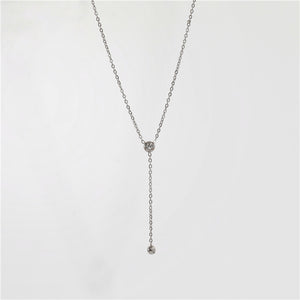
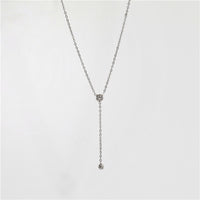
The piece they're describing → CZ Y-Halskette für Damen – aus Sterlingsilber 925, rhodiniert, mit Zirkonia-Tropfen
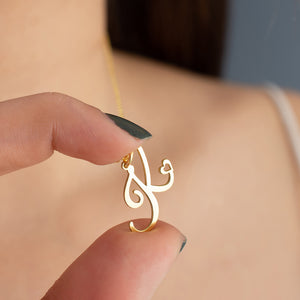
Personalize Yours


