


If you've bought "hypoallergenic" earrings before and still ended up with red, itchy, or crusted lobes, you already know the label means almost nothing. The real question isn't which style of earrings for sensitive ears looks best — it's which combination of metal and backing actually stops the reaction. This guide is the umbrella roundup: it compares every format side by side (studs, huggies, hoops, flat-backs) so you can pick the right one for your ear type, piercing age, and lifestyle, then routes you to our deep-dive guide for whichever format you land on.
Short version: nickel is the trigger behind roughly 90% of "sensitive ear" reactions. Once you eliminate nickel — in any format — most people stop reacting entirely. The rest of this guide shows you exactly how to do that, format by format.

Metal Comparison: What Actually Matters
Before you choose a style, choose a metal. Every format below performs the same way once you control for material — a titanium hoop and a titanium stud are equally safe; a nickel-alloy hoop and a nickel-alloy stud are equally risky.
| Metal | Nickel Content | Durability | Hypoallergenic Rating | Best For |
|---|---|---|---|---|
| Implant-grade titanium (ASTM F136) | Zero | Excellent — won't tarnish or corrode | Best in class | Fresh piercings, extreme sensitivity, daily wear |
| 925 sterling silver | None (properly sourced) | Good — can tarnish, needs light care | Excellent for healed piercings | Everyday wear once fully healed |
| 14K–18K solid gold | None at 14K+ | Excellent — doesn't tarnish | Excellent | Long-term investment pieces, gift-giving |
| 18K gold plated over 925 silver | None (base is nickel-free) | Fair — plating wears over 1–2 years | Good, only if base metal is specified | Healed piercings, budget-conscious gold look |
| Surgical/stainless steel (ASTM F138) | Trace, molecularly bound | Very good | Good for healed piercings, avoid for fresh | Healed lobes, budget picks |
| Unspecified "surgical steel" / "alloy" | Unknown, potentially 8–10% | Varies | Unreliable — avoid | Nothing — skip these entirely |
The rule that cuts through all the marketing noise: if a listing doesn't name the exact metal and grade (925, 14K, ASTM F136, ASTM F138), assume it's not safe. "Hypoallergenic" and "nickel-free" are unregulated terms on their own — they only mean something when paired with a real metal spec.
Decision Matrix: Best Format by Situation
Once your metal is locked in, the format you choose comes down to piercing age, ear anatomy, and how you wear earrings day to day. Use this table to find your situation, then click through to the dedicated guide for the details.
| Your Situation | Best Format | Why | Full Guide |
|---|---|---|---|
| Fresh piercing (0–8 weeks) | Flat-back studs, titanium | Flush disc back = no pressure point, minimal metal contact while healing | Flat back earrings for sensitive ears |
| Healed lobe, want classic everyday studs | Titanium or 925 sterling studs | Smallest metal footprint, easiest to match with any outfit | Best stud earrings for sensitive ears |
| Sleep in earrings / active lifestyle | Huggie earrings, sterling or titanium | Sits flush to the lobe, no dangling parts to snag on pillows or hair | Best huggie earrings for sensitive ears |
| Want a hoop look, not a huggie | 14K gold hoop earrings or 14K gold earrings hoops, lightweight wire | Solid gold hoops in the 10–14mm range keep weight low and skip plating wear entirely | See metal comparison above; pair any hoop with a 925 or 14K spec |
| Cartilage / helix / tragus | 16g titanium flat-backs | Cartilage heals slower, so material purity matters even more | Flat back earrings for sensitive ears |
| Want sparkle without real diamonds | CZ studs in 925 or titanium settings | Cubic zirconia itself doesn't react — it's the setting metal that matters | Complete guide to CZ stud earrings |
| Not sure yet, want the full picture | Read the general guide first | Covers every metal, symptom, and buying rule before you commit to a format | Best earrings for sensitive ears: what actually works |

Gold Studs, Gold Hoops, and Gold-Plated: What to Know Before You Buy
Gold is one of the most requested looks for sensitive ears, but "gold" covers a wide range of actual metal content — and that range is exactly where reactions happen.
Gold stud earrings. Solid 14K or 18K gold studs are safe for essentially everyone, including people with confirmed nickel allergies, because gold at 14K purity or higher doesn't contain nickel in meaningful amounts. Below 10K, alloy content rises and so does reaction risk.
14K gold hoop earrings and 14K gold earrings hoops. The same rule applies to hoops as studs — solid 14K gold hoops are safe regardless of diameter, because the entire hoop (not just a plated surface) is nickel-free gold alloy. Lightweight tube hoops in the 10–20mm range are the most comfortable for daily wear and put the least strain on the piercing.
Gold plated earrings and 14K gold plated earrings. This is where most reactions with "gold" earrings actually happen. Plating is a thin gold layer over a base metal — and that base metal is what touches your skin once the plating starts to wear (typically 6–18 months of regular wear). If the base is 925 sterling silver or titanium, gold-plated pieces are safe for healed piercings. If the base is brass, copper alloy, or unspecified "gold-tone metal," it's very likely to contain nickel and cause a reaction as the plating thins.
The fix is simple: before buying anything gold-plated, ask (or check the listing) what the base metal is. "18K gold plated over 925 sterling silver" is safe. "Gold plated" with no base metal named is a guess.
Earring Backs: Why the Backing Matters as Much as the Front
Most sensitive-ear guides focus entirely on the visible metal and skip the backing — but the back of the earring spends just as much time against your skin, often more, since it presses into your lobe continuously while the front dangles or sits loosely.
| Back Type | Skin Contact | Best For |
|---|---|---|
| Flat/push-back disc | Lowest — flush single disc, no raised parts | Fresh piercings, sensitive ears, sleeping in earrings |
| Screw-back | Low-moderate — secure but more metal surface than flat | Kids, active wearers who need extra security |
| Butterfly/friction clutch | Highest — two raised wings press into the lobe | Avoid for sensitive ears when possible |
| Hinged/lever back (huggies) | Low — smooth continuous metal, minimal moving parts | Huggie and small hoop formats |
If you've switched metals but still react, check the back first. A titanium stud with a cheap unlabeled butterfly clutch is only half solved — the clutch itself may be nickel-containing pot metal even when the visible post is titanium.
Infection Prevention and New-Piercing Care
Sensitive-ear reactions and piercing infections look similar (redness, swelling, discomfort) but need different fixes — treating an infection like an allergy, or vice versa, delays healing either way.
How to tell the difference: Allergic reactions are usually itchy, appear as a rash or small bumps, and stay contained to where the metal touches skin. Infections are more often painful (not just itchy), produce yellow or green discharge, and can come with warmth or fever. When in doubt, see a doctor or your piercer rather than guessing.
Prevention steps that cut risk for both:
- Clean with sterile saline only. A 0.9% sodium chloride wound wash, twice a day for new piercings. Skip alcohol and hydrogen peroxide — both damage healing tissue and can mimic an allergic reaction.
- Don't touch with unwashed hands. Most piercing infections trace back to bacteria transferred by hands, not the jewelry itself.
- Don't remove jewelry early. Taking earrings out during the healing window (6–8 weeks for lobes, 3–12 months for cartilage) lets the channel start closing, which causes pain and irritation when you try to reinsert.
- Dry thoroughly after showering. Moisture trapped against the metal accelerates both bacterial growth and nickel leaching — drying properly addresses both risks at once.
- Don't swap metals mid-heal. If you start a fresh piercing in titanium, stay in titanium until it's fully healed. Switching metals introduces a new variable while your body is already adjusting.
How to Shop Any Earring Listing for Sensitive Ears
Regardless of format, run every listing through this checklist before buying:
- Does it name a specific metal (925, 14K, 18K, ASTM F136, ASTM F138) — not just "hypoallergenic" or "nickel-free" alone?
- If it's plated, does it say what the base metal is?
- Is the back type specified, and is it flat-back or hinged rather than an unlabeled friction clutch?
- Is the gauge and post length appropriate for your piercing (18g/6mm standard lobe; 16g for cartilage; 8mm posts for fresh or thicker lobes)?
- Does the seller offer any return window in case of reaction? Reputable jewelers do.
A listing that answers all five clearly is far more trustworthy than one that just says "hypoallergenic earrings for sensitive ears" in the title and stops there.
Shop This Guide
Ready to try a format that's built for sensitive ears from the ground up? Our Flat Back Stud Earrings are 925 sterling silver with a flush push-pin disc back and an 18g post — nickel-free, no butterfly clutch pressing into your lobe, and priced at $32.
Shop Flat Back Stud EarringsPrefer to browse the full range first? See our hypoallergenic earrings collection or the complete earrings collection.
For our full style-by-style roundup — studs, hoops, huggies, and birthstone picks — see the best hypoallergenic earrings guide.
Related reading: Helix Piercing Jewelry: The Complete Guide to Studs, Hoops & Safe Materials (2026).
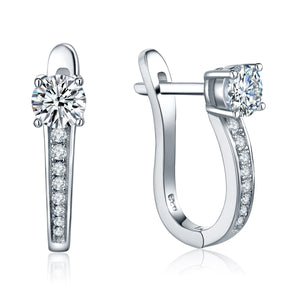
Shop AJLuxe Moissanite Hoop Earrings
925 sterling silver hoops set with lab-created CZ in a hinge-and-latch closure — nickel-free, unplated, 18.5mm.
Shop the Moissanite Hoop Earrings →Shop AJLuxe CZ Stud Earrings
925 sterling silver studs, rhodium plated, nickel-free — five stone sizes from 3mm to 7mm, so the same nickel-free build fits a subtler or a more visible look.
Shop the CZ Stud Earrings →Shop AJLuxe Silver Minimalist Huggie Earrings
Unplated 925 sterling silver hoops, hinged with a click-pin clasp — nickel-free, 5mm to 8mm.
Shop the Silver Huggie Earrings →Shop AJLuxe Silver Micro Pavé CZ Huggie Hoops
925 sterling silver, rhodium plated, with a row of micro-pavé CZ across the front arc — nickel-free, snap-hinge closure, sits close to the lobe.
Shop the Micro Pavé CZ Huggie Hoops →Shop AJLuxe 18K Gold Huggie Hoop Earrings
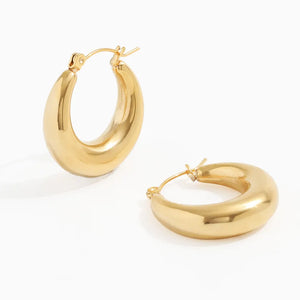
A 2.5mm 18K gold plated band in three sizes -- 15mm, 17mm, or 21mm -- with a hinged snap closure, sold as a pair.
Shop the Gold Huggie Hoop Earrings →Frequently Asked Questions
- What are the best earrings for sensitive ears overall?
- Implant-grade titanium, 925 sterling silver, or 14K+ solid gold — in any format (studs, huggies, hoops, flat-backs). The metal is what causes reactions, not the shape of the earring, so pick the format that fits your lifestyle and make sure the metal spec is genuine.
- Are studs or hoops better for sensitive ears?
- Neither is inherently better — both are equally safe when made from the same nickel-free metal. Studs have a smaller surface area touching the skin, which some people with severe sensitivity prefer, while hoops in lightweight titanium or 14K gold are just as tolerable for most wearers.
- Is titanium or stainless steel better for sensitive ears?
- Implant-grade titanium (ASTM F136) is the safer of the two — it contains zero nickel and is the standard piercers use for fresh piercings. Surgical steel (ASTM F138) contains trace nickel that's molecularly bound in the alloy, which most nickel-sensitive people tolerate once a piercing is healed, but titanium remains the safer default, especially for fresh piercings or severe sensitivity.
- Is 14K gold safe for sensitive ears?
- Yes. Solid 14K gold (and higher purities like 18K) doesn't contain nickel in amounts that trigger reactions. This applies to studs, hoops, and huggies alike, as long as the piece is solid gold rather than gold-plated over an unspecified base metal.
- Why do gold-plated earrings irritate my ears but solid gold doesn't?
- Gold plating is a thin layer over a base metal. Once the plating wears thin — usually within 6 to 18 months of regular wear — the base metal underneath starts contacting your skin. If that base is brass or an unspecified alloy, it likely contains nickel and will cause the same reaction plain gold never would. Solid gold has no base metal to expose.
- What's the difference between flat-back and butterfly-back earrings for sensitive ears?
- Flat-back earrings use a single flush disc that sits flat against the lobe, with minimal metal surface area and no pressure points. Butterfly backs use two raised clutch wings that press into the back of the lobe continuously, creating more skin contact and more potential for both nickel exposure and physical irritation. Flat-backs are the better default for sensitive ears.
- How do I know if my earrings are actually hypoallergenic?
- Check for a named metal and grade — "925 sterling silver," "14K gold," "implant-grade titanium ASTM F136," or "surgical steel ASTM F138." The word "hypoallergenic" by itself is an unregulated marketing term with no legal definition in jewelry, so it guarantees nothing on its own.
- Can I sleep in earrings if I have sensitive ears?
- Yes, if you choose a low-profile format like huggies or flat-back studs in titanium or 925 sterling. Dangling earrings and butterfly-back styles are more likely to snag or press into your ear at an angle overnight, which can cause irritation regardless of metal.
- What should I do if my ears react even to titanium?
- True titanium reactions are rare. First confirm the piece is genuinely implant-grade (ASTM F136) rather than a lower-grade titanium alloy or titanium-coated base metal. If a confirmed implant-grade piece still causes a reaction, see a dermatologist for patch testing — you may be reacting to a different component, like an earring back or a coating, rather than the titanium itself.
- Are cubic zirconia (CZ) earrings safe for sensitive ears?
- The CZ stone itself is inert and doesn't cause reactions. What matters is the setting metal holding the stone — a CZ stud in a 925 sterling or titanium setting is just as safe as a plain metal stud in the same material. See our complete guide to CZ stud earrings for setting-specific picks.
- How long should I wait before switching earring formats after a piercing?
- Standard lobe piercings need 6–8 weeks minimum before switching from your initial jewelry to a different format; cartilage piercings need 3–12 months due to slower healing. Switching too early — even to a "safer" material — can restart irritation because you're introducing new movement and pressure to tissue that hasn't fully closed.
- Which earring format is best for a first-time buyer with sensitive ears?
- Flat-back titanium studs are the safest starting point — lowest metal contact, no clutch mechanism to source separately, and the same closure professional piercers use. From there, once you know your ears tolerate the metal well, branching into huggies, hoops, or gold studs is straightforward.
Final Thoughts: Choosing the Right Format for Your Ears
The best earrings for sensitive ears aren't a single style — they're any format built from a genuinely nickel-free metal with a low-contact back. Studs, huggies, hoops, and flat-backs all work equally well once the material is right; the format decision comes down to your piercing stage, comfort preferences, and how you wear jewelry day to day.
Use the decision matrix above to find your situation, then dive into our format-specific guides for the full detail: stud earrings, huggie earrings, or flat-back earrings. Want the full material science first? Start with our complete earrings for sensitive ears guide.
Or skip straight to a proven safe pick: AJLuxe Flat Back Stud Earrings in 925 sterling silver, $32 — nickel-free, flush back, built for sensitive ears from the first wear.
Written by the AJLuxe team — specialists in personalized sterling silver jewelry. Last updated: July 2026. Medical information referenced from the American Academy of Dermatology. Piercing and aftercare standards from the Jewelers of America.
Alle Marken, Markennamen und Produktnamen Dritter sind Eigentum ihrer jeweiligen Inhaber. AJLuxe steht in keiner Verbindung zu den in diesem Artikel genannten Marken Dritter und wird von diesen weder unterstützt noch gesponsert. Markennamen werden ausschließlich zur sachlichen vergleichenden Bezugnahme verwendet; Materialangaben entsprechen den eigenen veröffentlichten Produktangaben der jeweiligen Marke zum Zeitpunkt der Erstellung.
You Might Also Like

The piece they're describing → Moissanit-Creolen für Damen — 925er Sterlingsilber, Brillantschliff, hypoallergen
Personalize Yours


