



The short answer
Moissanite runs 9.25 on the Mohs hardness scale (GIA), just below diamond’s 10 and well above cubic zirconia’s 8-8.5, and its refractive index (about 2.65-2.69) is actually higher than diamond’s 2.42 -- meaning moissanite throws more colorful fire, a real and often-cited difference, not a downgrade. At the affordable end of the market, price mostly reflects metal choice (sterling silver plated in white gold vs. solid gold) and setting style rather than stone quality, since moissanite itself is inherently accessible compared to mined diamond.
Moissanite has become one of the most searched diamond alternatives specifically because it’s a genuine gemstone with real hardness and brilliance credentials, not a downgrade dressed up in marketing language the way some diamond simulants are. This guide covers the real numbers and what to actually check when shopping at the affordable end.

What moissanite actually is
Moissanite is silicon carbide, first identified in 1893 by chemist Henri Moissan in fragments of a meteorite -- natural moissanite is extremely rare, so virtually all moissanite sold in jewelry today is lab-created rather than mined, using a manufacturing process refined and patented over the past few decades. That lab origin is exactly why it’s dramatically more affordable than a mined diamond of comparable visual size -- it’s not diluted or simulated, it’s a genuinely different, naturally-occurring mineral produced in a controlled setting instead of dug out of the ground.
The real numbers: hardness and brilliance vs. diamond and CZ
On the GIA Mohs hardness scale, diamond sits at 10, moissanite at 9.25, and cubic zirconia at roughly 8-8.5 -- moissanite is meaningfully harder and more scratch-resistant than CZ, which matters for how well a ring holds up to years of daily wear. On brilliance, moissanite's refractive index (about 2.65-2.69) is actually higher than diamond's 2.42, which is why moissanite is often described as throwing more visible "fire" (colorful light flashes) than a diamond of the same cut -- a genuine optical difference, not a marketing exaggeration.
What actually drives price at the affordable end
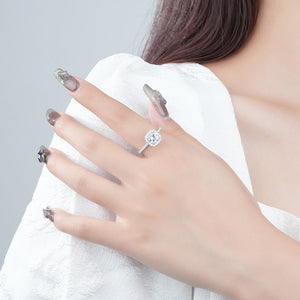
Once you're shopping moissanite specifically, price differences mostly come down to metal and setting rather than the stone: sterling silver with white gold or rhodium plating costs meaningfully less than solid 14K or 18K gold, and a simple solitaire setting costs less than a full halo with pave accent stones. A ring built in 925 sterling silver with a moissanite center stone and a CZ halo -- like AJLuxe's version -- gives most of the visual presence of a larger center stone at a fraction of a solid-gold halo ring's price.
Shop This Guide
A sterling silver moissanite halo ring with an 18K white gold plated finish -- the moissanite center stone sits in a full CZ halo setting for extra sparkle at an accessible price.
Shop the Moissanite Halo RingFrequently Asked Questions
Is moissanite a fake diamond?
No -- moissanite is a genuine, distinct gemstone (silicon carbide), not a diamond simulant trying to pass as diamond. It’s harder than cubic zirconia and has its own real optical properties, including a higher refractive index than diamond, which is why it’s marketed and sold on its own merits rather than as an imitation.
How does moissanite hardness compare to diamond?
Diamond is 10 on the Mohs scale, moissanite is 9.25 -- both are considered excellent for daily-wear jewelry, and moissanite is meaningfully harder than cubic zirconia’s roughly 8-8.5, which is part of why it holds up better to years of regular wear than CZ does.
Why is moissanite more affordable than diamond?
It’s lab-created rather than mined, which removes the extraction, rarity, and supply-chain costs that drive mined-diamond pricing -- moissanite of a given visual size is inherently far less expensive to produce than a mined diamond of comparable carat weight.
What metal should I look for on an affordable moissanite ring?
925 sterling silver with rhodium or white gold plating is the standard, honestly-disclosed accessible option -- check the listing states the base metal and plating plainly rather than implying solid gold or platinum at a price point that wouldn’t support it.
Related reading: how a halo setting compares to a solitaire, pave, or three-stone ring.
Alle Marken, Markennamen und Produktnamen Dritter sind Eigentum ihrer jeweiligen Inhaber. AJLuxe steht in keiner Verbindung zu den in diesem Artikel genannten Marken Dritter und wird von diesen weder unterstützt noch gesponsert. Markennamen werden ausschließlich zur sachlichen vergleichenden Bezugnahme verwendet; Materialangaben entsprechen den eigenen veröffentlichten Produktangaben der jeweiligen Marke zum Zeitpunkt der Erstellung.
You Might Also Like
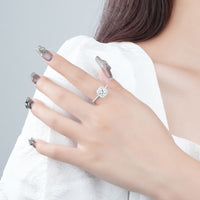
The piece they're describing → Moissanit-Halo-Ring — Sterlingsilber, 18 Karat Weißgold, Zirkonia
Personalize Yours


